
Experienced Attorneys
Committed to Protecting the
Rights of Injured Workers
Committed to Protecting the
Rights of Injured Workers



Reviewed by Jonathan Rosenfeld, Chicago work injury lawyer | Last updated: 26 October 2026
A ladder accident lawyer can help Illinois construction and trade workers injured in a ladder fall pursue compensation. Families may also have legal options after a fatal fall. Depending on how the accident happened, an injured worker may qualify for workers’ compensation through their employer and may have a separate lawsuit against a contractor, property owner, or ladder manufacturer. A defective ladder can also support a product liability claim. Each option has different rules and deadlines. Contact our firm for a free consultation about your legal options.
Our firm has handled serious injury claims involving ladder failures and falls.
$7.3 million — Manuel: A ladder collapsed because of an alleged structural defect.
$4.4 million — Susan: An electrician fell while installing lights after using a defective ladder supplied by a property owner.
Prior results do not guarantee a similar outcome. Attorney advertising.
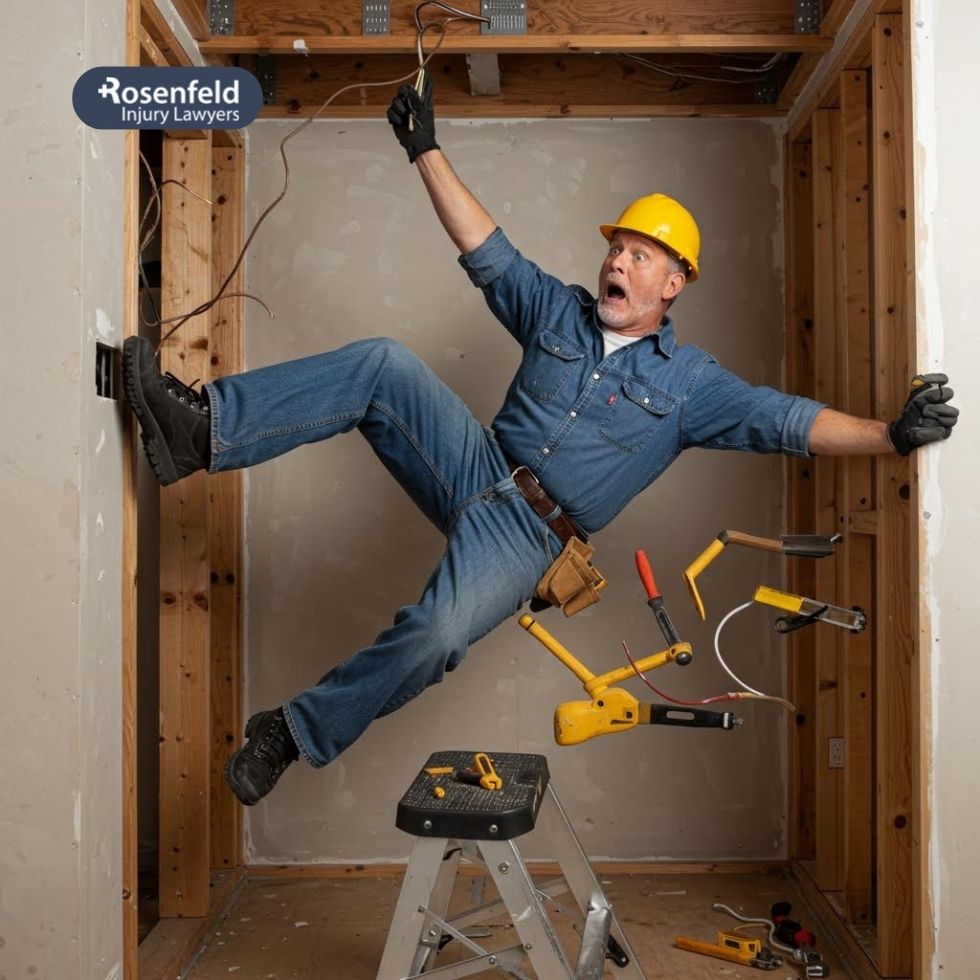
Our firm represents injured workers after serious workplace accidents, including ladder falls. We investigate how an accident happened, identify potentially responsible parties, and assess whether workers’ compensation, a third-party lawsuit, or both may be available.
Our construction accident lawyers evaluate the facts of each case and explain the legal options available to the injured worker.
A ladder fall can result from defective equipment, unsafe setup, poor maintenance, or hazardous working conditions. Common causes include:
Metal ladders can conduct electricity. A worker injured by electrical contact may have additional legal options; learn more about construction electrocution accidents.
Identifying the applicable safety rule can help explain how a fall occurred. An OSHA violation may be relevant evidence, but it does not automatically establish negligence or civil liability.
OSHA sets requirements for ladder setup, condition, use, and training. Construction work is generally covered by 29 CFR 1926.1053, while general-industry workplaces are generally covered by 29 CFR 1910.23. Construction ladder-safety training is addressed in 29 CFR 1926.1060.
When a worker falls, evidence that a ladder safety rule was violated may help establish how the accident happened. A violation does not automatically prove liability; the facts and the legal duties of each party still matter.
| OSHA provision | General requirement |
| 29 CFR 1926.1053(b)(1) | An extension ladder used to access an upper landing generally must extend at least 3 feet above the landing, subject to applicable alternatives. |
| 29 CFR 1926.1053(b)(5)(i) | Portable ladders generally must be set at a 4:1 angle. |
| 29 CFR 1926.1053(a)(1) | Ladders must meet the applicable load-capacity and safety-factor requirements. |
| 29 CFR 1926.1053(b)(13) | Workers generally may not stand on the top step or top cap of a stepladder unless it is designed for that use. |
| 29 CFR 1926.1053(b)(16) | Structurally defective ladders must be removed from service until properly repaired or otherwise taken out of use. |
| 29 CFR 1926.1060 | Employers must provide required ladder-safety training through a competent person. |
Federal OSHA generally covers private-sector employers in Illinois, while Illinois OSHA covers state and local government employees.
Read the OSHA construction safety rules or learn how to report an OSHA violation.
A ladder that breaks, slips, or collapses during foreseeable use may support a product liability claim. Under Illinois law, a manufacturer or another party in the product’s distribution chain may be liable when a defect makes a product unreasonably dangerous and causes an injury.
Defects may involve the ladder’s design, manufacturing, warnings, or instructions. Potential failure points include rung locks that do not engage, rails that buckle or split, slipping feet, broken braces or rivets, and a duty rating unsuitable for foreseeable use. Labels and markings, including ladder ratings and applicable ANSI A14 standards can help identify the product, but do not establish a defect by themselves.
Photograph the ladder, its model and rating labels, damaged components, locks, feet, and braces if possible. Preserve the ladder and related parts; do not allow them to be discarded, repaired, or altered before they can be examined. A listing in the CPSC recall database may be relevant, but a recall is not required to bring a product claim.
Illinois product liability claims are subject to a statute of repose under 735 ILCS 5/13-213. Generally, the period is 12 years from the product’s first sale, lease, or delivery, or 10 years from its first sale, lease, or delivery to its initial user, whichever expires earlier, subject to statutory exceptions. A product claim may be pursued alongside workers’ compensation when the evidence supports both.
A fall from a ladder can cause serious injuries, even from a relatively short height. Common injuries include:
The U.S. Bureau of Labor Statistics reported 844 fatal work injuries involving falls, slips, and trips nationwide in 2024. This figure includes different types of workplace incidents and is not a ladder-only statistic.
Serious injuries may require surgery, rehabilitation, assistive equipment, or long-term care and may prevent a worker from returning to the same job. Learn more about construction brain injuries, construction back injuries, and other construction accident injuries.
If you fell off a ladder at work, you may have more than one path to compensation. Illinois workers’ compensation generally provides benefits without requiring proof that your employer was at fault. A separate lawsuit may be possible if a third party, such as a contractor, property owner, or ladder manufacturer, caused or contributed to the injury.
| Issue | Workers’ compensation | Third-party lawsuit |
| Who may pay? | Employer’s insurer or self-insured employer. | A legally responsible third party or its insurer. |
| Must you prove fault? | Generally no. | Yes. |
| Pain and suffering | Generally not paid separately. | May be recoverable if supported by the claim. |
| Lost income | May include temporary disability benefits. | May include recoverable lost earnings and other damages. |
| Deadline | Special workers’ compensation deadlines apply. | Depends on the type of claim and defendant. |
Workers’ compensation may cover reasonable medical care and temporary total disability (TTD) benefits when a worker cannot work during recovery and meets the legal requirements. TTD is generally calculated at two-thirds of average weekly wages, subject to statutory rules and limits. See our pages on temporary total disability benefits and construction workers’ compensation.
Under section 5(a) of the Illinois Workers’ Compensation Act, 820 ILCS 305/5(a), employees generally cannot sue their employer for a covered workplace injury. However, a claim may be possible against a general contractor, subcontractor, property owner, equipment rental company, or ladder manufacturer, depending on the evidence. Learn more about a construction accident lawsuit.
A third-party recovery may be subject to an employer or insurer lien under 820 ILCS 305/5(b). Statutory rules govern the lien, attorney-fee contribution, costs, and the worker’s net recovery.
If a ladder fall is fatal, eligible family members may have claims under the Illinois Wrongful Death Act, 740 ILCS 180/2, for qualifying losses such as grief and loss of support. The Survival Act, 755 ILCS 5/27-6, may allow recovery for certain losses sustained before death. Learn more about fatal construction accidents.
Liability depends on who controlled the work, supplied or maintained the ladder, knew about a hazard, and had a legal duty to prevent the injury. Potentially responsible parties include:
Claims against government entities, including public transit agencies, school districts, or park districts, may have special requirements and shorter deadlines. A one-year limitation period may apply to certain claims under 745 ILCS 10/8-101.
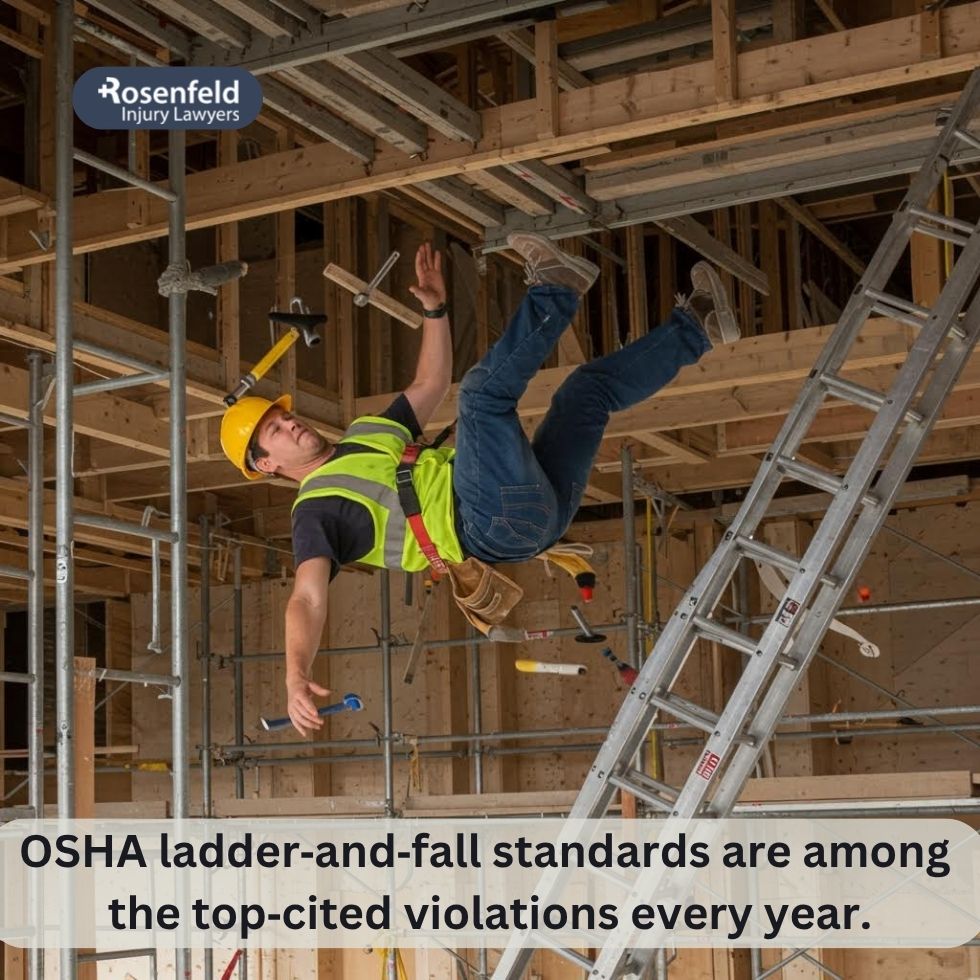
Illinois ladder accident claims may involve workers’ compensation, negligence, premises liability, or product liability. The Structural Work Act was repealed in 1995. Illinois does not have a general ladder-specific strict-liability statute equivalent to New York’s ladder laws.
Premises liability claims may be governed by the Illinois Premises Liability Act, 740 ILCS 130, while product claims may involve 735 ILCS 5/13-213. In Deibert v. Bauer Brothers Construction Co., 141 Ill. 2d 430 (1990), a worker stepped into a tire rut while looking up at debris being thrown from balconies. The case addressed the open-and-obvious doctrine and distraction; it was not a ladder accident case.
Different deadlines apply to different claims. Missing a deadline may prevent recovery.
| Type of claim or requirement | General Illinois deadline |
| Report a work injury to the employer | Generally 45 days under 820 ILCS 305/6(c). |
| File a workers’ compensation claim | Generally 3 years from injury or 2 years from the last compensation payment, whichever is later, under 820 ILCS 305/6(d). |
| Personal injury lawsuit | Generally 2 years under 735 ILCS 5/13-202. |
| Wrongful death claim | Generally 2 years from death under 740 ILCS 180/2. |
| Certain local government claims | A 1-year period may apply under 745 ILCS 10/8-101. |
| Product liability repose | Generally 12 years from first sale, lease, or delivery, or 10 years from delivery to the initial user, whichever expires earlier, subject to exceptions under 735 ILCS 5/13-213. |
These are general descriptions; exceptions and case-specific facts may affect the deadline. Read more about workers’ comp deadlines.
A worker may still have options if the accident was partly their fault. Read more about whether you can get workers’ comp if the accident was your fault.
Ladder injuries also affect warehouse stockers, maintenance workers, electricians, and other employees working in finished buildings. Workers’ compensation may apply outside construction, but the relevant OSHA rules can differ: construction ladder work is generally addressed by 29 CFR 1926.1053, while general-industry ladder requirements are generally addressed by 29 CFR 1910.23. Learn more about warehouse injuries.
Workplace falls are a significant source of serious and fatal injuries, but broad fall statistics should not be presented as ladder-only data. The U.S. Bureau of Labor Statistics reported 844 fatal work injuries involving falls, slips, and trips nationwide in 2024.
For additional context, see our construction accident statistics page.
A ladder injury claim requires evidence about the fall, the equipment, the worksite, and the parties responsible. Our approach may include:
Qualifying cases are handled on a contingency-fee basis under an agreed representation contract. The contract should explain attorney fees and case costs.
Learn more about what to do after a work injury.
Other construction falls may involve different equipment and safety rules. Learn about scaffolding accidents, roof falls, skylight falls, and scissor lift accidents.
You may qualify for Illinois workers’ compensation after a work-related ladder fall, even if you were partly at fault. Workers’ compensation generally does not require proof that your employer caused the accident. If a contractor, property owner, ladder supplier, or manufacturer contributed to the fall, you may also have a separate civil claim.
You may have a product liability claim if a ladder defect caused your injury. The evidence may involve design, manufacturing, warnings, or instructions. Preserve the ladder and identifying labels if possible. Illinois product liability claims have deadlines, including a statute of repose with exceptions, so seek advice promptly.
Your own fault generally does not prevent workers’ compensation benefits. For a civil claim, Illinois comparative-fault rules may reduce damages. A plaintiff who is more than 50% at fault is generally barred under 735 ILCS 5/2-1116; at exactly 50%, damages are reduced by 50%.
There is no reliable average that predicts the value of an individual claim. The amount depends on the injuries, medical needs, lost earnings, long-term limitations, available insurance, and whether a third-party claim exists. Read more about construction accident settlements in Illinois.
Our firm handles qualifying cases on a contingency-fee basis under an agreed fee arrangement. The attorney’s fee is generally tied to a recovery rather than charged as an hourly fee upfront. The representation agreement should explain attorney fees, case costs, and what happens if there is no recovery.
If you were injured in a ladder fall at work, our firm can review the circumstances and explain whether workers’ compensation, a third-party lawsuit, or both may be available. We offer a free consultation and handle qualifying cases on a contingency-fee basis under an agreed fee arrangement. Call our office to discuss your options. Our team is available 24/7 to receive inquiries.
Contact our work injury lawyers to discuss your ladder accident and the next steps.
 Legally Reviewed By
Attorney Jonathan Rosenfeld
Content legally reviewed by Jonathan Rosenfeld The information on this page has been legally reviewed by Attorney Jonathan Rosenfeld, founder and managing partner of Rosenfeld Injury Lawyers LLC. With extensive experience representing injured workers across Illinois, Mr. Rosenfeld is dedicated to helping workplace accident victims pursue the maximum compensation available under the law. His extensive legal knowledge and commitment to client advocacy ensure that the information provided is accurate, reliable, and aligned with current legal standards.