
Experienced Attorneys
Committed to Protecting the
Rights of Injured Workers
Committed to Protecting the
Rights of Injured Workers



A construction accident lawsuit in Illinois may allow an injured worker to seek compensation from a responsible third party, such as a general contractor, subcontractor, property owner, or equipment manufacturer. You may be able to pursue this claim alongside workers’ compensation, potentially recovering damages such as pain and suffering that workers’ compensation does not pay.
The following results were reported by Rosenfeld Injury Lawyers LLC.
$11,750,000: Garcia fell to his death while working on a Logan Square construction project. We demonstrated that the job site supervisor had not provided him with fall protection, securing workers’ compensation benefits for his family.
$10,500,000: Mason suffered serious electrical burns when the aerial lift he was using came into contact with an overhead power line. In this third-party lawsuit, we showed that the site supervisor had disregarded safety standards.
$2,600,000: Construction employee John required knee surgery after a fall at a Pullman construction site. We showed that a subcontractor had not cleaned up construction debris, leading to his fall.
Disclaimer: Past results do not guarantee a similar outcome. Every case is different.
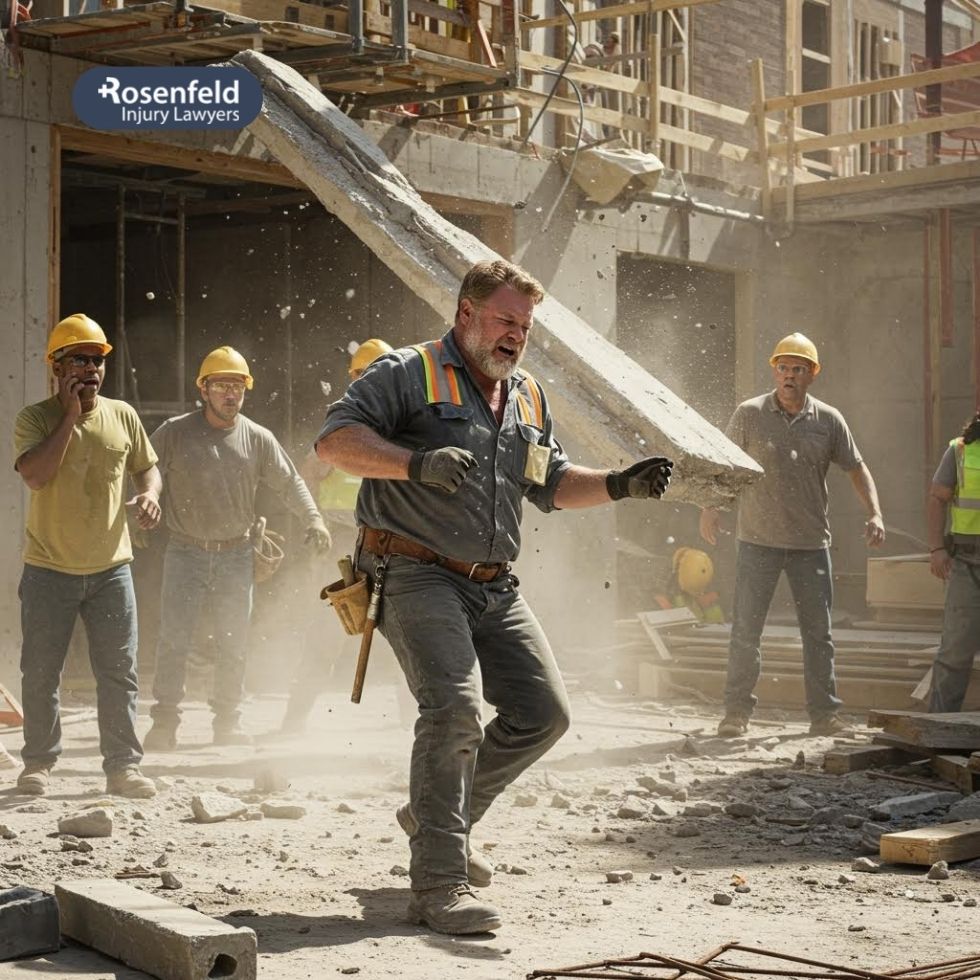
You may be able to sue a third party if its negligence or other actionable conduct contributed to your construction injury. To recover damages, you generally need to show that the party owed you a duty, breached that duty, and caused your injuries and losses.
Illinois workers’ compensation generally prevents employees from suing their employer for a covered workplace injury, subject to narrow exceptions. A worker may still have a third-party claim against another company or person involved in the project.
Workers’ compensation eligibility is not determined solely by whether someone is called an employee, temporary worker, or independent contractor. A staffing-agency worker may qualify for benefits, and a worker classified as an independent contractor may dispute that classification depending on the facts.
Workers’ compensation can cover medical care and part of qualifying lost wages. A third-party lawsuit may also seek pain and suffering and other damages, but any workers’ compensation lien and comparative-fault reduction can affect the final recovery.
Read about workers’ comp benefits for construction workers.
| Issue | Workers’ compensation | Third-party lawsuit |
| Fault | Generally, employer negligence need not be proved. | Liability must be established under the applicable legal theory. |
| Payment | Workers’ compensation insurer pays covered benefits. | A liable third party or its insurer may pay damages. |
| Pain and suffering | Not paid as a separate benefit. | May be recoverable if supported by the claim. |
| Lost income | Generally replaces part of qualifying wages. | May include broader wage-loss damages, subject to proof. |
| Deadline | Separate notice and filing rules apply. | Civil limitation and repose periods may apply. |
The responsible party depends on who controlled the work, created or knew about the hazard, and contributed to the injury.
| Potential defendant | Possible basis for liability |
| General contractor | Retained control over work or safety practices that contributed to the injury; Section 414 of the Restatement may apply. |
| Subcontractor | Unsafe work, a hazard it created, or failure to take required precautions. |
| Property owner or possessor | A dangerous property condition where a legal duty existed under the applicable law. |
| Manufacturer or seller | Defective equipment, design, manufacture, or warnings. |
| Equipment rental company | A defective machine or another actionable failure connected to the injury. |
| Architect or engineer | Negligent professional services that caused or contributed to the injury. |
| Driver or other third party | Negligence that caused or contributed to the accident. |
A defendant’s title or presence at the site does not automatically establish liability. Contracts, safety plans, inspection records, photographs, and witness statements can help show who controlled the work and who was responsible for the hazard.
For related guidance, see scaffolding accident liability and who is liable for a crane accident.
A general contractor is not automatically liable for every job-site injury. A claim may be possible if the contractor retained control over part of the work and exercised that control in a way that contributed to the accident.
Evidence may include safety plans, contract terms, stop-work authority, daily safety meeting records, and proof that supervisors directed how tasks were performed. Illinois repealed the Structural Work Act in 1995, so modern claims must rely on other applicable legal theories rather than that repealed law.
Confirm the discussion of Section 414 and Carney v. Union Pacific Railroad Co. with Illinois counsel before publication.
Several Illinois statutes and legal doctrines can affect who may be sued, how fault is assessed, and what compensation may be available.
| Law or doctrine | Why it matters |
| 820 ILCS 305/5(a) | Generally establishes workers’ compensation as the exclusive remedy against an employer for a covered injury, subject to exceptions. |
| 820 ILCS 305/5(b) | Addresses workers’ compensation liens against certain third-party recoveries. |
| Kotecki v. Cyclops Welding Corp. | May limit an employer’s contribution liability in certain third-party cases. |
| 735 ILCS 5/2-1116 | Generally bars recovery if the plaintiff is more than 50% at fault and may reduce damages according to the plaintiff’s share of fault. |
| 735 ILCS 5/2-1117 | Governs aspects of joint and several liability in qualifying cases. |
| OSHA regulations | A safety violation may be evidence, but does not automatically establish negligence in a civil lawsuit. |
| Best v. Taylor Machine Works | Relevant to Illinois law on statutory caps on damages. |
The Illinois Premises Liability Act, 740 ILCS 130, may apply when an unsafe property condition contributes to an injury. Ownership alone does not establish liability; the duty and circumstances must be examined.
A workers’ compensation lien can reduce the amount an injured worker keeps from a third-party settlement. The amount repaid depends on the applicable statute, fees, costs, and any resolution of the lien—not simply the total benefits paid.
Have counsel confirm the legal summaries, citations, Deibert and Suvada references, and the applicable lien rules before publication.
Filing deadlines depend on the claim and defendant. Missing the applicable deadline can prevent a case from proceeding, so do not assume every construction accident claim has the same two-year limit.
| Claim type | General deadline to check |
| Personal injury | Often two years under 735 ILCS 5/13-202. |
| Construction-related professional services | Section 13-214 may provide a four-year limitation period and a ten-year repose period, subject to the specific claim and exceptions. |
| Product liability | Section 13-213 contains applicable limitation and repose rules. |
| Wrongful death | Generally two years from death under 740 ILCS 180/2, subject to exceptions. |
| Workers’ compensation | Section 6(d) generally refers to three years after the accident or two years after the last compensation payment, whichever is later. |
Learn about Illinois workers’ comp filing deadlines.
Preserve photographs, incident reports, equipment details, and witness information as early as possible. Early investigation can help identify responsible parties before a deadline passes.
Counsel should confirm the limitation and repose rules and exact statutory wording for each claim type before this table is published.
A third-party lawsuit may allow an injured worker to seek economic and non-economic damages caused by the accident, depending on the evidence and applicable law.
Economic damages may include:
Non-economic damages may include:
Punitive damages are not awarded simply to punish ordinary negligence. They may be available in limited circumstances involving sufficiently serious misconduct, subject to Illinois law and applicable court procedures.
No single settlement figure applies to every case. Liability evidence, injury severity, future treatment, lost income, comparative fault, insurance coverage, and any workers’ compensation lien can all affect the amount ultimately recovered.
Read about the factors affecting an average construction accident settlement in Illinois. In fatal cases, eligible family members may have claims under Illinois wrongful-death and survival law; see our page on construction accident death claims.
Falls, falling debris, electrocution, scaffolding failures, and heavy-equipment incidents can cause serious construction injuries. Whether a lawsuit is possible depends on the cause of the accident and the parties who may be legally responsible.
Related information: ladder falls, falling debris, electrocution, scaffolding accidents, and heavy-equipment accidents.
Trench collapses can also cause catastrophic injuries; learn about trench collapse lawsuits.
Confirm the exact ladder, falling-debris, and trench-collapse URLs before publishing. Remove the existing unsupported or misapplied statistics and safety citations rather than reusing them without verification.
Our team investigates construction accidents, evaluates potential third-party claims, and helps injured workers understand their legal options. We can also coordinate a third-party lawsuit with a workers’ compensation claim, including issues involving a lien against a recovery.
The firm reports more than $450 million in settlements and verdicts. Confirm that this figure is current and substantiated before publication.
Our award-winning work injury attorneys have secured over $450 million in settlements and verdicts for 5,000 satisfied clients. With a 98% success rate and the prestigious Super Lawyers designation, we are widely considered the top construction accident attorneys in Illinois. Our team has statewide reach, supporting clients from East St. Louis to Chicago and beyond.
[rewritten] A construction accident lawsuit typically involves investigation, filing a complaint, discovery, pretrial proceedings, settlement negotiations, and trial if the case does not settle.
Many cases take more than a year, but timing depends on the injuries, number of parties, discovery, court schedule, and settlement discussions. Cases involving minors or a deceased person’s estate may require additional approval or procedures.
If you were injured on an Illinois construction site, contact us to discuss potential claims against responsible third parties and the deadlines that may apply. We handle qualifying cases on a contingency-fee basis, subject to the firm’s fee agreement.
Replace any promise to obtain the “highest possible workers’ compensation” with “the full compensation a third-party claim allows.”
Usually, workers’ compensation is the exclusive remedy against an employer for a covered workplace injury. A narrow exception may apply in certain intentional-harm circumstances, but ordinary negligence generally does not allow an employee to sue the employer directly.
Yes, you may be able to receive workers’ compensation and pursue a separate claim against a responsible third party. The insurer may have a lien against the recovery, which can affect how much you keep after applicable fees, costs, and reductions.
It may be worth investigating if a contractor or another third party contributed to the accident. A lawsuit may allow damages unavailable through workers’ compensation, but liability evidence, insurance, comparative fault, and any lien affect the potential recovery.
Illinois generally bars recovery if your fault is more than 50% of the proximate cause of the injury. If your fault does not exceed that threshold, your damages may be reduced by your share of fault.
Potentially, yes. A temporary worker may qualify for workers’ compensation and may also have a claim against a contractor, property owner, equipment maker, or another responsible third party. The employment arrangement and each company’s role should be examined.
 Legally Reviewed By
Attorney Jonathan Rosenfeld
Content legally reviewed by Jonathan Rosenfeld The information on this page has been legally reviewed by Attorney Jonathan Rosenfeld, founder and managing partner of Rosenfeld Injury Lawyers LLC. With extensive experience representing injured workers across Illinois, Mr. Rosenfeld is dedicated to helping workplace accident victims pursue the maximum compensation available under the law. His extensive legal knowledge and commitment to client advocacy ensure that the information provided is accurate, reliable, and aligned with current legal standards.