
Experienced Attorneys
Committed to Protecting the
Rights of Injured Workers
Committed to Protecting the
Rights of Injured Workers



Most scissor lift accidents in Illinois involve tip-overs, falls from the platform, or structural collapses, and the resulting injuries are often severe enough to end a career. Liability frequently extends beyond the employer to the equipment rental company or manufacturer, which is why a full investigation matters before any claim moves forward.
Scissor lifts present unique risks on a construction site. If you get hurt while using or standing near a scissor lift, you could suffer serious injuries that put you out of work. A scissor lift accident claim attorney from IL Work Injury Lawyer can guide you through the claims process to pursue compensation.
Our firm has received an A+ grade from the Better Business Bureau, and our head attorney serves as a contributing author for the National Law Review. We also have experience in lift accident cases and have secured millions for our clients at a 98% success rate.
Jamal, a 42-year-old electrician from Garfield Park, suffered severe electrical burns when his aerial lift hit an unmarked live power line at a West Loop construction site. He was left with permanent nerve damage due to poor site safety and contractor negligence. The accident settlement was worth $10.5 million.
Prior results do not guarantee a similar outcome; every case is evaluated on its own facts.
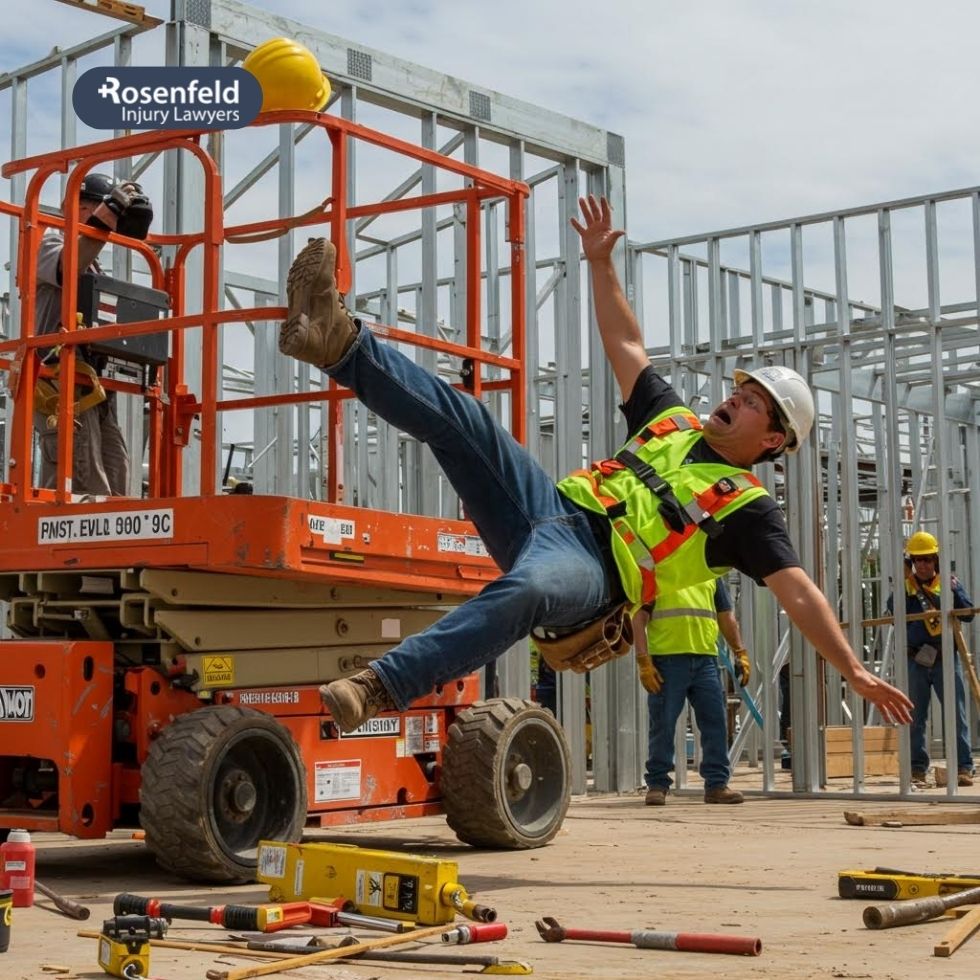
A scissor lift tip-over rarely comes down to a single careless moment, it is almost always a site-condition or equipment failure the employer should have caught first.
Common causes include:
These are the same site-condition failures behind many scaffolding and ladder falls, a lost stable base, not necessarily operator error. Workers hurt in similar circumstances on scaffolding or ladders can review our page on scaffolding and ladder falls for a closer look at how those claims are built.
Tip-overs and falls from the platform account for most scissor lift injuries. Structural collapse and contact with overhead power lines happen less often but tend to cause some of the most severe outcomes.
| Accident Types | Common Mechanism | Typical Injury | Relative Frequncy |
| Tip-over | Uneven ground, overloading, slope, wind | Fractures, spinal injury | Most common |
| Fall from platform | Missing guardrails, no fall protection, fall from height | Traumatic brain injury, spinal cord injury | Common |
| Structural collapse | Defective components, poor maintenance, worker caught-between platform and structure | Crush injuries, fatal injuries | Less common, often severe |
| Contact with overhead power lines | Lift raised near power slines | Burns, electrocution injuries, cardiac arrest | Occur mainly outdoors |
Under state law 820 ILCS 305, injured construction workers can seek lost wages, medical expenses, TTD benefits, PPD/PTD benefits, and death benefits for surviving family members through workers’ compensation for construction workers.
Personal injury victims can pursue damages if they are no more than 50% liable for their accidents (735 ILCS 5/2-1116). You can recover lost wages, medical expenses, emotional distress, pain and suffering, and loss of normal life after a scissor lift accident.
The range of scissor lift accident payouts is $80,000 to $16.55 million. The average settlement is almost $3 million. Factors that affect your claim’s value include fall height, injury severity, ability to work, OSHA violations, and defective scissor lift claims.
These figures reflect scissor lift and aerial lift accident settlements and verdicts our firm has tracked in Illinois construction injury cases. Prior results do not guarantee a similar outcome; every case is evaluated on its own facts.
The presence of multiple defendants can complicate matters. You may need to prove liability for the employer, general contractor, equipment rental company, or manufacturer.
Another challenge you’ll face is the defense strategy of the at-fault party, which could involve:
IL Work Injury Lawyer can overcome these defenses with maintenance records, witness statements, surveillance footage, and OSHA investigations.
In 2024, there were four scissor lift accidents reported in Chicago alone. All four of these incidents resulted in the deaths of construction workers or other employees.
Nationally, the trend is just as sobering. CDC/NIOSH research tracking the Census of Fatal Occupational Injuries identified 306 aerial lift deaths across the country between 1992 and 2003, and found that 78 of those fatalities specifically involved scissor lifts.
If you want to take advantage of the benefits workers’ compensation covers, you may need proof of OSHA violations.
OSHA has several regulations regarding the safe operation of scissor lifts:
Scissor lifts fall under OSHA’s scaffold standard (29 CFR 1926.451), not the aerial lift standard, a distinction most safety content online gets wrong. It matters because it determines which guardrail, fall protection, and stability rules apply to a claim.
Under this classification and OSHA’s related mobile scaffold rule (29 CFR 1926.452(w)), employers must also meet:
Understanding OSHA construction regulations can help clarify whether a violation contributed to your injury.
The following steps can help you build a strong claim after a catastrophic injury:
Our legal team can provide the following services:
Tip-overs and falls from the platform cause most scissor lift injuries. Both usually trace back to unstable ground, an overloaded platform, or a missing guardrail rather than a single moment of operator error.
CDC/NIOSH data identified 78 scissor-lift-specific fatalities out of 306 total aerial lift deaths nationwide between 1992 and 2003. In Illinois, all four scissor lift accidents reported in Chicago in 2024 proved fatal.
A scissor lift, a type of aerial work platform, also called a mobile elevating work platform, is safe only when its guardrails are intact, the ground is level, and the load stays within rated capacity. Remove any one of those conditions and the risk of a tip-over or fall rises sharply.
In many cases, yes. Rental companies can be held liable for renting out a defective or poorly maintained lift. See “Who Can Be Liable for a Scissor Lift Accident in Illinois?” above for the full list of potentially liable parties.
Liability can fall on the employer, general contractor, rental company, manufacturer, or property owner, depending on what caused the fall. See “Who Can Be Liable for a Scissor Lift Accident in Illinois?” above.
IL Work Injury Lawyer operates on a contingency fee basis. This means you owe nothing unless we win the case. Additionally, we also offer a free consultation so you can ask questions about common causes of scissor lift accidents, your workers’ compensation, or third-party liability claim.
We can represent clients across the state. Contact us today to schedule a free case evaluation with a Chicago construction accident attorney.
 Legally Reviewed By
Attorney Jonathan Rosenfeld
Content legally reviewed by Jonathan Rosenfeld The information on this page has been legally reviewed by Attorney Jonathan Rosenfeld, founder and managing partner of Rosenfeld Injury Lawyers LLC. With extensive experience representing injured workers across Illinois, Mr. Rosenfeld is dedicated to helping workplace accident victims pursue the maximum compensation available under the law. His extensive legal knowledge and commitment to client advocacy ensure that the information provided is accurate, reliable, and aligned with current legal standards.