
Experienced Attorneys
Committed to Protecting the
Rights of Injured Workers
Committed to Protecting the
Rights of Injured Workers



Construction work is governed primarily by 29 CFR Part 1926, which contains federal safety and health requirements specific to construction. When a violation contributes to an injury, it may be relevant to a workers’ compensation claim and, depending on who is responsible, a separate third-party claim. Understanding OSHA requirements can help injured workers identify potential safety violations and responsible parties.
OSHA construction regulations establish safety requirements for construction worksites under 29 CFR Part 1926. These 1926 OSHA construction industry regulations apply to construction work and address hazards that differ from those covered by OSHA’s general industry standards in Part 1910. For an injured worker, identifying the applicable standard can help determine whether a safety violation contributed to an accident.
Occupational Safety and Health Administration (OSHA) construction standards are federal regulations designed to protect workers from serious accidents. Failure to obey these standards often leads to serious injuries and even death for construction workers.
Compliance with OSHA regulations is both crucial for workplace safety and for demonstrating negligence in third-party lawsuits. For injured workers, OSHA construction safety regulations may also provide evidence about whether a hazardous condition contributed to an accident. If you’ve suffered a workplace injury, contact us today for a free consultation about your rights.
Construction is one of the most hazardous occupations due to heavy machinery, hazardous substances, and hard physical labor. According to construction industry accident statistics, 20.8% of all occupational fatalities in 2023occurred in the construction field, and construction laborers accounted for 47.8% of all fatal slips, trips, and falls.
OSHA standard 1926 regulates occupational safety in construction occupations, particularly the “fatal four:” falls, struck-by, caught in/between, and electrocution. These 29 CFR 1926 OSHA construction industry regulations address many other construction hazards as well, including scaffolds, excavations, electrical work, cranes, equipment, and respiratory hazards. Compliance with these general requirements is mandated for all Illinois companies (820 ILCS 219/25). OSHA is tasked with monitoring, enforcement, and fining companies that don’t comply.
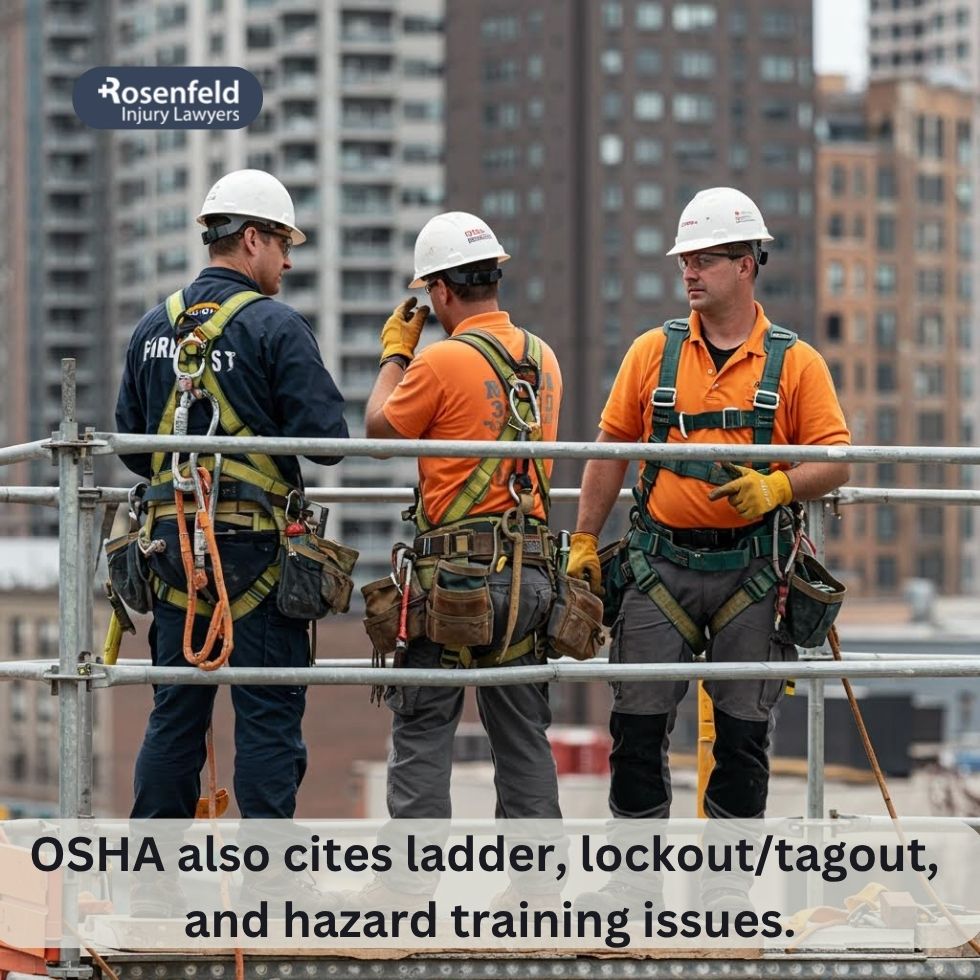
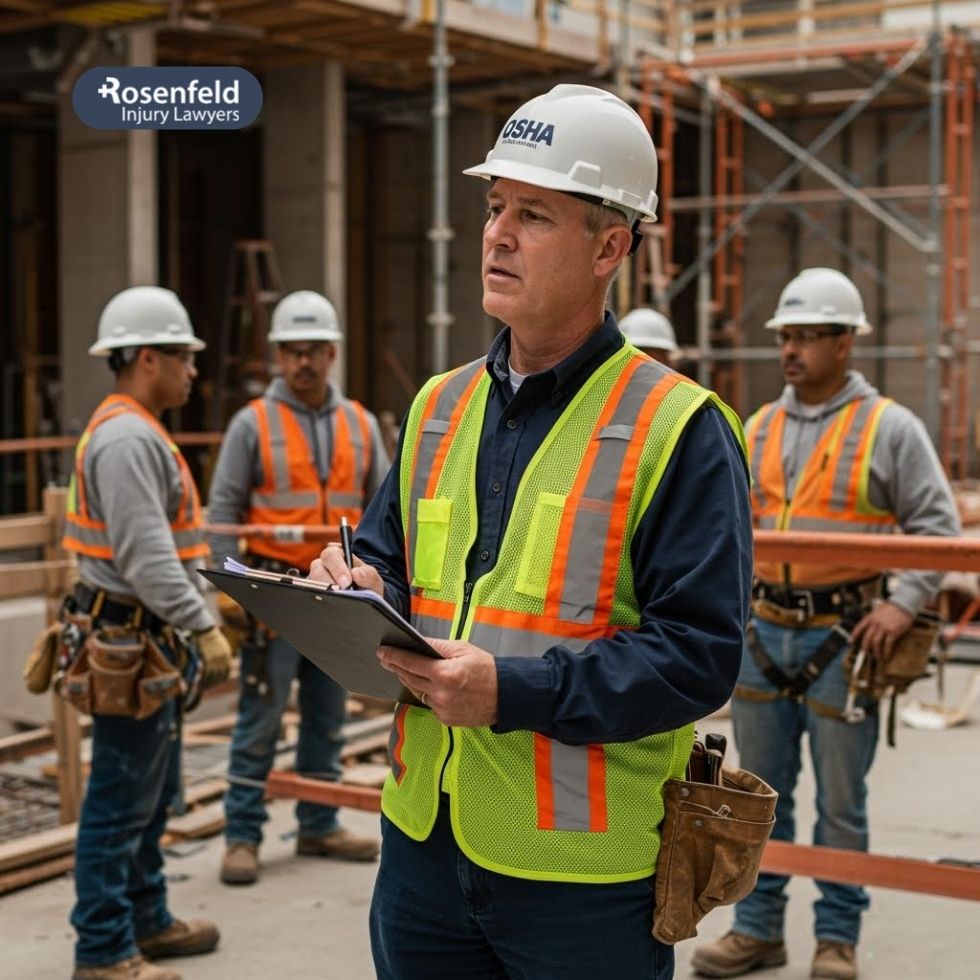
Companies must allow OSHA inspectors access to construction sites to identify potential hazards and ensure the well-being of all employees (29 CFR 1926.3).
OSHA’s general requirements and safety standards apply to all workers, including general contractors and subcontractors (29 CFR 1926.13). Contractors can make their own arrangements regarding safety and health on a job site, but they must be in line with these regulations (29 CFR 1926.16).
Employers are mandated to perform regular inspections of job sites, enforce guidelines, and only allow qualified employees with the proper certification to operate heavy machinery (29 CFR 1926.20(b)). Additionally, employers are required to provide personal protective equipment and proper training to all employees so as to mitigate potential hazards (29 CFR 1926.20(f)).
There should be adequate illumination in all workspaces, whether that is natural or artificial (29 CFR 1926.26). Scrap and debris, such as wood shavings or broken concrete, must be regularly removed (29 CFR 1926.25). Any hazardous or combustible material must be disposed of in accordance with environmental regulations.
Employees should be trained on the specific needs of their job duties, including how to handle dangerous equipment or chemicals. Employers should use the safety programs provided by OSHA and train their employees on safe work practices, as well as provide resources to prevent illnesses or injuries (29 CFR 1926.21).
Every company should have emergency plans in place, such as for fires, chemical exposure, and falls on construction sites (29 CFR 1926.35). All employees should be trained on what to do in the event of an emergency, and the employer must designate a certain number of individuals who can coordinate evacuations or provide first aid (29 CFR 1926.35(e)).
There must be a plan in place for contacting emergency personnel. For worksites in remote areas, there must be at least one individual certified in first aid. Every workplace should have a fully stocked emergency kit. When working with hazardous chemicals, eyewash stations should be available (29 CFR 1926.50).
All employers must provide personal protective equipment that is suitable for the given task. This can include personal fall arrest systems, earplugs to reduce occupational noise exposure, and respiratory protection, depending on the job (29 CFR 1926.95).
Employers are required to maintain this gear to ensure its effectiveness and train employees in its use as necessary (29 CFR 1926.95(c)).
Protective equipment should be provided at no cost to employees unless they choose to purchase their own gear, such as specialty boots or everyday clothing (29 CFR 1926.95(d)).
Those working in electrical installation, maintenance, or repair must have safety equipment that is graded for the specific electrical hazards they may face (29 CFR 1926.97).
The employer is liable if any individual is found not to be using the proper protective equipment (29 CFR 1926.28).
For more information, see our PPE requirements for construction and other workplace hazards.
Face protection is essential for any task with a risk of employee exposure to hazardous substances, flying debris, molten metal, caustic chemicals, or lasers. Employers must provide both face and eye protection as necessary and ensure that all workers comply (29 CFR 1926.102).
Respiratory protection is required for any work practices that may expose laborers to dangerous materials like respirable crystalline silica, asbestos, chemical fumes, or hazardous vapors (29 CFR 1910.134(a)(2)).
All companies must provide fall protection that is suitable for the specific work completed, and the employer must perform a safety assessment to determine whether all walking surfaces will hold a worker’s weight (29 CFR 1926.501).
Ladder safety devices must be able to hold at least 500 pounds and activate no less than 2 feet after a fall (29 CFR 1926.1053(a)(22)).
For roof construction, acceptable fall protection systems include safety nets, personal fall protection systems, guardrails, and a warning line system (29 CFR 1926.501(b)(10)).
Anyone working at height should be protected from falling through holes, such as skylights, by using personal fall protection, guardrails, or covers (29 CFR 1926.501(b)(4)).
Safety nets must be provided when a worker is above 25 feet from the ground. The nets should extend at least eight feet from the work surface (29 CFR 1926.105). Fall protection is OSHA’s most-cited construction standard in its FY 2025 Top 10 list. If a fall-protection violation contributed to your injury, see our ladder fall and scissor lift injury resources.
Falling debris is a major cause of construction accidents. Safe work practices involve securing any loose equipment or materials that may fall and providing overhead protection, such as safety nets or scaffolds (29 CFR 1926.759). A struck-by hazard can result in serious head, crush, or other traumatic injuries. Learn more about falling debris injuries and potential claims.
Approximately 150 workers die every year due to electrocution in construction, and 74% of construction worker fatalities are in non-electrical occupations. Safe work processes, including following OSHA guidelines, could have prevented many of these deaths.
Employers must examine all electrical equipment before installation to ensure that it is safe and defect-free (29 CFR 1926.403). All conductors must have a clear shutoff (29 CFR 1926.404(d)(1)(i)) and overcurrent protection (29 CFR 1926.404(e)).
Anyone who may come into contact with electrical currents must be provided with the proper protection (29 CFR 1926.97). The protection should be made of insulated rubber made with a seamless process to provide full coverage. This can include gloves, sleeves, boots, mats, and covers.
Workers must be protected from potential hazards while working with electricity by shutting off power or locating underground electrical currents (29 CFR 1926.416). When performing installation, maintenance, or repair on electrical equipment, everyone present must follow lockout/tagout (LOTO) guidelines (29 CFR 1926.417). Electrical hazards can cause electrocution and other serious injuries. See our electrocution injury page for more information.
Scaffolds must be able to support their own weight and four times the intended load (29 CFR 1926.451(a)). Platforms should be no less than 18 inches wide to ensure safety access (29 CFR 1926.451(b)(2)).
Those working on scaffolds should be provided with personal fall arrest systems, including either a vertical or horizontal lifeline that will catch them if necessary (29 CFR 1926.451(g)). For information about injuries involving scaffold failures or falls, see our scaffolding injury page.
Cranes and derricks used for construction must be placed on even, well-drained, and properly graded ground (29 CFR 1926.1402(b)). They must be assembled and disassembled by individuals with the proper training and certification, and the worker must review all necessary procedures right before beginning the assembly or disassembly (29 CFR 1926.1404).
The equipment must never be placed where it may come into contact with overhead power lines (29 CFR 1926.1410). Additionally, the operator has the right to stop work if they feel there is any danger to themselves or another worker (29 CFR 1926.1418). If a crane-related hazard contributed to an injury, see our crane accident page.
Heavy equipment, like scissor lifts, aerial lifts, forklifts, and other motor vehicles, must always be secured and have the necessary safety aids, such as blinkers, mirrors, and lights (29 CFR 1926.600). Vehicles must be inspected before each shift to ensure that they are in working order, have brakes, and have restraints for occupants (29 CFR 1926.601).
For injuries involving heavy construction equipment, see our heavy equipment injury page.
Employers should never allow any hand tool to be used that is in an unsafe condition (29 CFR 1926.301). This would include adjustable wrenches with slipping jaws, tools with wooden handles that are cracked or splintered, and impact tools like hammers with mushroomed heads.
Tools like cutting blades, circular saws, and table saws must be maintained in a safe condition and removed from service if they are damaged (29 CFR 1926.300). Guards must be installed and kept in working order to ensure the operator’s safety (29 CFR 1926.300(b)).
Workers using these tools must have personal protective equipment available, like gloves, eye protection, and respirators (29 CFR 1926.300(c)).
For more information about tool-related injuries, see our cutting injury resource.
Employers must have a fire protection program in place, including firefighting equipment (29 CFR 1926.150). All companies must have hazard communication systems in place that will prevent contact with caustic chemicals like wet cement (29 CFR 1910.1200).
Additionally, they must assess whether there is any risk of exposure to hazardous chemicals and provide adequate protection, such as gloves (29 CFR 1926.62(d)).
Medical assistance must be made immediately available to any employee who suffered a burn, whether that was due to concrete burns, caustic chemicals, explosions, or fires (29 CFR 1926.50). Learn more about potential claims involving concrete burns.
Before beginning demolition work, a survey must be completed to determine any potential hazards and plan the project (29 CFR 1926.850). Holes in the floor must never be more than 25% of the total floor space, and floors weakened by demolition work should be shored to prevent falls (29 CFR 1926.853).
No one should be in the path of a wrecking ball, and a demolition ball should never be more than 50% of a crane’s total weighted load (29 CFR 1926.859). Any stairways, ladders, or other means of access that have not been designated as entry points must be closed off to prevent accidents (29 CFR 1926.851). If a demolition hazard contributed to your injury, see our demolition accident page.
Any underground utilities or structures that the excavation work may impact must be identified prior to beginning the project, and utility companies should be notified (29 CFR 1926.651(b)). Structural ramps must be designed by a competent individual with the proper training (29 CFR 1926.651(c)).
Employees who may be exposed to vehicle traffic should wear high-visibility clothing to prevent car accidents (29 CFR 1926.651(d)). Air quality should be tested prior to anyone entering an excavation, air quality should be continuously monitored. There should be emergency equipment, including breathing apparatuses, available at all times (29 CFR 1926.651(g)).
Additionally, protective systems like shields, sloping systems, and benching systems should be designed and installed by competent engineers (29 CFR 1926.652). For more information about injuries involving trenching and excavation hazards, see our excavation accident page.
OSHA’s construction silica standard, 29 CFR 1926.1153, addresses occupational exposure to respirable crystalline silica and establishes a permissible exposure limit of 50 micrograms per cubic meter of air as an 8-hour time-weighted average. The standard also requires employers to use exposure-control measures, including wet methods and dust-collection systems, and to provide respiratory protection when required.
These OSHA construction dust control regulations apply to work that can generate silica dust, including cutting, drilling, grinding, and crushing materials containing crystalline silica. Prolonged exposure can contribute to serious respiratory illnesses that may develop over years. The timing of diagnosis or discovery may therefore be relevant when evaluating applicable claim deadlines.
Added a new section
OSHA’s FY 2025 Top 10 list includes several standards frequently cited in workplaces, including fall protection, ladders, scaffolding, fall-protection training, and eye and face protection. OSHA published the list in April 2026. Because the federal Top 10 is an all-industry list, not every entry applies specifically to construction.
| Rank | Standard | CFR reference | Typical hazard | Potential injury |
| 1 | Fall Protection, general requirements | 29 CFR 1926.501 | Falls from elevated surfaces | Traumatic injuries, fractures, head injuries |
| 2 | Hazard Communication, general industry | 29 CFR 1910.1200 | Chemical hazards | Burns, respiratory injuries, illness |
| 3 | Ladders, construction | 29 CFR 1926.1053 | Unsafe ladder use | Falls, fractures, head injuries |
| 4 | Control of Hazardous Energy | 29 CFR 1910.147 | Unexpected equipment startup or energy release | Crush, amputation, electrical injuries |
| 5 | Respiratory Protection | 29 CFR 1910.134 | Exposure to airborne hazards | Respiratory illness and injury |
| 6 | Scaffolding, construction | 29 CFR 1926.451 | Scaffold instability or falls | Falls, fractures, traumatic injuries |
| 7 | Fall Protection Training, construction | 29 CFR 1926.503 | Inadequate fall-hazard training | Falls and related injuries |
| 8 | Powered Industrial Trucks | 29 CFR 1910.178 | Forklift hazards | Crush injuries, fractures, fatalities |
| 9 | Eye and Face Protection, construction | 29 CFR 1926.102 | Flying particles and other eye hazards | Eye and facial injuries |
| 10 | Machine Guarding | 29 CFR 1910.212 | Unguarded machinery | Lacerations, amputations, crush injuries |
OSHA also publishes construction-specific citation data. These OSHA construction safety regulations can be relevant when investigating falls, scaffold accidents, eye injuries, and other construction injuries. The circumstances of each accident determine whether a cited violation has relevance to a particular claim.
OSHA enforces rules through inspections, citations, and fines. There are both regular inspections and imminent danger inspections based on whistleblower complaints. If an inspector finds violations, they will submit a report that details the exact violations and proposes penalties, which may be thousands of dollars.
There are three categories of OSHA inspections, which are as follows.
Imminent Danger Inspections: These emergency inspections are performed when there are credible reports of imminent danger to health and safety. For example, if someone reports that the employer is allowing minors to operate heavy machinery without the proper training, this would be an imminent danger.
Targeted Inspections: Certain industries, like construction, are known to have higher risks of severe injuries and illnesses. As such, OSHA inspectors prioritize these occupations and conduct more frequent inspections.
Complaint-Driven Inspections: Any worker can complain about non-compliance with OSHA standards, triggering an investigation. Not only will the inspector review the specific hazard mentioned, but they will also review any other potential hazards.
OSHA also enforces the laws in place to protect whistleblowers who raise the alarm about imminent dangers, such as being asked to work without fall protection or unqualified individuals performing tasks. If violations are found, inspectors may conduct follow-up inspections to determine whether the cited issues have been fixed and if further violations are found.
Failure to comply or enforce OSHA guidelines can be key evidence in a workers’ compensation or personal injury case, as it will show that the employer was negligent. When advocating for our clients, we thoroughly review the employer’s OSHA record.
OSHA’s maximum civil penalties are adjusted annually. For 2026, OSHA lists maximum penalties of $16,550 per violation for serious and other-than-serious violations, $165,514 per violation for willful and repeat violations, and $16,550 per day for failure to abate a violation after the abatement date, generally subject to a 30-day maximum.
| Violation type | What it means | Maximum penalty in 2026 |
| Other-than-serious | A violation that would not ordinarily cause death or serious physical harm, although OSHA may assess a penalty based on the circumstances. | $16,550 |
| Serious | A violation where there is substantial probability that death or serious physical harm could result and the employer knew or should have known of the hazard. | $16,550 |
| Willful | A violation involving intentional disregard of, or plain indifference to, OSHA requirements. | $165,514 |
| Repeat | A substantially similar violation for which the employer was previously cited. | $165,514 |
| Failure to abate | Failure to correct a cited violation by the required abatement date. | $16,550 per day |
The actual proposed penalty can be lower than the statutory maximum depending on OSHA’s penalty policies and the circumstances of the violation.
OSHA can cite more than one employer on a worksite with multiple contractors when the facts satisfy its multi-employer citation policy. OSHA evaluates whether an employer is a creating, exposing, correcting, or controlling employer and then considers whether the employer’s actions were sufficient under the applicable requirements.
A creating employer is one that creates hazardous conditions. An exposing employer has employees exposed to the hazard. A correcting employer is responsible for correcting the hazard, while a controlling employer has authority over the worksite or another employer sufficient to exercise safety-related control. An employer can have more than one role.
For an injured worker, this distinction can matter because the company that directly employs the worker may not be the only party involved in creating or controlling a hazardous condition. Depending on the facts, another contractor, general contractor, property owner, or other responsible party may be relevant to a third-party claim. OSHA’s citation decision itself does not automatically establish civil liability, however.
General requirements for all industries are covered in 29 CFR Part 1910. The standard notes that if there are any conflicting guidelines within the general industry requirements, then the subsection focused on that particular industry should be followed instead (29 CFR 1910.5(c)).
OSHA standards for construction are laid out in 29 CFR Part 1926 and cover technical details that are specific to construction work environments. They include guidelines for hazard communication, fall protection, equipment maintenance, and inspections.
However, employers from all industries are beholden to some of the same OSHA standards, including recordkeeping requirements (29 CFR 1904.0). This standard requires employers to immediately report any injury, occupational disease, or accident to OSHA so that it can be investigated. This data is also used by other agencies, like the Bureau of Labor Statistics, to study trends in occupational accidents and develop stronger standards.
The main distinction is scope: Part 1926 contains standards specifically addressing construction work, while Part 1910 generally covers general industry. Some OSHA standards from Part 1910 can also apply in construction when incorporated or referenced by an applicable construction requirement.
| Category | 29 CFR Part 1926: Construction | 29 CFR Part 1910: General Industry |
| Scope | Construction work and construction-related hazards | General industry workplaces |
| Examples | Fall protection, scaffolds, excavations, cranes, demolition | Hazard communication, respiratory protection, machine guarding, lockout/tagout |
| Key construction subparts | Subpart L: Scaffolds; Subpart M: Fall Protection; Subpart P: Excavations; Subpart CC: Cranes | Applicable general-industry requirements depend on the hazard and workplace |
Understanding whether a Part 1926 or Part 1910 provision applies can be important when evaluating an OSHA citation or an injured worker’s claim.
Violations of OSHA standards can be strong evidence in a work injury claim. The Illinois Workers’ Compensation Act is a no-fault system, meaning that you can receive compensation for medical bills and lost wages even if you were entirely at fault (820 ILCS 305). However, failure to comply with general requirements can be used as evidence if your claim is denied and we must appeal.
Understanding OSHA standards can also help demonstrate that your injury was work-related. Per the Illinois Supreme Court Case McAllister v. Illinois Workers’ Compensation Commission, you must be able to demonstrate that you were at higher risk of this type of injury due to the work environment; in other words, it was not a neutral risk that anyone may have experienced. Investigating these regulations can connect your injury to the work environment and its hazards.
Violations can also form the basis of a third-party lawsuit against a party other than your employer, such as a manufacturer, general contractor, or property owner. Personal injury claims require proving negligence by another party, and OSHA violations can be strong evidence.
An OSHA violation is evidence, not automatic proof of negligence or liability. OSHA regulations do not create a separate private personal injury cause of action for an injured worker. Instead, an OSHA violation may be considered as evidence within a workers’ compensation or negligence claim. Illinois courts have recognized that OSHA violations may be evidence relevant to reasonable care, while an OSHA regulation itself does not necessarily create a new duty or establish liability.
For a third-party negligence claim, the evidence must still establish the elements required under Illinois law, including an applicable duty, breach, causation, and damages. The role of an OSHA violation can therefore depend on the facts, the applicable legal duty, and the relationship between the parties.
Injured workers can also request OSHA inspection records through the agency’s Freedom of Information Act process. OSHA identifies records such as inspection reports, violation worksheets, citations, settlement agreements, and management or managerial witness statements as records that may be requested. The request should include identifying information such as the inspection number, location, incident date, and inspected employer.
If the OSHA violation involved a contractor or other party besides the worker’s direct employer, the multi-employer rules may also be relevant to a third-party claim. See the multi-employer worksite section above for an explanation of creating, exposing, correcting, and controlling employers.
For help evaluating both types of claims, see our Chicago construction accident attorney, workers’ compensation for construction workers, and construction accident lawsuit resources.
Our Super Lawyers-rated firm fights for the rights of injured workers throughout Illinois. We provide comprehensive services to ensure the highest possible compensation for victims. You can expect assistance with the following tasks when working with our skilled, compassionate attorneys.
Accident Investigation: We will review the incident and collect evidence proving liability, such as surveillance footage, employment records, site inspections, medical records, and photos of the accident scene.
OSHA Standard Review: Whether you have a workers’ comp claim or a third-party lawsuit, a thorough evaluation of potential OSHA violations is an essential element of the investigation. We will assess applicable standards, review previous OSHA reports, and consult with OSHA experts to understand what standards may have been broken.
Claim Coordination: Construction accidents often involve both workers’ comp claims and third-party liability claims. We will file a workers’ comp claim with the insurance company and appeal any denials with the Illinois Workers Compensation Commission (IWCC) while also pursuing third-party claims against other parties.
Negotiation: Insurers will do everything possible to diminish their liability. For example, they may claim that you were primarily responsible for the accident based on Illinois’s comparative negligence laws (735 ILCS 5/2-1116). We will refute this using the gathered evidence and our familiarity with case law.
Hearing and Trial Representation: While many cases settle out of court, it is sometimes necessary to attend hearings at the IWCC or file a lawsuit with the relevant court. We prepare every case as if it will go to trial, ensuring that we are always prepared to represent you in front of a judge, jury, or IWCC panel.
Our top-rated attorneys work on a contingency fee basis, meaning that our legal fees are deducted from your settlement.
You must act quickly after an accident. Workers’ compensation has a statute of limitations of just two years after the last remuneration from the company, or three years after the date of injury (820 ILCS 305/6). Personal injury cases have a statute of limitations of two years (735 ILCS 5/13-202). Contact us immediately to get started on your journey to justice.
We are a member of the Million Dollar Advocates Forum, having secured over $450 million in successful verdicts and settlements for over 5,000 clients nationwide. Some of our construction settlements are well above the national average, demonstrating our fierce commitment to excellent legal advocacy. These are just some of the thousands of cases we have successfully litigated.
$11,750,000: Jose tragically lost his life after falling from a roof while performing carpentry work. We sued the company for its negligence and refusal to comply with roofing standards, including providing fall protection for employees while working at height.
$2,150,000: Tom, a tuckpointer, fell from a scaffold at a Gold Coast construction site. We demonstrated that the company had failed to ensure that the scaffolding could hold up to four times its intended load, leading to a collapse.
$480,000: Robert, a carpenter, fell through an opening in a home under construction in Palos Heights. We showed that the general contractor had failed to mark the opening, cover it, or place guardrails around the opening in accordance with OSHA standards. This settlement was secured in addition to workers’ compensation, which covered Robert’s medical bills and lost wages.
Prior results do not guarantee or predict a similar outcome. Each case is different, and past results depend on the specific facts and circumstances of each matter.
OSHA construction safety regulations are primarily found in 29 CFR Part 1926, which establishes federal safety and health requirements for construction work. The rules address hazards including falls, scaffolds, excavations, cranes, electrical work, equipment, and respirable crystalline silica. The specific requirement that applies depends on the work and hazard involved.
Commonly cited construction standards include fall protection, ladders, scaffolding, fall-protection training, and eye and face protection. OSHA’s FY 2025 Top 10 list ranks fall protection first overall, with several construction-specific standards appearing in the list. OSHA also publishes separate frequently cited data for the construction industry.
An OSHA violation does not by itself create a right to sue an employer for personal injury. In Illinois, an injured employee will generally pursue workers’ compensation benefits for an injury arising out of employment. A separate third-party negligence claim may be available against someone other than the employer when the legal requirements for that claim are met.
No. An OSHA citation does not automatically prove negligence or establish civil liability. Illinois courts have recognized that an OSHA violation may be relevant evidence concerning reasonable care, but the violation does not necessarily create a new legal duty. The effect of a citation depends on the facts and the legal theory of the claim.
An injured worker can request federal OSHA inspection records through OSHA’s FOIA process. OSHA identifies inspection reports, violation worksheets, citations, settlement agreements, and certain witness statements among the records that may be requested. The request should provide the inspection number, location, incident date, and employer information when available.
Responsibility can involve more than one employer. Under OSHA’s multi-employer citation policy, an employer may be considered a creating, exposing, correcting, or controlling employer. More than one employer may be citable for the same hazardous condition when the applicable requirements are met. The facts of the worksite determine which roles apply.
A worker’s safety and health should be the top priority at all times, but many companies fail to protect their employees from harm. Our nationally recognized work accident law firm holds negligent parties accountable through our meticulous understanding of OSHA standards and all applicable Illinois laws. We work on a contingency fee basis, ensuring victims across Illinois can afford high-quality legal representation. Contact us for a free consultation about your occupational injury case.
 Legally Reviewed By
Attorney Jonathan Rosenfeld
Content legally reviewed by Jonathan Rosenfeld The information on this page has been legally reviewed by Attorney Jonathan Rosenfeld, founder and managing partner of Rosenfeld Injury Lawyers LLC. With extensive experience representing injured workers across Illinois, Mr. Rosenfeld is dedicated to helping workplace accident victims pursue the maximum compensation available under the law. His extensive legal knowledge and commitment to client advocacy ensure that the information provided is accurate, reliable, and aligned with current legal standards.