
Experienced Attorneys
Committed to Protecting the
Rights of Injured Workers
Committed to Protecting the
Rights of Injured Workers



The family of a seaman killed on the job may bring a Jones Act wrongful death claim. Which law applies can depend on where the death happened: more than 3 nautical miles offshore, closer to shore, or on inland waters such as the Great Lakes. A maritime wrongful death lawyer can explain how Jones Act claims work.
Reviewed by attorney Jonathan Rosenfeld, Rosenfeld Injury Lawyers LLC | Last updated: September 23, 2026
Fatal Jones Act claims offer long-term financial support for surviving kin of deceased seamen who died while working in the maritime industry. This unique subset of general maritime law requires careful investigation, which only a skilled Jones Act attorney can provide. Contact us today to learn if you’re eligible for a wrongful death claim and get started on the claims process.
Maritime law permits the personal representative of a deceased seaman to file a wrongful death claim (46 U.S.C. § 30104). This can be children, spouses, dependent parents, or another relative for whom the late worker was providing care or financial support before death.
These claims can be made only if the deceased was classified as a “seaman.” Federal law defines a seaman as a person engaged or employed in any capacity on board a vessel, provided they are not scientific personnel, sailing instructors, or sailing students (46 USC § 10101(3)).
Seaman status depends on the worker’s duties and connection to a vessel in navigation. Our guide on who is covered under the Jones Act explains how that status is determined.
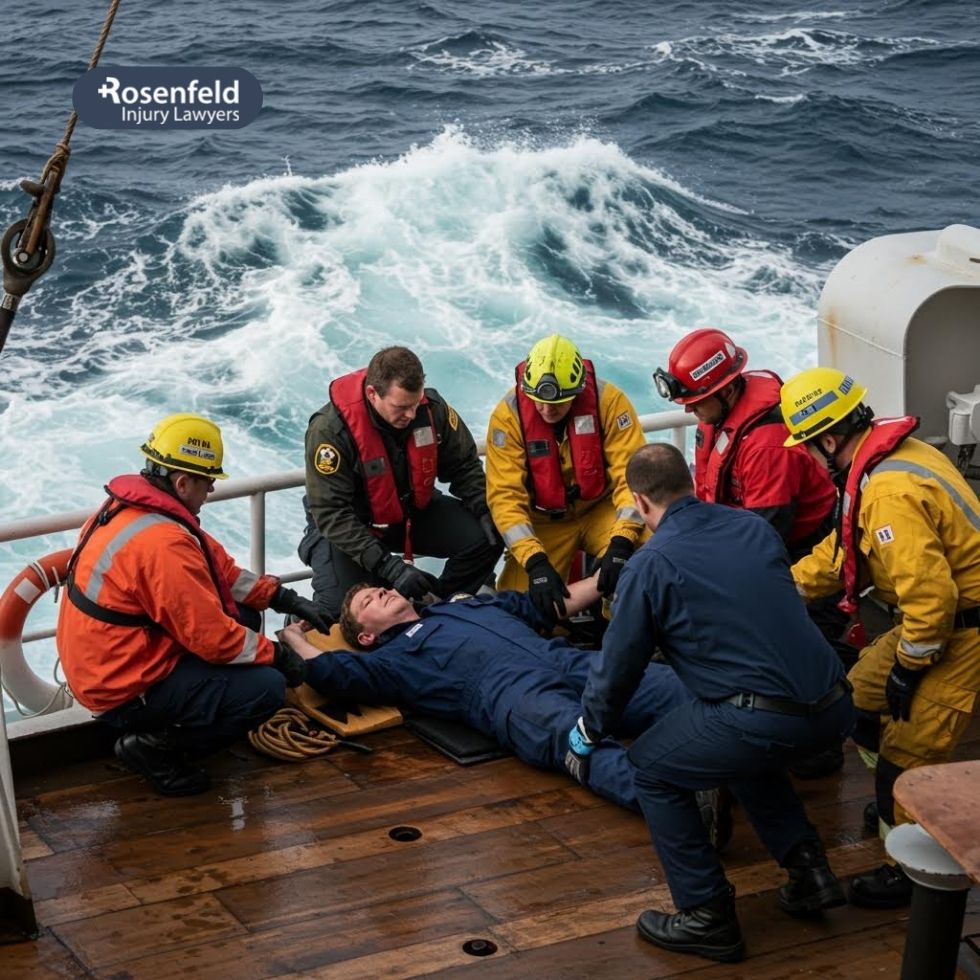
Under the Jones Act, also known as the Merchant Marine Act of 1920, seamen who are injured or die while employed on a vessel in navigation can recover compensation. Unlike workers’ compensation, though, the plaintiff must prove negligence on the part of the employer or another third party.
A common form of Jones Act negligence is unseaworthiness. For example, if a maritime injury or death occurs because the ship did not have adequate railings and the person fell overboard, this would count as unseaworthiness.
Our firm will fight hard to ensure you receive fair compensation for your loved one’s death. These death benefits can include:
What a family can recover depends on which law governs the claim. The table below gives a general comparison. For examples of how these damages have been resolved in practice, see our Jones Act Settlement page.
| Law | Financial losses (lost support, funeral costs) | Pre-death pain and suffering (survival action) | Grief / loss of companionship |
| Jones Act | Yes | Yes | Generally no |
| DOHSA | Yes | No | No (narrow exception for commercial aviation accidents) |
| General maritime law | Yes | Generally yes | Depends on the victim’s work status and where the death occurred |
There are two different types of claims you may make. The first is a wrongful death claim, which compensates family members for their financial and emotional losses. These can include medical bills you may have had to pay for your loved one and your medical costs, like mental health support.
A survival action focuses on what the deceased seaman experienced prior to death, such as physical and mental anguish.
Several federal laws can apply after a fatal maritime accident. An offshore death lawyer starts by identifying which one governs, based on the worker’s job, where the death happened, and whether fault must be proven.
| Law | Who it covers | Where it applies | Must negligence be proven? |
| Jones Act | Seamen | Vessels in navigation | Yes |
| DOHSA | Anyone killed at sea | More than 3 nautical miles from shore | Yes |
| LHWCA | Longshore and harbor workers | Docks, piers, harbors | No |
| General maritime law | Where no statute applies | Various | Yes |
This federal law applies to offshore workers stationed more than 3 nautical miles at sea (46 U.S.C. §§ 30301–30308). It is usually used to recover compensation for the deaths of those not considered Jones Act seamen. For example, the loved ones of deceased scientists researching the outer continental shelf lands or sailing instructors can use the Death on the High Seas Act to be compensated for their loss.
The Death on the High Seas Act generally limits recovery to financial, or pecuniary, losses. That means lost support and services, not grief. There is a narrow exception for commercial aviation accidents.
DOHSA also does not apply to the Great Lakes. Deaths there follow different rules, which we explain in our section on fatal accidents on the Great Lakes and Illinois waterways. A lawyer can determine whether DOHSA or another law controls your family’s claim.
Longshore workers and harbor workers are not covered by the Merchant Marine Act of 1920. Instead, their loved ones can receive death benefits through the Longshore and Harbor Workers’ Compensation Act (33 U.S.C. §§ 901–950). This system works similarly to standard workers’ comp and does not require negligence by any party.
If neither of these statutes applies, claimants can use general maritime law, like Moragne v. States Marine Lines, Inc., to seek damages. This US Supreme Court case overturned previous cases that did not allow for wrongful death claims by family members of non-seamen who died while performing a maritime job.
Like with the Merchant Marine Act, you must demonstrate that one or more parties were primarily negligent and that it is their actions, or inactions, that resulted in death. Additionally, you will need to clarify why this law, rather than another law, is most appropriate to pursue your claim.
Our attorneys will guide you through the process of selecting the right arguments for your case, ensuring you have a strong lawsuit.
Many Illinois maritime deaths do not happen on the open ocean. They happen on Lake Michigan, the Chicago River, the Illinois River, and the Mississippi River, where freighters, towboats, barges, and dredge crews carry much of the region’s commercial traffic.
Location matters because the Death on the High Seas Act does not apply on the Great Lakes (46 U.S.C. §§ 30301–30308). A Great Lakes maritime death involving a seaman usually proceeds under the Jones Act (46 U.S.C. § 30104). When the worker who died was not a seaman, the claim often proceeds under general maritime law, the wrongful death remedy the Supreme Court recognized in Moragne.
The law that applies shapes what the family can recover. The Jones Act generally allows recovery for pecuniary loss, such as loss of support, along with a survival action for the seaman’s suffering before death. Rules on grief and companionship damages vary by the victim’s work status and the place of death. Seamen’s families may also pursue an unseaworthiness claim and any unpaid maintenance and cure owed before death.
For that reason, the exact location of the accident is one of the first facts we confirm. The Great Lakes freighter explosion described in our notable wrongful death cases below shows how these claims arise close to home. As noted later on this page, we also serve families around the Port of Chicago and the Mississippi River, where barge accidents and towboat incidents on inland waterways remain a serious risk.
A family generally has three years to file a wrongful death claim under the Jones Act (46 U.S.C. § 30106) and the Death on the High Seas Act.
The Merchant Marine Act has a statute of limitations of three years (46 U.S.C. § 30104). Failing to act within this timeframe can mean that you have no claim. Contact us immediately so that we can investigate the circumstances surrounding the death and determine which law applies.
Jose Flores, a deckhand, was bitten by a brown recluse spider while on deck. Despite developing abscesses and losing the ability to urinate, he remained on board the vessel until the end of the journey, at which time he was admitted to the hospital. Flores contracted MRSA, which ultimately led to liver failure, sepsis, and death. His family alleged the vessel was unseaworthy because of the spider infestation, and a jury awarded them $41,104,000.00.
A seaman was working on a freighter in the Great Lakes when hydraulic fluid hit a 500-watt halogen light, sparking an explosion. He was thrown 20 feet by the force of the blast, dying within minutes due to burns and smoke inhalation. His family sued the vessel, claiming $950,000 in future lost wages. A verdict provided $1,312,985.00 in death benefits.
A 32-year-old deckhand suffered a fatal head injury while working on the defendant’s tug, which was occupied in dredging mud with two scows. While the deckhand was attempting to climb onto the tug from the scow, the winch line broke. The tug drew away from the scow, and the deckhand lost his balance, falling into the water after hitting his head. He was declared dead upon retrieval. The plaintiff’s estate sued the company, alleging that the tug captain’s maneuvers were not safe according to the US Army Corps of Engineers. The defendant settled for $945,000.00.
Disclaimer: Some of the settlements and verdicts posted on The Firm’s website may have been realized by The Firm using a co-counsel relationship with other attorneys and law firms. Past results are not an indication of future performance.
Our attorneys are highly skilled at navigating wrongful death benefits, including those involving maritime workers. We will assist you with every aspect of your case from start to finish, including these crucial elements. A maritime wrongful death attorney handles the legal work so your family can focus on one another.
Determining Jurisdiction and Relevant Statutes: Because multiple laws govern these claims, and because vessels may have traveled from different states or countries, we must first determine which court has jurisdiction before deciding which type of claim to file. Our firm works with clients from across Illinois, including areas like the Port of Chicago and the Mississippi River.
Investigating Employer Negligence: Companies will insist that they are blameless, relying on comparative negligence to diminish their responsibility. They may state that the worker was not following safety procedures or that they had no prior warning of potential danger. We will use maintenance records, OSHA violations, crew logs, and witness testimony to refute this.
Proving Unseaworthiness: To make a claim, family members must demonstrate that the vessel was unseaworthy. This is a vague term that can cover everything from malfunctioning winches to food poisoning. We will meticulously scrutinize every element of the vessel, relying on independent experts who can provide their unbiased opinion.
Expert Testimony: These cases are complex because they involve vessel maintenance, navigation, marine safety procedures, and the standard operation of a specific ship make. Using our extensive professional network, we will retain the right experts who can demystify the circumstances of the accident.
Multi-Jurisdictional Issues: Multiple federal and state laws govern death benefits for maritime accidents. For example, the deceased’s status as a seaman versus a harbor employee will determine what type of claim we can make. We will investigate the deceased’s work status and apply the correct statutes to recover benefits.
Evidence Preservation: Vessel black box data, logbooks, witness testimony, and accident scene surveillance footage can all clarify how the accident occurred, which determines liability. Unfortunately, this information can quickly be lost after an accident, even without malintent. Our team will demand that evidence be preserved so that we can thoroughly review all the available information.
Negotiation: Insurance companies will fight to avoid responsibility, using tactics such as delaying their investigation or quickly offering a lowball settlement. We will ensure that they pay their fair share and counter their deceptive tactics, improving your chances of a fair Jones Act settlement.
Trial Representation: While not every case must go to trial, we prepare every claim for court. Our legal team is highly familiar with all local court systems at the local, state, and federal levels, and will ensure that we file in the correct venue. We have an excellent track record of fair verdicts through our skillful case preparation.
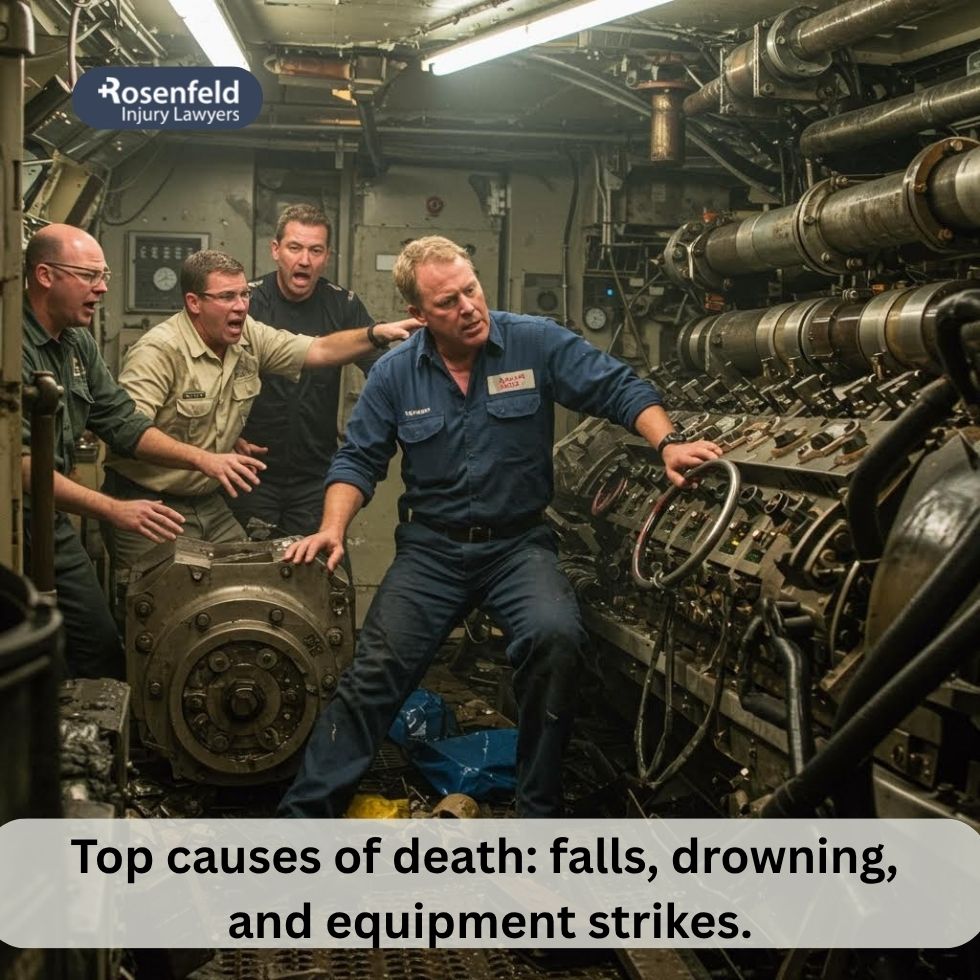
We are the best maritime law firm in Illinois, helping grieving families secure the funds they need to heal. Our team has recovered over $4950 million in verdicts and settlements, helping over 5,000 clients in the past 25 years. We are a member of the Million Dollar Advocates Forum, the American Association for Justice, and the Illinois Trial Lawyers Association, representing our commitment to continuing scholarship and advocacy outside of the courtroom.
When you work with us, you can expect attentive service, peerless trial representation, and a steadfast dedication to securing the highest settlement possible. We work on a contingency fee basis, meaning that you owe us nothing unless we win.
The seaman’s personal representative files the claim on behalf of the surviving spouse, children, or other dependent relatives (46 U.S.C. § 30104). The representative is often a family member named in a will or appointed by a court. The person who died must have qualified as a seaman at the time of death.
A family generally has three years to file a Jones Act wrongful death claim (46 U.S.C. § 30106). Some claims, such as those involving government-owned vessels, can carry shorter deadlines. Our guide to the Jones Act filing deadline explains the time limit in more detail.
A wrongful death claim compensates the family for its own losses, such as lost support and funeral costs. A survival action is brought on behalf of the seaman’s estate for harm the seaman suffered before death, such as conscious pain and suffering. Families can often pursue both claims together.
No, this act does not apply on the Great Lakes (46 U.S.C. §§ 30301–30308). Deaths on Lake Michigan and other Great Lakes usually proceed under the Jones Act for seamen or under general maritime law for other maritime workers, depending on the facts.
Generally not when the person who died was a seaman. Jones Act and DOHSA recovery is usually limited to financial losses, such as lost support and services. The families of non-seamen may have broader options depending on where the death occurred, so an attorney should review the facts.
No. We handle these claims on a contingency fee basis, which means the family owes us nothing unless we win. The first consultation is free and carries no obligation. You can contact our office to discuss your loved one’s case at any time.
When fatal accidents happen on the high seas, families are left to navigate the complexities of maritime statutes, but yours doesn’t have to go through that alone. Our Chicago work accident attorneys have a 98% success rate, and you owe us nothing unless we secure compensation for you. Contact us today for a free, no-obligation consultation and begin your journey toward justice.
 Legally Reviewed By
Attorney Jonathan Rosenfeld
Content legally reviewed by Jonathan Rosenfeld The information on this page has been legally reviewed by Attorney Jonathan Rosenfeld, founder and managing partner of Rosenfeld Injury Lawyers LLC. With extensive experience representing injured workers across Illinois, Mr. Rosenfeld is dedicated to helping workplace accident victims pursue the maximum compensation available under the law. His extensive legal knowledge and commitment to client advocacy ensure that the information provided is accurate, reliable, and aligned with current legal standards.