
Experienced Attorneys
Committed to Protecting the
Rights of Injured Workers
Committed to Protecting the
Rights of Injured Workers



Legally reviewed by Attorney Jonathan Rosenfeld | Last updated: September 24, 2026
A grain auger accident can take a hand, arm, or leg in an instant. Most auger injuries happen through contact with exposed flighting, the rotating spiral blade inside the auger tube, or with an unguarded PTO shaft, and these injuries often result in amputation. A grain auger accident lawyer can identify who left the equipment unguarded.
Grain auger accidents can lead to tragic consequences, from traumatic amputation to death. With over 71,000 farms in Illinois, thousands of farm workers are at risk of crush injuries, entanglement, and electric shock.
Our farming injury attorneys in Chicago fight for the rights of agricultural workers and their family members, holding agri businesses accountable for negligence. Contact us today for a free consultation about your legal rights.
$7,000,000: Tyler lost his arm after an unguarded auger accident. We demonstrated that the manufacturers were aware of the entanglement risk posed by the machinery but failed to warn farmers about the danger.
$3,850,000: 19-year-old John was cleaning the auger flighting, which is the rotating blade inside the conveying equipment. The machinery overturned, crushing his legs and feet. We demonstrated that the farm had failed to perform regular inspections, resulting in the auger collapsing.
Some of the settlements and verdicts posted on the firm’s website may have been realized by the firm using a co-counsel relationship with other attorneys and law firms. Past results are not an indication of future performance.
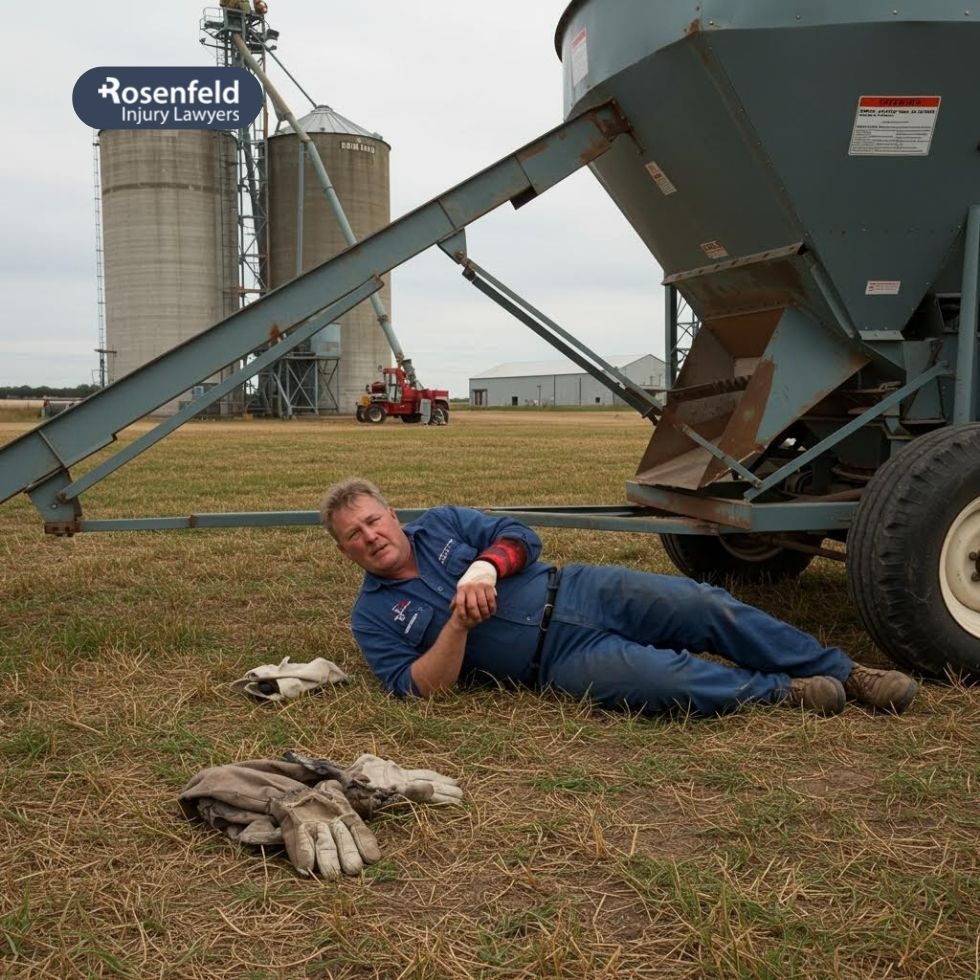
We are the top-rated farm accident attorneys in Illinois, serving both metropolitan and rural victims. Over the past 25 years, we have secured over $490 million in settlements and verdicts for our clients, earning our place at the Million Dollar Advocates Forum.
Our attorneys are active members of the American Association for Justice and contribute to the National Law Review, demonstrating our commitment to ongoing legal scholarship and advocacy. You can be assured of robust legal representation that provides you with the best possible chance of securing compensation.
While augers and other conveying equipment are essential to farm operations, they can also be extremely dangerous. Common hazards that may contribute to grain auger accidents include:
Auger entanglement usually starts at the intake of a portable auger, where the flighting turns inside an open hopper. When the intake guard is missing or damaged, a glove, sleeve, or boot can be pulled into the flighting before the worker has time to react.
PTO entanglement is the second major hazard. The PTO shaft that powers many augers spins hundreds of times per minute, and an unshielded shaft can wrap a pant leg or jacket around itself in seconds. The same hazard causes many hay baler injuries on Illinois farms. When a guard or shield has been removed, the key legal questions are who removed it, who allowed the auger to run without it, and whether the manufacturer designed it to come off too easily.
A sweep auger moves across the floor of a grain bin to push out the last of the grain. Unlike most augers, it operates at the same level where workers stand, and its rotating flighting is often exposed along its length. A worker who steps too close or reaches in to clear a clog can be caught by the flighting, leading to crushed feet, degloving, or amputation.
Federal safety rules strictly limit this work. OSHA’s grain handling standard, 29 CFR 1910.272, bars workers from entering a bin while a sweep auger is running, except under strict conditions. The standard also requires the equipment to be locked out before entry. When a farm or grain facility sends workers into a bin with the sweep auger energized, that decision can serve as strong evidence of negligence.
This section focuses on injuries caused by the auger machinery itself. If you or a loved one was buried or trapped in flowing grain, visit our page on grain bin entrapment to learn how those claims work.
Accidents while operating a grain auger may result in severe injuries among farmers, including:
Potential damages you can claim include:
Illinois does not have a cap on non-economic damages, as per the Illinois Supreme Court case Lebron v. Gottlieb Memorial Hospital. This means that if your case goes to trial, a jury can award any amount they see fit for pain and suffering.
The average farming injury payout is $1,814,702, with payouts ranging between $2,500 and $6,550,000. Factors influencing payouts include injury severity, liability, evidence, insurance policies, and overall damages.
Several factors can affect the value of a grain auger injury claim:
A five-year-old child was attempting to remove a rock from a grain auger when he became entangled, resulting in the degloving of his arm and hand. A jury awarded the family $6,550,000.00.
Robbie Plyler was working on an unguarded auger when his right leg fell into the shaft, amputating his foot. The plaintiff’s attorneys asserted that the farm workers had failed to adhere to Occupational Safety and Health Administration standards that require guards to be installed around all shafts. A jury awarded Plyler $2,500,000.00.
Some of the settlements and verdicts posted on the firm’s website may have been realized by the firm using a co-counsel relationship with other attorneys and law firms. Past results are not an indication of future performance.
Auger accident investigations are time-sensitive. Vital evidence, such as maintenance records and OSHA reports, may quickly disappear, and equipment itself may be repaired or modified. This can make it difficult to ascertain third-party liability, such as manufacturer negligence.
Our attorneys can swiftly preserve evidence and consult with safety experts, such as those at the National Safety Council or OSHA, to better understand the circumstances. With our aggressive legal representation, you have a higher chance of receiving a fair settlement.
Every farm equipment accident raises the same early question: does the claim belong in workers’ compensation, a third-party lawsuit, or both? An experienced farm accident lawyer can answer that question before key deadlines pass.
Agriculture is one of the most dangerous industries, with approximately 200,000 work-related injuries on farms annually (USDA National Agricultural Statistics Service survey, reported by the USDA Farm Service Agency, 2022). 65% of those injuries occurred to family members of farm workers (USDA Farm Service Agency, 2022).
Since 2020, 15 auger-related accidents have been reported to OSHA nationwide (OSHA Accident Investigation Search, 2020 to 2026). However, this may hide the true extent of incident rates. SafetyNow reports that there are 37 fatal auger accidents per 100,000 agricultural workers (SafetyNow, citing 1992 national data) and that 80% of all injuries requiring hospitalization involved entanglement in the machine (SafetyNow, accessed 2026).
Common locations of auger accidents include:
Workers’ compensation is typically considered the first step for injured workers. This no-fault system provides medical and wage benefits (820 ILCS 305). However, under the agricultural exemption, agricultural employers with fewer than 400 working days per quarter in a calendar year are not required to provide workers’ compensation insurance for employees (820 ILCS 305/3). Learn more about workers’ compensation for farm workers in Illinois.
Instead, farmers may pursue a third-party liability suit, which does require proving negligence. A product liability suit would hold manufacturers and distributors accountable if faulty equipment, like broken guards, contributed to the accident (735 ILCS 5/2-21).
Premises liability can hold farmers and property owners liable for failing to rectify potential hazards, such as overhead power lines too close to the auger area (740 ILCS 130/).
For auger accidents resulting in death, the next of kin can file a wrongful death suit (740 ILCS 180/). This requires connecting the fatal farming injury to improper auger operation or maintenance. OSHA standards for auger operation, such as providing proper training (1910.272(e)(1)) and installing protective grates (1910.272(k)), can be used to demonstrate negligence.
In general, you have two years to file a lawsuit after an auger accident (735 ILCS 5/13-202). However, the statute of limitations may be tolled for workers under 18 or those who were temporarily disabled due to their injuries. Contact us immediately so that we can meet all applicable deadlines.
Our nationally recognized attorneys will review your case to identify all potentially liable parties, which can include:
You may sue more than one organization or individual using the Joint Tortfeasor Contribution Act (740 ILCS 100/2).
Illinois assigns a portion of blame to everyone involved in a lawsuit (735 ILCS 5/2-1116), so insurers will insist you are primarily responsible. We will demonstrate that you are not liable for these common defenses using evidence.
Unauthorized Use: Insurers will insist you were not authorized to use the auger but did so anyway. Employment records, certifications, and witness testimony can expose this as false.
No Defect: Manufacturing companies will insist their product was not defective. We’ll work with experts to show that issues like weak auger screws contributed to the accident.
Proper Safety Measures Followed: Employers may insist that the auger was equipped with protective shields, and you were offered PPE. Surveillance footage, incident reports, and witness testimony can refute this claim.
No Duty: Defendants will argue they had no responsibility to reduce risks. Using case law and expert testimony, we’ll show they had an obligation to protect you from harm.
Taking immediate action can protect your health and legal rights. Follow these steps immediately.
Our Chicago work injury law firm will guide you through the entire legal process, including:
We serve clients across Illinois, including the Cook County area and rural communities.
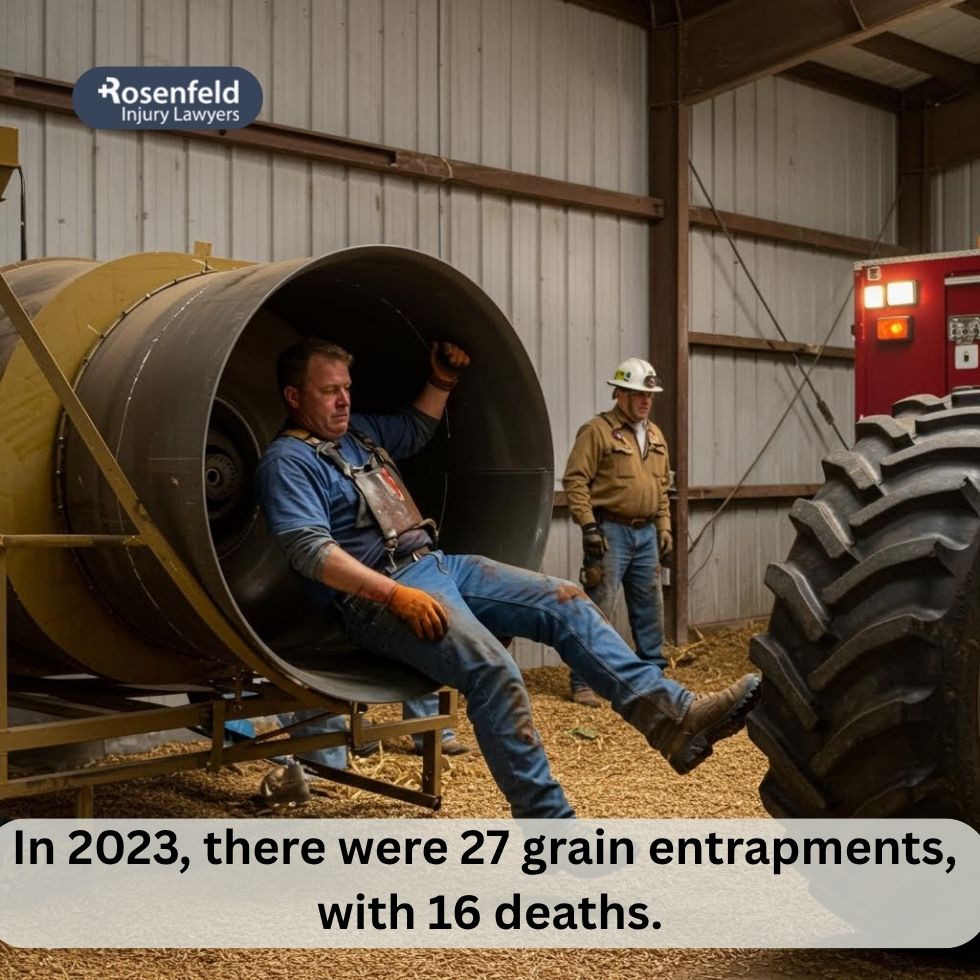
We work on a contingency fee basis, so you owe us nothing unless we win your case.
Farm workers, contractors, vendors, and family members can file claims for auger accidents.
Most grain auger injuries are caused by contact with exposed flighting at the intake or by an unguarded PTO shaft. A missing intake guard, a removed shield, or skipped lockout/tagout procedures can turn a routine task into an amputation. Suffocation in flowing grain is a different type of grain bin accident with its own legal issues.
Yes. A removed guard can support a claim against whoever took it off or allowed the auger to run without it, such as an employer, farm owner, or maintenance contractor. If the guard was poorly designed or easy to remove, the manufacturer may also face a product liability claim. Partial fault may reduce, but not automatically bar, recovery.
Often, but not always. Illinois does not require agricultural employers with fewer than 400 working days per quarter in a calendar year to carry workers’ compensation. Covered workers receive medical care and wage benefits regardless of fault. Workers on exempt farms may still pursue a negligence or product liability claim.
Our compassionate legal advocates assist workers across Illinois in receiving maximum compensation for auger accidents. We work on a contingency fee basis, meaning you owe us nothing unless we win. To schedule a free consultation with an award-winning attorney, contact us today.
 Legally Reviewed By
Attorney Jonathan Rosenfeld
Content legally reviewed by Jonathan Rosenfeld The information on this page has been legally reviewed by Attorney Jonathan Rosenfeld, founder and managing partner of Rosenfeld Injury Lawyers LLC. With extensive experience representing injured workers across Illinois, Mr. Rosenfeld is dedicated to helping workplace accident victims pursue the maximum compensation available under the law. His extensive legal knowledge and commitment to client advocacy ensure that the information provided is accurate, reliable, and aligned with current legal standards.