
Experienced Attorneys
Committed to Protecting the
Rights of Injured Workers
Committed to Protecting the
Rights of Injured Workers



If you were hurt in a warehouse or distribution center, a warehouse accident lawyer in Chicago can help you pursue workers’ compensation and determine whether another company may also be responsible. Warehouse work often involves heavy equipment, tall storage racks, moving vehicles, repetitive tasks, and demanding production schedules. These hazards can lead to injuries that prevent employees from returning to work.
IL Work Injury Lawyer assists warehouse employees in Chicago, Cook County, Will County, and throughout Illinois. We help permanent employees, temporary workers, pickers, packers, forklift operators, and delivery drivers injured inside another company’s warehouse. A warehouse worker injury lawyer can review the circumstances of your accident and explain your options.
Workers’ compensation generally covers qualifying work-related injuries regardless of fault. A separate personal injury lawsuit may also be possible when a third party’s negligence or defective product caused the injury. Contact our team for a free consultation. You owe no attorney fee unless we recover compensation for you.
Warehouse injuries commonly result from lifting, repetitive motion, falls, falling merchandise, conveyor equipment, and powered industrial vehicles. According to the U.S. Bureau of Labor Statistics (BLS), warehousing and storage recorded 4.8 injury and illness cases per 100 full-time workers in 2024, including 4.1 cases involving days away from work, restricted duty, or job transfer. The industry recorded 32 fatal work injuries that year. (BLS warehousing data)
| Cause | What happens | Where to read more |
| Lifting and overexertion | Repeated lifting, pulling, and moving heavy stock can cause back, shoulder, and other musculoskeletal injuries. | Lifting injuries, back injuries |
| Repetitive motion | Repeated scanning, picking, packing, and sorting may contribute to repetitive strain injuries and carpal tunnel syndrome. | Repetitive strain injuries, carpal tunnel |
| Slips, trips, and falls | Wet floors, cluttered aisles, damaged flooring, and unprotected mezzanines can cause falls and broken bones. | Broken bones |
| Falling stock or collapsing racks | Poor stacking, overloaded shelving, or damaged rack uprights may cause merchandise or storage systems to collapse. | A claim review can help identify unsafe storage practices and responsible parties. |
| Conveyor and machinery incidents | Unguarded moving parts and attempts to clear jams without proper energy isolation can cause caught-in injuries, crush injuries, and amputations. | Equipment maintenance and safety records may help establish what happened. |
| Pallet jacks and forklifts | Powered equipment can strike pedestrians, crush workers, or drop loads. A warehouse forklift accident may involve operator training, traffic controls, or equipment maintenance. | See our forklift accident resources. |
| Heat exposure | Hot warehouse floors and trailers, especially during summer peaks, can contribute to heat exhaustion and other heat-related illness. | Temperature conditions, work demands, and available rest and hydration measures may be relevant. |
| Trailer and dock incidents | Unsecured trailers, unsafe dock plates, and moving vehicles can injure workers during loading and unloading. | Read about loading dock accidents. |
Production quotas, peak-season overtime, and pressure to maintain pick rates may encourage rushing, skipped breaks, or unsafe shortcuts. Fatigue and inadequate staffing can compound existing hazards. An investigation can examine training, staffing, maintenance, work procedures, and whether an unsafe condition contributed to the accident. These factors may matter to a workers’ compensation claim or a separate third-party lawsuit.
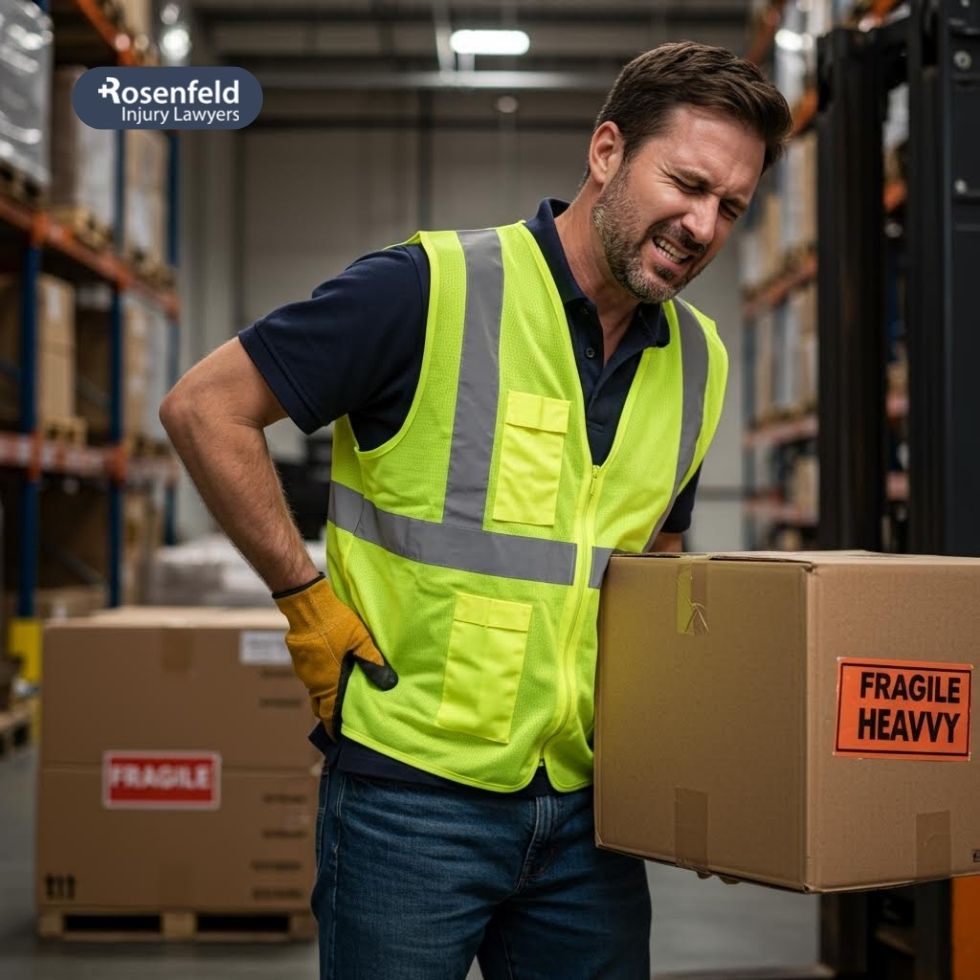
Warehouse workers’ compensation is generally a no-fault system. An employee’s own mistake does not, by itself, reduce workers’ compensation benefits. Repetitive injuries that develop over time may also qualify when the evidence establishes a work-related condition. See Peoria County Belwood Nursing Home v. Industrial Commission, 115 Ill. 2d 524 (1987).
The Illinois Workers’ Compensation Act provides several types of benefits. Eligibility and amounts depend on the injury, medical evidence, earnings, and applicable statutory rules.
| Benefit | What it pays | Statute |
| Medical care | Reasonable and necessary medical treatment for the work injury. Employees generally have two choices of providers, subject to statutory rules and any applicable preferred provider program. | 820 ILCS 305/8(a) |
| Temporary total disability (TTD) | Generally two-thirds of the average weekly wage while a covered injury prevents the employee from working, subject to statutory conditions and limits. See TTD benefits. | 820 ILCS 305/8(b) |
| Temporary partial disability (TPD) | Generally compensates for part of the wage loss when an employee performs temporary light-duty work at reduced pay during recovery. | 820 ILCS 305/8(a) |
| Permanent partial disability (PPD) | Compensation for permanent loss or impairment, calculated under the applicable statutory method. See PPD benefits. | 820 ILCS 305/8(e), 8(d)(2) |
| Wage differential | In qualifying cases, compensates for the difference between pre-injury earnings and reduced earnings in a lower-paying job. | 820 ILCS 305/8(d)(1) |
| Permanent total disability (PTD) | Benefits for qualifying permanent total disability under the Act. | 820 ILCS 305/8(f) |
| Death benefits | Benefits for eligible dependents after a fatal work injury, including applicable burial expenses. See death benefits. | 820 ILCS 305/7 |
Learn more about available workers’ comp benefits and medical care. Workers’ compensation benefits are distinct from damages that may be available in a third-party lawsuit.
If you are hurt at work, take these steps to protect your health and document your claim:
Different claims have different deadlines.
| Claim type | General deadline | Legal reference |
| Workers’ compensation notice | Generally 45 days after the accident | 820 ILCS 305/6(c) |
| Workers’ compensation application | Generally three years after the accident or two years after the last compensation payment, whichever is later | 820 ILCS 305/6(d) |
| Third-party personal injury lawsuit | Generally two years after the injury | 735 ILCS 5/13-202 |
| Wrongful death lawsuit | Generally two years from the date of death | 740 ILCS 180/2 |
Product liability claims may also be subject to a statute of repose under 735 ILCS 5/13-213. Exceptions and claim-specific rules may apply, so do not assume that one deadline governs every case. Review our guide to workers’ comp deadlines.
An insurer may dispute a warehouse injury claim because it questions whether the injury happened at work, challenges the medical evidence, argues that a condition existed before the accident, or alleges that notice or filing requirements were not met.
A pre-existing condition does not automatically prevent recovery. Under Sisbro, Inc. v. Industrial Commission, 207 Ill. 2d 193 (2003), an injury that aggravates or accelerates a pre-existing condition may be compensable when the evidence establishes the required connection to work.
If the insurer denies benefits, a dispute may proceed before an arbitrator at the Illinois Workers’ Compensation Commission, followed by applicable review procedures and court review. Medical records, work restrictions, witness accounts, and incident documentation can be important evidence.
Can I be fired for filing a workers’ compensation claim? Illinois law prohibits an employer from retaliating against an employee for exercising rights under the Workers’ Compensation Act. A qualifying retaliatory discharge may support a separate lawsuit under Kelsay v. Motorola, Inc., 74 Ill. 2d 172 (1978). Workers should document relevant communications and seek legal advice if they fear retaliation after reporting an injury.
Many Chicago-area warehouses use staffing agencies to fill picking, packing, sorting, and loading positions. A temporary worker may have workers’ compensation rights even when the staffing agency, rather than the warehouse operator, issued the paycheck.
Under 820 ILCS 305/1(a)(4), the loaned-employee provisions can make a borrowing employer and lending employer responsible for workers’ compensation in qualifying circumstances. The exact employment arrangement and statutory requirements matter.
Illinois’ Day and Temporary Labor Services Act also addresses safety training. Under 820 ILCS 175/85, staffing agencies must provide general safety awareness training, while client companies must provide site-specific training before work begins and address new hazards when assignments or tasks change. The Act includes requirements for documenting training and communicating hazards. (Illinois statute, 820 ILCS 175/85)
Missing or inadequate training may be relevant evidence in investigating an accident. Read more about temporary worker injuries.
Amazon warehouse employees in Illinois generally have the same workers’ compensation protections and potential third-party claim options as other warehouse workers, depending on the facts. Our guide to Amazon warehouse injury claims covers fulfillment center and delivery station cases in more detail.
A warehouse accident attorney can investigate whether another company’s negligence or a defective product contributed to your injury. Illinois workers’ compensation generally prevents an employee from suing their employer for a covered workplace injury, subject to the Act’s provisions (820 ILCS 305/5(a), 11). A claim against a legally responsible third party may be available separately.
| Potentially responsible party | Warehouse example | Possible legal basis |
| Equipment manufacturer | A conveyor lacks appropriate guards, a pallet jack has a defect, or a rack fails despite being used within its rated capacity. | Product liability, subject to applicable defenses and the statute of repose under 735 ILCS 5/13-213 |
| Property owner or landlord | A broken dock leveler, unsafe floor, or inadequate lighting contributes to a fall or other accident. | Premises liability, including applicable duties under 740 ILCS 130 |
| Outside contractor | A racking installer, maintenance contractor, or another company’s driver creates a hazard. | Negligence, depending on the duty owed and the facts |
| Host company in a staffing arrangement | A host company controls the worksite and may have responsibilities relevant to a temporary worker’s injury. | Depends on employment status, statutory provisions, and the facts |
Delivery drivers and vendors injured inside someone else’s warehouse may have a claim against the warehouse operator or another responsible party, depending on who controlled the hazard and what duties applied.
Comparative negligence applies to a third-party lawsuit, not to the no-fault calculation of workers’ compensation benefits. Under 735 ILCS 5/2-1116, damages may be reduced by the claimant’s share of fault, and a claimant who is more than 50% at fault is barred from recovering damages under that rule.
If a third-party recovery is obtained, the workers’ compensation insurer may have a lien against it. Under 820 ILCS 305/5(b), the statutory lien calculation includes a reduction for attorney fees and a share of costs. The allocation of responsibility between an employer and a third party may also raise issues under Kotecki v. Cyclops Welding Corp., 146 Ill. 2d 155 (1991), which addresses limits on an employer’s contribution liability.
For a related issue, read can I sue for a forklift accident at work.
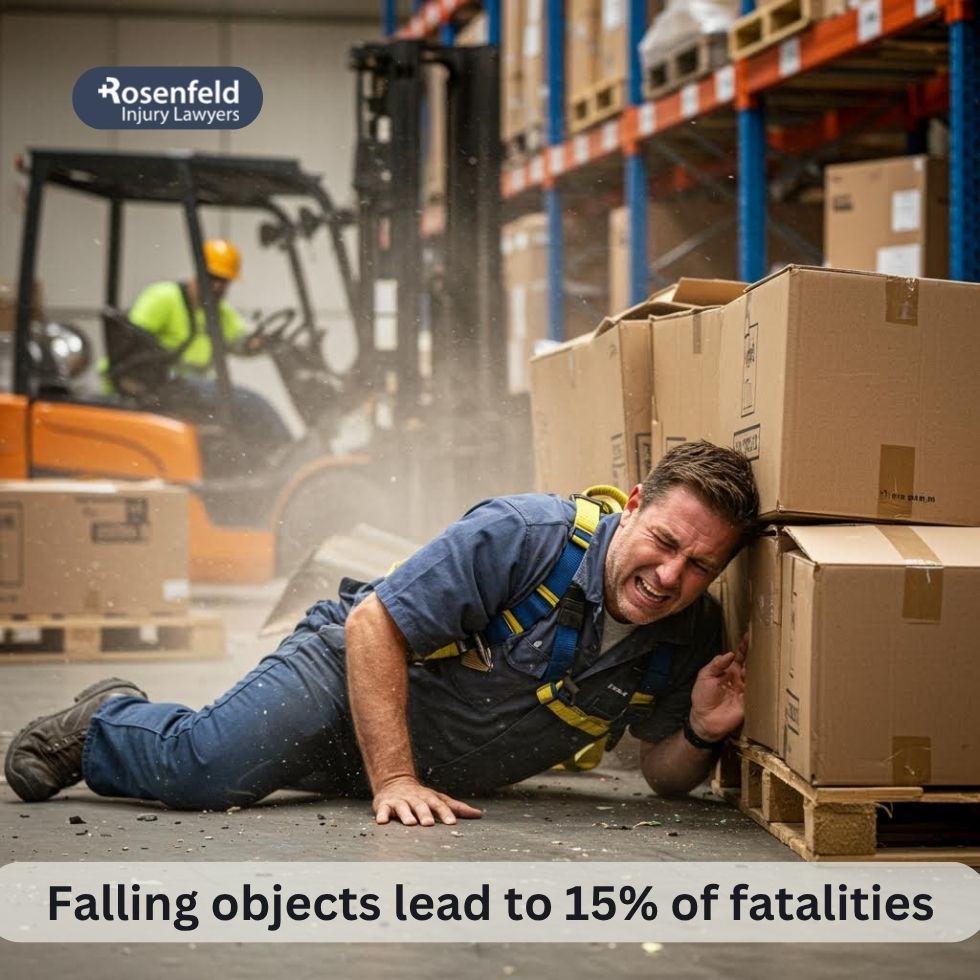
Federal OSHA standards address common hazards in warehouses and distribution centers. A violation does not automatically decide a workers’ compensation claim, which generally does not depend on fault. However, safety evidence may help establish negligence in an appropriate third-party lawsuit.
| OSHA rule | What it requires | How a violation may appear |
| 29 CFR 1910.176 | Safe material handling and storage, orderly aisles, and appropriate stacking and storage practices. | Blocked aisles, unstable stacks, or stored materials that can slide or collapse. |
| 29 CFR 1910.178 | Safety requirements for powered industrial trucks, including operator training and evaluation. | An inadequately trained operator or unsafe powered equipment use. See OSHA forklift regulations. |
| 29 CFR 1910.212 | Appropriate guarding of machine hazards, including dangerous moving parts. | Exposed conveyor nip points or accessible moving machinery. |
| 29 CFR 1910.147 | Hazardous-energy control, including lockout/tagout when applicable during servicing and maintenance. | Clearing a conveyor jam without properly isolating hazardous energy. |
OSHA’s National Emphasis Program for Warehousing and Distribution Center Operations, directive CPL 03-00-026, began in 2023, with a revised directive taking effect July 31, 2026. The program targets warehouses, distribution centers, and related operations for inspections addressing hazards such as powered industrial vehicles, material handling, walking-working surfaces, heat, ergonomics, exits, and fire protection. (OSHA warehousing enforcement guidance)
If a serious hazard remains unaddressed, workers can learn how to report an OSHA violation. An OSHA report may be useful evidence, but it does not by itself establish liability or guarantee a recovery.
A warehouse accident attorney in Chicago may assist injured workers across the region’s major logistics and distribution areas. In Will County, warehouses and distribution operations are located along the I-55 and I-80 corridors, including areas around Joliet, Elwood, Romeoville, and Bolingbrook. Cook County has warehouse operations on Chicago’s South and West Sides and in suburbs such as Bedford Park. Air cargo and distribution facilities are also concentrated around O’Hare, including Elk Grove Village, Bensenville, and Franklin Park.
Our team reviews cases involving workers throughout Chicago, Cook County, Will County, and other Illinois communities. Workers’ compensation disputes proceed through the Illinois Workers’ Compensation Commission. A third-party lawsuit may be filed in an appropriate circuit court, depending on venue rules, where the accident occurred, and where the defendant resides or does business.
If you were hurt in a warehouse or distribution center, we can explain the process and help you understand which deadlines and legal options may apply.
Publication note: Retain this section only after the firm confirms each result, the facts, the amount, and the type of claim. The existing $750,000, $3.33 million, and $11 million descriptions have inconsistencies with other pages and should not be republished without verification.
If no results are confirmed, use this sentence instead: Read more about workers’ comp settlements. Past results do not guarantee a similar outcome.
Generally, workers’ compensation is the exclusive remedy against an employer for a covered workplace injury, subject to statutory exceptions. However, you may be able to bring a separate lawsuit against a negligent third party, such as an equipment manufacturer, contractor, or property owner. The facts determine which claims are available.
Your own mistake generally does not reduce workers’ compensation benefits because the system is no-fault. A third-party lawsuit follows different rules. Under Illinois’ modified comparative negligence law, damages may be reduced by your share of fault, and recovery is barred if you are more than 50% at fault.
Illinois law prohibits certain forms of retaliation against employees who exercise their rights under the Workers’ Compensation Act. A qualifying retaliatory discharge may support a separate claim under Kelsay v. Motorola, Inc. Keep relevant messages and employment records, and seek legal guidance if your employer threatens or disciplines you after you report a work injury.
The outcome depends on whether the evidence establishes a work-related injury, timely notice, medical support, and eligibility for benefits. Disputes may arise over causation, treatment, or disability. An insurer’s denial does not necessarily end the claim; the employee may challenge it through the Illinois Workers’ Compensation Commission process.
Attorney fees for Illinois workers’ compensation claims are generally subject to Section 16a of the Workers’ Compensation Act, which ordinarily limits fees to 20% of compensation recovered, subject to statutory provisions and Commission approval. Fees for a third-party personal injury lawsuit are typically governed by a separate written fee agreement. Ask for the terms before retaining counsel.
A warehouse injury can affect your health, income, and ability to return to work. IL Work Injury Lawyer can review your situation, explain available workers’ compensation benefits, and assess whether a third-party claim may also be appropriate. We assist permanent and temporary warehouse workers, as well as delivery drivers injured at another company’s facility.
Contact our team for a free consultation with a warehouse injury lawyer. There is no attorney fee unless we recover compensation for you. Learn more about our workers’ compensation lawyers.
 Legally Reviewed By
Attorney Jonathan Rosenfeld
Content legally reviewed by Jonathan Rosenfeld The information on this page has been legally reviewed by Attorney Jonathan Rosenfeld, founder and managing partner of Rosenfeld Injury Lawyers LLC. With extensive experience representing injured workers across Illinois, Mr. Rosenfeld is dedicated to helping workplace accident victims pursue the maximum compensation available under the law. His extensive legal knowledge and commitment to client advocacy ensure that the information provided is accurate, reliable, and aligned with current legal standards.