Experienced Attorneys
Committed to Protecting the
Rights of Injured Workers
Committed to Protecting the
Rights of Injured Workers



Consult our forklift accident attorneys to protect your rights as an injured worker.
In Illinois and across the country, OSHA forklift regulations establish strict safety standards to protect employees operating powered industrial trucks. Whether in warehouses, construction sites, distribution centers, manufacturing facilities, or other non-agricultural workplace across Chicago, Aurora, Rockford, Naperville, Joliet, and Elgin, these OSHA forklift safety standards are designed to reduce forklift accidents, prevent workplace injuries, and ensure employers maintain a safe working environment. Proper forklift operator training, routine equipment inspections, and compliance with OSHA workplace safety regulations are essential for protecting workers throughout Illinois workplaces.
The Occupational Safety and Health Administration (OSHA) is the federal agency responsible for enforcing forklift safety regulations that protect forklift operators and nearby workers from hazards such as falling loads, tip-overs, load instability, struck-by incidents, and other dangerous workplace conditions. These federal workplace safety standards apply to employers across Illinois, including businesses in Cook County, DuPage County, Lake County, Will County, and Kane County, helping reduce the risk of preventable workplace injuries.
Under OSHA Standard 1910.178 for Powered Industrial Trucks, employers must provide forklift certification, hands-on forklift operator training, formal instruction, and performance evaluations before employees are permitted to operate forklifts, lift trucks, pallet jacks, or other industrial trucks. Employers must also maintain safe equipment, perform workplace hazard assessments, and ensure operators are qualified to use the specific equipment assigned to them.
For employees injured in Chicago, Springfield, Peoria, Rockford, or anywhere else in Illinois, violations of OSHA forklift regulations and forklift training requirements can lead to devastating workplace accidents and serious injuries. When employers fail to comply with OSHA safety regulations and Illinois workplace safety laws, injured workers may be entitled to workers’ compensation benefits and, in some cases, additional legal compensation. OurIllinois workplace injury lawyer helps injured workers throughout Illinois hold negligent employers accountable when workplace safety standards are ignored.
Under OSHA Standard 1910.178(a), forklift operators are responsible for handling a wide range of powered industrial trucks—including fork trucks, platform lift trucks, motorized hand trucks, and other specialized industrial trucks powered by electric motors or internal combustion engines. These rules apply in general industry, warehouses, manufacturing facilities, and more, but exclude over-the-road hauling, farm vehicles, and earth-moving equipment.
OSHA requires that all new powered industrial trucks meet the American National Standard for Powered Industrial Trucks (ANSI B56.1-1969) design and construction standards. Only approved trucks bearing the mark of a nationally recognized testing laboratory can be used in the workplace. Nameplates and capacity markings must be legible, and any modifications that affect capacity or operational safety require prior manufacturer approval.
OSHA’s 1910.178(l) lays out detailed forklift training standards to protect workers. Before an employee can operate a forklift, they must complete a combination of formal practical training and on-the-job evaluation.
Training may include lectures, written materials, videos, or interactive learning. Practical training involves hands-on demonstrations and supervised driving exercises. Training content must cover both truck-related topics (controls, capacity, stability, fueling, maintenance) and workplace-related topics (surface conditions, load composition, narrow aisles, ramps, and unique hazards).
Only trainers with the knowledge, training, and experience to train operators and evaluate their competence may provide instruction. Employers are also required to offer additional training if workplace conditions change or if an operator is assigned to a different type of forklift.
Get help from an Illinois OSHA violation lawyer today!
OSHA stresses that formal instruction alone is not enough—skills must be proven through supervised forklift training. Trainers must observe operators during normal tasks, including load stacking, traveling in narrow aisles, and working around pedestrians.
Instruction must also cover fueling and battery charging. Fuel tanks cannot be filled while the engine is running, and fuel handling must follow the National Fire Protection Association (NFPA) standards. In battery charging, operators must use proper lifting devices, such as an overhead hoist, and ensure ventilation is adequate to avoid hazardous gas buildup.
Per 1910.178(b), OSHA identifies eleven designations for industrial trucks: D, DS, DY, E, ES, EE, EX, G, GS, LP, and LPS based on power source and safety safeguards. For example:
Employers must match the truck designation to the location’s hazard classification (Class I, II, or III) to ensure operational safety in areas such as grain storage, chemical plants, and narrow aisles with limited ventilation.
Safe operating practices for powered industrial trucks are critical to avoid injuries. OSHA prohibits actions such as stunt driving, horseplay, and allowing unauthorized personnel to ride on the truck. Operators must maintain a safe following distance of about three truck lengths and yield to emergency vehicles.
When traveling, visibility is essential. If the load blocks the view ahead, the truck should be driven in reverse. Crossing railroad tracks diagonally, avoiding sudden turns, and traveling slowly on grades are part of OSHA’s safety expectations. Trucks must not be driven up to people standing in front of a fixed object, and arms or legs must be kept inside the running lines at all times.
In loading, only stable or safely arranged loads should be handled. Forklift operators must avoid exceeding rated capacity and must use a load backrest extension if there is a risk of the load falling backward.
Special requirements in 1910.178(c) apply when operating powered industrial trucks in hazardous areas. For example, only EX-designated trucks may be used in the presence of flammable vapors. In locations with combustible dust, such as grain elevators or aluminum powder processing facilities, special electrical enclosures and ventilation are required.
The classification of a location (hazardous vs. nonhazardous) determines what industrial trucks are allowed. OSHA also addresses overhead hoist use in battery charging areas, requiring proper handling equipment and precautions against sparks, open flames, and poor ventilation.
The OSHA requirements in 1910.178(m)-(n) detail safe operation procedures, including maintaining a clear square foot of space for fire aisles, keeping fire equipment unobstructed, and ensuring adequate headroom under overhead installations.
The rules also mandate that trucks be kept under control at all times, with speeds adjusted for wet or slippery conditions. Operators must avoid loose objects on travel surfaces and reduce speed before turning. In all cases, the goal is to protect workers from tip-overs, collisions, and falling materials.
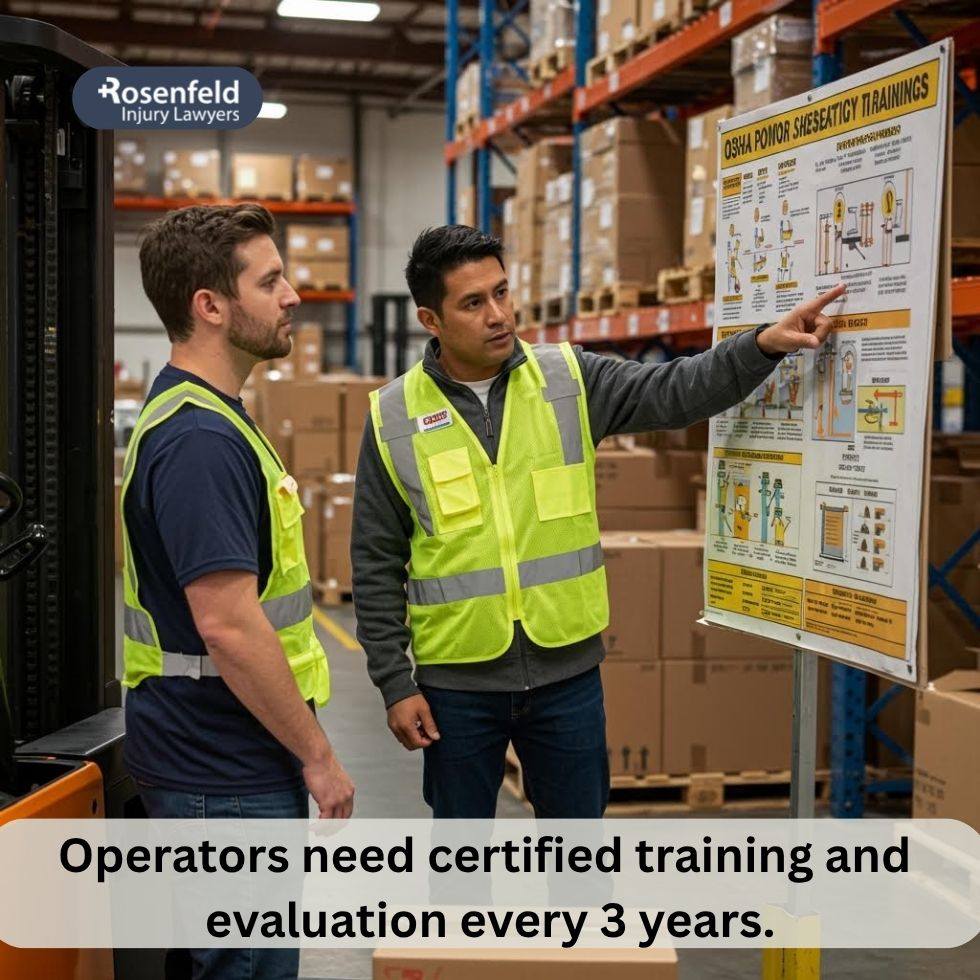
Employers must provide forklift certification that documents each operator’s name, the training and evaluation dates, and the name of the person conducting the training. OSHA requires evaluations at least once every three years and refresher training if an operator is observed driving unsafely, is involved in an accident, or workplace conditions change.
A certified forklift operator is considered properly trained when they can demonstrate competence in both handling the truck and responding to workplace hazards. Certification isn’t just a formality; it’s part of OSHA’s enforcement to protect workers and promote occupational safety.
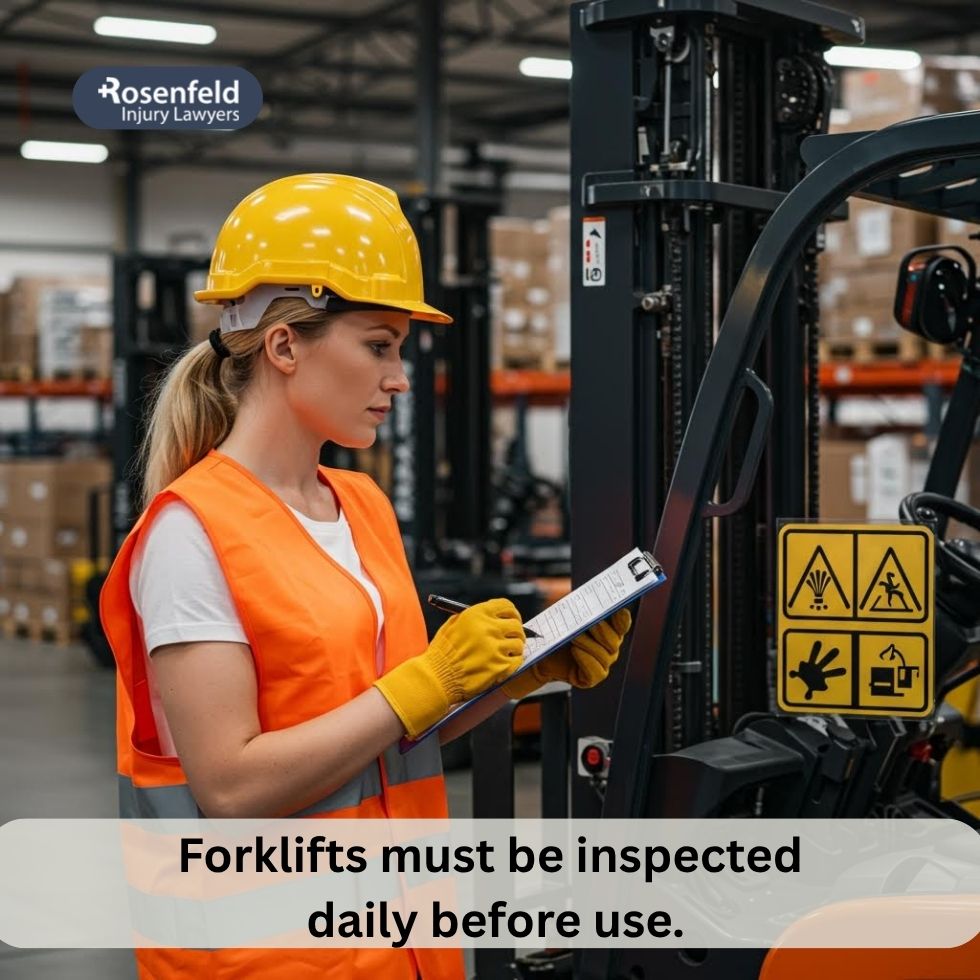
Routine inspection and maintenance of lift trucks is essential for compliance with 1910.178(q). Trucks must be examined before each shift, with defects reported and corrected before use. Fuel leaks, worn brakes, faulty steering, and excessive smoke from the exhaust are all red flags.
Cleaning must be done with noncombustible agents, avoiding low-flash-point solvents. Trucks should be free of lint, grease, and excess oil, and mufflers must be unclogged. Compressed air must not be used for cleaning in a way that creates hazardous flying debris.
At our Chicago forklift accident law firm, we know the OSHA standard for operating powered industrial trucks is more than a rulebook; it’s a critical safeguard meant to protect workers in busy warehouses, retail spaces, manufacturing facilities, and distribution hubs across Illinois. As experienced Illinois forklift accident lawyers, we help injured workers pursue compensation when employers violate OSHA forklift regulations, workplace safety standards, and forklift training requirements.
Our record of success includes cases where truck collisions, equipment defects, and unsafe operating practices, such as stunt driving, ignoring blind spots, or failing to maintain a safe distance, caused life-changing forklift accident injuries. We have successfully represented victims of workplace accidents, warehouse injuries, and OSHA safety violations throughout Illinois.
Take Marcus, for example. He was a temporary worker at a large West Side shipping facility when a forklift backed into him, pinning him against a loading dock. Despite multiple OSHA forklift regulations violations, his employer had never provided proper forklift operator training. We fought to prove negligence and secured an $11 million settlement that will help Marcus and his family rebuild their lives.
Then there was David, a skilled powered industrial truck operator at a South Side manufacturing plant, who was severely injured when a lift truck tipped over due to poor load stability and a lack of safety guards. His pelvic and leg fractures left him unable to work for over a year. Through evidence of OSHA safety standard breaches, employer negligence, and unsafe workplace conditions, we obtained $4.4 million in compensation for his medical care, lost wages, and long-term rehabilitation needs.
Finally, Anthony, a Chicago resident, suffered spinal injuries after being struck by a forklift in the parking lot of a home improvement store. The incident occurred because an employee, who had never received complete forklift certification or training, was allowed to operate a powered industrial truck in a congested customer area. We negotiated a $1.25 million settlement to cover his recovery and ensure improvements to the store’s workplace safety and health procedures.
No matter where your injury occurred or the type of machinery involved, our Chicago work injury attorneys know how to investigate every factor, from the type of forklift used to fuel handling, fuel tanks, and excess oil hazards. Our deep understanding of Illinois workplace safety laws, OSHA compliance, workers’ compensation claims, and Chicago’s industrial landscape allows us to build strong cases for injured workers. Book a free consultation with our Illinois forklift accident lawyers today!
OSHA forklift regulations require employers to provide proper forklift operator training, equipment inspections, and safe operating procedures under OSHA Standard 1910.178 for powered industrial trucks.
Yes. If OSHA safety violations, employer negligence, or unsafe workplace conditions contribute to a forklift accident, an injured worker may have legal options for compensation.
OSHA requires forklift certification, formal instruction, hands-on training, and operator evaluations before employees can operate powered industrial trucks in the workplace.
Employers may be responsible when they fail to follow OSHA forklift safety standards, provide proper training, maintain equipment, or correct workplace hazards.
Depending on the circumstances, injured workers may pursue workers’ compensation benefits or additional legal claims when OSHA violations contribute to serious forklift injuries.
An Illinois forklift accident lawyer can investigate OSHA violations, gather evidence, identify negligence, and help injured workers seek the compensation they deserve.
 Legally Reviewed By
Attorney Jonathan Rosenfeld
Content reviewed by Chicago work accident lawyer Jonathan Rosenfeld of Rosenfeld Injury Lawyers LLC, who holds employers, contractors, and third-party defendants accountable to recover compensation for injured workers, and is a trial lawyer recognized by the Illinois Trial Lawyers Association, the Illinois Workers Compensation Bar Association, and America’s Top 100 High Stakes Litigators.