
Experienced Attorneys
Committed to Protecting the
Rights of Injured Workers
Committed to Protecting the
Rights of Injured Workers



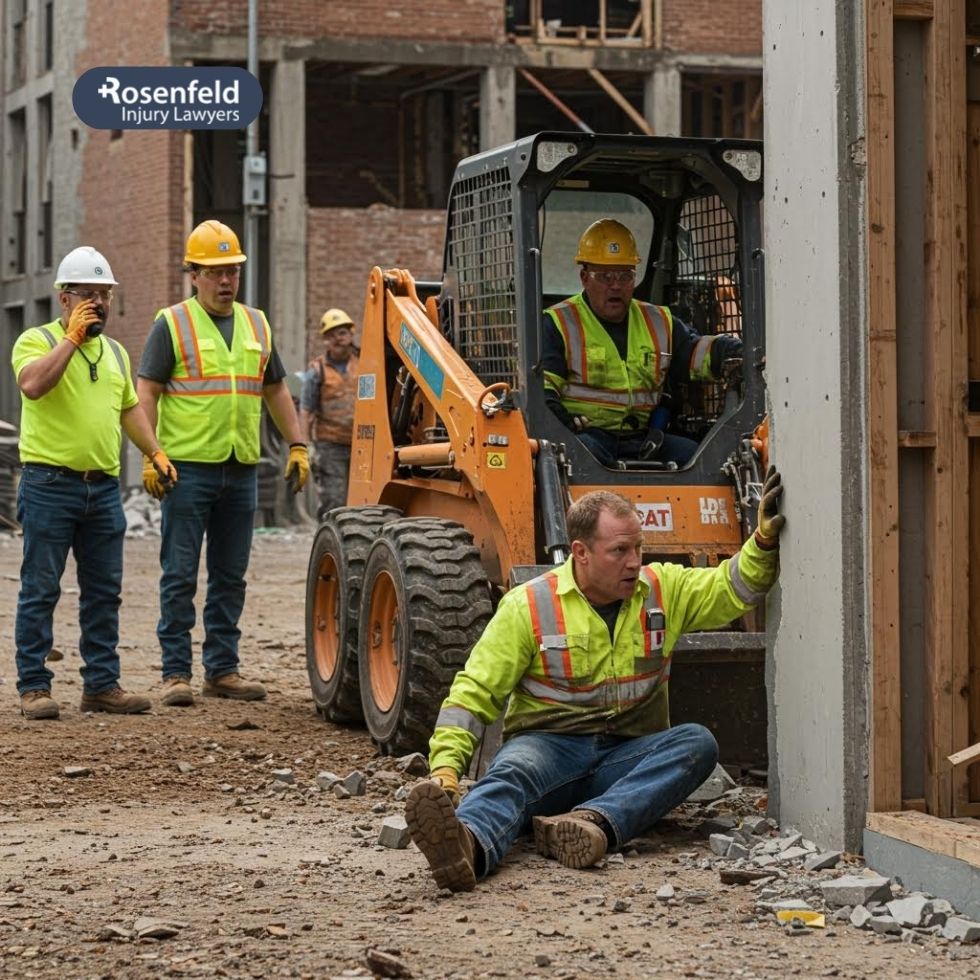
A skid steer accident lawyer can help you pursue compensation after a serious injury. Most serious skid steer loader injuries involve one of three hazards: being crushed under raised lift arms, rollovers, or starting the machine from outside the cab. After a skid steer accident, liability can extend beyond your employer to rental companies and manufacturers.
By Attorney Jonathan Rosenfeld | Last updated: September 24, 2026
A skid steer is a versatile piece of machinery that can serve both commercial and residential purposes in Illinois. However, like any complex machinery, people can get hurt in skid steer loader accidents, especially when safety devices fail or operators fail to follow safety tips.
IL Work Injury Lawyer is a law firm specializing in work-related accidents. Whether you are operating the vehicle when the brakes fail or you are a passerby when someone hits you with a skid steer loader arm, our team can guide you through the claims process to recover compensation for legal damages.
Our firm has recovered millions of dollars for past clients to help cover lost wages, medical expenses, and other losses. Here are some past payouts we have secured:
Disclaimer: Prior results do not guarantee a similar outcome. Every case is different, and each result depends on its specific facts, injuries, and legal issues. These results should not be interpreted as a prediction of the outcome of your case.
For the best chance of compensation, you need a top-rated farm accident law firm with experience litigating similar incidents. IL Work Injury Lawyer is recognized among the top 5% of attorneys by Super Lawyers, while also maintaining an A+ grade from the Better Business Bureau.
Skid steer accidents can cause serious injuries, so it is important to know what circumstances led to your accident. Here are the leading causes of farming injuries from skid steer loaders:
Bypass starting means starting a skid steer from outside the cab, usually by jumping the starter. This gets around the seat and seat-bar safety interlocks, which are designed to keep the machine from moving unless the operator is seated with the seat bar lowered.
When a skid steer starts this way, it can lurch forward and crush or run over the person standing beside it. Workers are often pinned between the machine and a wall, trailer, or building. Unlike a skid steer rollover, which usually injures someone inside the cab, bypass starting puts the worker on the ground directly in the machine’s path. It is a well-documented cause of fatal skid steer accidents. NIOSH warns that safety devices on these machines should never be modified or bypassed (NIOSH Alert: Preventing Injuries and Deaths from Skid-Steer Loaders, DHHS [NIOSH] Publication No. 2011-128, December 2010).
If an employer instructed workers to start machines this way, tolerated the practice, or failed to repair a faulty starter or interlock, that is strong evidence of negligence. Manufacturers have issued warnings and starter protections against bypass starting, and whether a machine had them can matter in a product claim. After any skid steer accident involving bypass starting, including a bobcat accident, we examine both the employer’s practices and the machine’s starter protections. Our firm also investigates backhoe accidents and other loader injuries on Illinois farms.
The purpose of a lawsuit or workers’ compensation claim is to seek a payout or benefits to cover your losses.
Economic Damages
Non-Economic Damages
Punitive Damages
This additional compensation may be awarded in skid steer accidents caused by gross negligence or intentional misconduct.
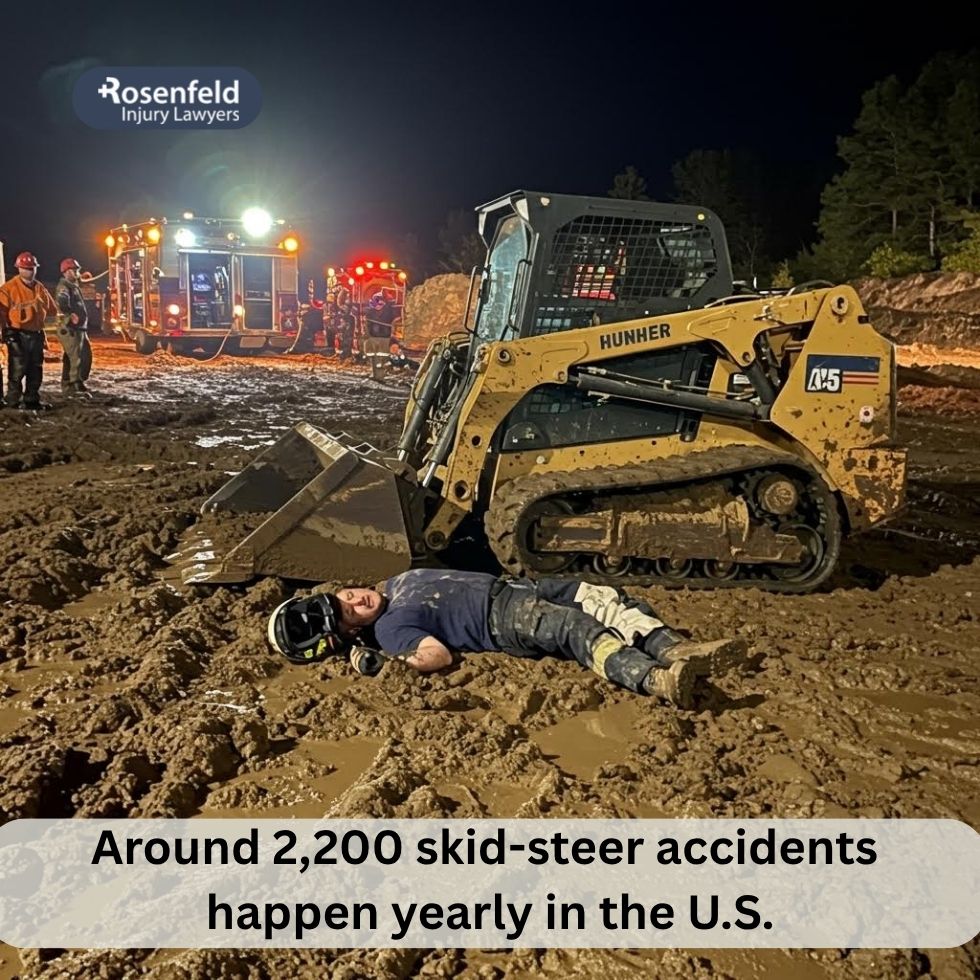
A significant number of accidents involving skid steer loaders occurred in the United States. The average payout for farming accident cases is $4.84 million. The range for these settlements is $320,000 to over $20 million.
Factors that would influence your payout include injury severity, legal damages, insurance policies, and available evidence.
What drives the value of a skid steer claim:
Accident type: Skid steer cab crush (product liability claim against the manufacturer).
In 2016, Wayne, an auto repair business owner, was working on a skid steer that a customer had brought in for repair. While he had the cab open to work on the engine, it fell and crushed him, causing fatal injuries. His wife and adult children sued the manufacturer for a design defect in the latch that was meant to hold the cab open, claiming it was poorly made and insufficiently tested. The family was awarded $13 million in the wrongful death suit.
Accident type: Skid steer backover (claim against the leasing company for failure to inspect).
Raul, a Waste Management truck driver, was cleaning leaves and debris for a contracted project in 2010. Another co-worker was using a skid steer to load the debris into the truck when the operator backed into Raul and pinned him against the truck, causing a pelvic injury. Raul sued the leasing company for failing to regularly inspect the machine because the backup alarm was not loud enough to be heard with the engine running, so he did not have time to react. A settlement of $3.85 million was negotiated between the parties.
Disclaimer: Prior results do not guarantee a similar outcome. Every case is different, and each result depends on its specific facts, injuries, and legal issues. These results should not be interpreted as a prediction of the outcome of your case.
Skid steer incidents can be incredibly complex in terms of compensation claims. Equipment must be preserved and inspected promptly. Skid steers are often rented or subcontracted, so third-party liability must be identified early. Occupational Safety and Health Administration (OSHA) violations must be properly documented, and eyewitnesses or footage may be lost or destroyed.
An experienced farm accident lawyer can act quickly to secure the machine, maintenance logs, and rental agreements before they are repaired, returned, or lost.
IL Work Injury Lawyer handles cases involving skid steer accidents in Cook, DuPage, Kane, McLean, and other rural counties throughout Illinois.
In the last five years, roughly 74 reports of skid steer incidents have been listed on OSHA’s website (Source: OSHA Accident Investigation Search, January 2020 to July 2026). Many of these accidents resulted in fatalities, while others caused severe injuries. Between 2015 and 2020, the construction industry experienced the highest rate of equipment-related injuries, with 44 states reporting incidents (Source: Safety journal, MDPI, 2022).
While preventing injuries entirely may not be possible, workers in certain industries should be extra vigilant in certain locations:
In Illinois, victims of personal injury incidents have two years to file their claims and seek compensation (735 ILCS 5/13-202).
To receive a settlement, you must prove that the liable party is mostly at fault for the skid steer rollover or other accident type. Potentially liable parties may include:
Our law firm can counter these arguments with maintenance reports, broken safety features, a lack of proper training protocols, surveillance footage, witness statements, and photos of the accident scene.
Defendants often blame the operator, but poor skid steer safety practices, such as tolerating bypass starting or ignoring a broken seat bar, usually trace back to the employer, contractor, or rental company that controlled the machine.
Taking the proper steps after the skid steer accident can make all the difference in winning your claim:
After a skid steer loader accident, these additional steps can protect key evidence:
Our legal services include:
A skid steer injury attorney from our firm can identify every party that may share responsibility, from the employer and general contractor to the rental company and the manufacturer.
We work on a contingency fee basis, which means you owe nothing unless we win.
Surviving family members, such as spouses, parents, and adult children, can file a wrongful death suit for a skid steer fatality.
Most skid steer accidents are caused by crushing under raised lift arms or the bucket, rollovers on slopes or uneven ground, and bypass starting from outside the cab. Overloading beyond the rated operating capacity, missing ROPS or FOPS, and disabled interlocks add to the risk. The same hazards cause heavy equipment accidents on construction sites.
Yes, in many cases. If a contractor, property owner, or rental company disabled the interlock or failed to repair it, you may have a negligence claim. A defective interlock design can support a product claim against the manufacturer. Claims against your own employer usually go through workers’ compensation. On construction sites, OSHA 29 CFR 1926.602 governs equipment safety.
The rental company may be liable if it supplied rental equipment with a broken seat bar, faulty interlock, or worn brakes, or if it skipped required inspections. The contractor or farm that rented the machine may share fault for poor training or supervision. The manufacturer can also be liable for a design or manufacturing defect.
Yes, in many cases, but not always. Illinois workers’ compensation covers many farm employees, but the agricultural exemption in 820 ILCS 305/3 excludes some smaller farms based on labor days worked. If you are not covered, you may be able to sue the farm directly for a farm equipment accident. Learn more about workers’ compensation for farm workers.
IL Work Injury Lawyer will work tirelessly to guide you through the claims process and fight for fair compensation. There are no fees unless we win, and we have a 98% success rate. We offer a statewide reach, a compassionate approach, and a free case evaluation.
Contact us today to schedule your free consultation.
 Legally Reviewed By
Attorney Jonathan Rosenfeld
Content legally reviewed by Jonathan Rosenfeld The information on this page has been legally reviewed by Attorney Jonathan Rosenfeld, founder and managing partner of Rosenfeld Injury Lawyers LLC. With extensive experience representing injured workers across Illinois, Mr. Rosenfeld is dedicated to helping workplace accident victims pursue the maximum compensation available under the law. His extensive legal knowledge and commitment to client advocacy ensure that the information provided is accurate, reliable, and aligned with current legal standards.