
Experienced Attorneys
Committed to Protecting the
Rights of Injured Workers
Committed to Protecting the
Rights of Injured Workers



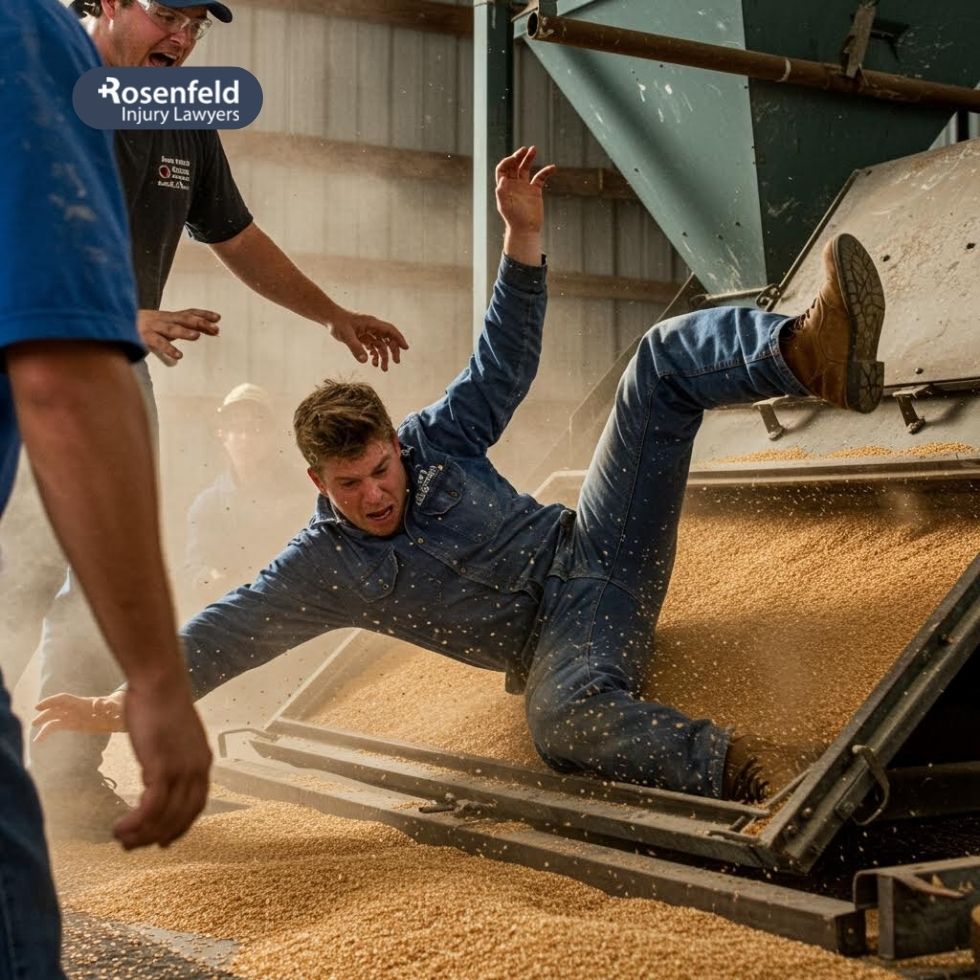
Grain bin entrapment happens when flowing or bridged grain traps a worker inside a storage bin, often within seconds. Liability in these cases typically comes down to one question: did the property owner or employer follow the required entry precautions under OSHA’s grain handling standard before someone went inside?
One of the most recognizable sights on a farm in Illinois is a grain bin (also called a grain silo). These towering structures store grain in massive quantities, and unfortunately, grain bin accidents can lead to serious injuries and even death, especially since rural fire departments may be too far away to provide successful rescue efforts for the trapped person.
If you get injured while entering or using a grain bin or grain truck, you could recover compensation for certain losses with a workers’ compensation claim or personal injury lawsuit.
IL Work Injury Lawyer is an experienced Illinois law firm that can provide legal guidance throughout the claims process. Our team understands the risks associated with grain production and storage, so we are well-equipped to investigate your case and secure fair compensation.
Issues with grain bins and other production processes typically occur on a farm. Here are some farming accident settlements we have won in the past for our Illinois clients:
Past results do not guarantee or predict similar outcomes in future cases. Every grain bin accident claim is evaluated on its own facts.
A top-rated injury firm can make all the difference in your case involving grain entrapment or other hazards. Our firm has a five-star rating from AVVO and an A+ grade from the Better Business Bureau.
Stored grain can present numerous safety concerns for farmers and their workers. Here are a few examples of when dangerous incidents occur:
This page focuses on grain entrapment and engulfment specifically. If your accident involved a sweep auger, unloading auger, or other machinery entanglement rather than being buried in flowing grain, see our page on grain auger injuries for case-specific guidance.
Grain bin accidents are common on farms. Many of these rural issues are preventable with caution and proper safety equipment. Here are some common causes of grain bin entrapments:
Two of these causes deserve special attention. Bridged grain forms when out-of-condition or crusted grain creates a hollow void beneath the surface; the crust looks solid but collapses the moment a worker’s weight lands on it. Walking down grain, where workers are told to stomp on crusted grain to break it loose, is expressly prohibited under OSHA’s grain handling standard. When an employer instructs a worker to do this, it can point to direct liability rather than a purely comparative-fault dispute.
Agricultural safety concerns associated with grain bins can lead to serious injuries to the human body. Let’s examine common injuries caused by these incidents:
Most incidents involving grain bins are not fatal; however, even mild injuries can have significant physical, emotional, and financial consequences.
Economic Damages
Non-Economic Damages
Punitive Damages
This additional compensation may be awarded in cases of gross negligence or intentional misconduct.
Over the years, several grain bin accidents have occurred in the United States. The average settlement for these claims is $27.11 million, with a range between $1.63 million and $181.14 million. Factors that affect these amounts include injury severity, liability, insurance coverage, and economic damages.
Every case is different, and these figures are just one starting point. For more examples of what other Illinois farm workers have recovered, you can take knowledge regarding farm accident settlements
In 2010, three men were working at a food facility when a grain elevator exploded, causing significant burn injuries to the victims. The three plaintiffs sued the company for negligent practices because they had been informed of an issue with the grain bin, but spent a long time seeking cheaper contractors to repair it. The plaintiffs, along with one of their wives, were awarded over $180 million in total damages for pain and suffering, disfigurement, medical costs, and other types of losses.
In 2020, Robbie, a farm maintenance worker, was assigned to clean out a grain bin on the property. He was not informed that the safety guard on one of the holes at the bottom of the bin had been removed, which led to the spinning sub-floor auger. When Robbie opened the door, his leg fell into the hole, and the spinning machinery amputated his foot. Later, his leg had to be amputated below the knee. He sued the farmers and owners for negligence and was awarded $2.5 million.
Past results do not guarantee or predict a similar outcome in any future case.
An experienced injury lawyer can make all the difference in the outcome of your claim. These cases are often very technical, involving OSHA regulations, confined space standards, and third-party liability. It is also challenging to preserve evidence, such as grain movement logs, ventilation records, and auger maintenance records.
Our team can overcome these challenges and handle cases in Cook County Circuit Court and rural jurisdictions statewide.
Since 2020, there have been 27 records of grain entrapment or other grain bin accidents in the US. Of these 27 incidents, 19 resulted in at least one death.
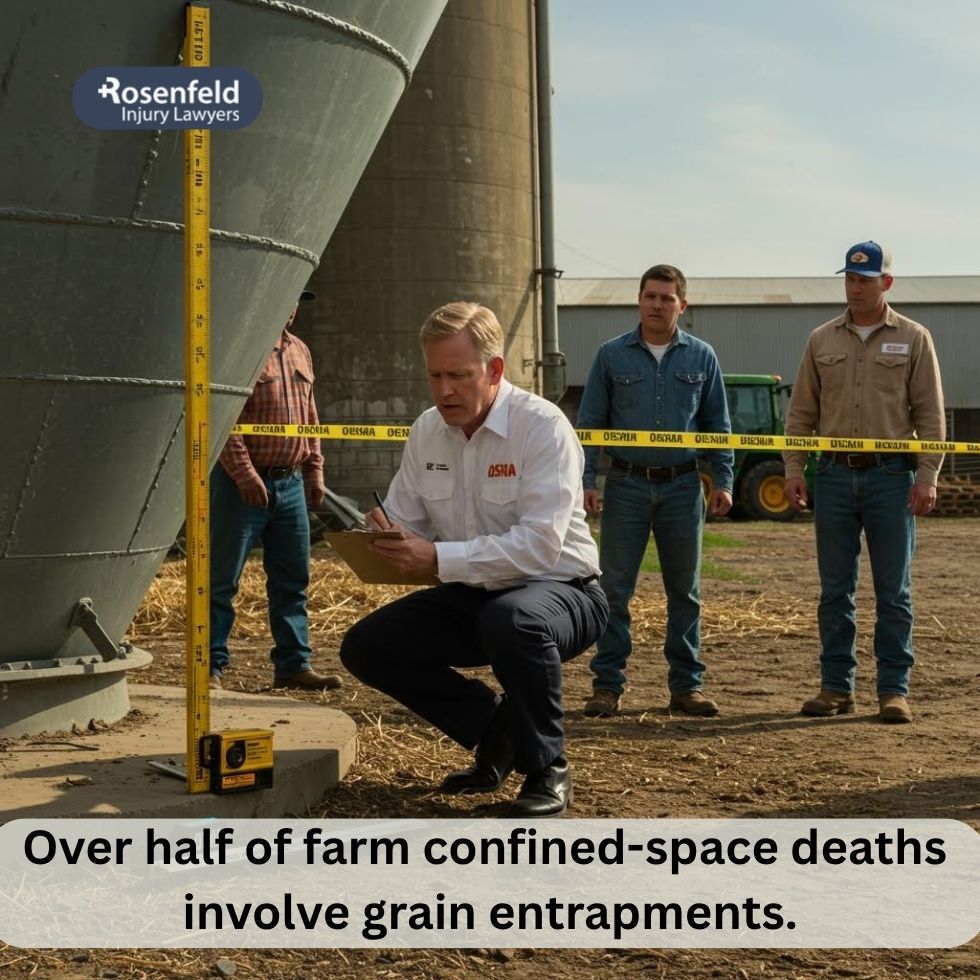
According to a 2024 Purdue University study, grain bin entrapments are also the leading cause of death in confined space injuries and fatalities on farms.
A person can sink knee-deep into flowing grain in seconds, and full grain engulfment can occur in under 20 seconds once the grain starts moving. Self-rescue becomes nearly impossible almost immediately: agricultural extension research has found that it can take well over 400 pounds of force to pull a person free once they are buried waist-deep, far more than a bystander or coworker can apply by hand. That is why bystanders who attempt a rescue without proper equipment are frequently injured or killed themselves. Because self-rescue is effectively impossible once entrapment begins, the entire burden shifts to prevention: functioning lockout/tagout systems, an observer stationed outside the bin, and a body harness and lifeline for anyone who enters. When those precautions are missing or ignored, the resulting entrapment is rarely an accident in the legal sense. It is the foreseeable result of skipped safety steps, which underpins the liability claims discussed later on this page.
In Illinois, grain bin entrapments and other issues are most likely to occur in the following locations:
Under 29 CFR 1910.272, OSHA’s grain handling standard, facilities are required to follow several specific safety duties before anyone enters a bin. Each one plays a direct role in building a liability case:
Each of these duties creates a paper trail: training logs, entry permits, and OSHA citations that our firm can use as evidence when a required precaution was skipped.
Not always. OSHA’s grain handling standard under 29 CFR 1910.272 was written primarily for commercial grain elevators, feed mills, and other large-scale grain handling facilities. Many on-farm storage bins fall outside OSHA’s direct jurisdiction under a longstanding exemption for small farming operations, which is a separate issue from whether the farm carries workers’ compensation coverage. This distinction matters because it often decides which safety duties can be proven to have applied, and therefore what breach can be established in your case.
It also connects to a related exemption. Under Illinois law, farms that use less than 400 days of labor per quarter are not required to carry workers’ compensation for farm workers. Where a farm has no workers’ comp coverage, the exclusive remedy bar that normally blocks a lawsuit against an employer may not apply, which can open the door to a direct negligence claim against the farm itself. Because these two exemptions interact, it takes a case-specific review to determine whether OSHA’s standard applied to your accident and what claim options are available as a result.
In Illinois, you have two years from the date of your injury to seek damages from the at-fault party under the statute of limitations (735 ILCS 5/13-202).
Whether OSHA’s grain handling standard applied to the facility, discussed above, can affect which of these parties can be held liable and under what legal theory.
If you sue an agriculture entity, they may hire lawyers to build a strong defense. Here are some common arguments defense attorneys may use:
Our firm will use training records, OSHA findings, and witness statements to overcome these defenses.
You must take the proper steps immediately after the entrapment occurs to build a strong claim:
An expert attorney from IL Work Injury Lawyer will increase your chances of a fair settlement. We provide the following services after agriculture injury accidents:
We work on a contingency fee basis, so you owe nothing unless we win.
Anyone who is hurt in a grain bin accident can file a claim if they are of age, including employees, bystanders, property owners, and farmers.
A person can become trapped in flowing grain within seconds, and full engulfment can happen in under half a minute once the grain starts moving. Because self-rescue is rarely possible once entrapment starts, most cases turn on whether required safety precautions, like lockout and an outside observer, were followed before entry.
Not always. OSHA’s grain handling standard mainly covers commercial elevators and large facilities, while many on-farm storage bins fall under a separate exemption. Whether the standard applied to your accident depends on the size and classification of the facility, which our firm can help determine.
Yes. OSHA prohibits walking down grain to break up a crust because it puts workers directly over a collapse hazard. If an employer or supervisor instructed this practice, it can support a strong claim for direct liability rather than a comparative-fault dispute.
Surviving family members may recover funeral and burial costs, lost future income, loss of companionship, and other damages through a wrongful death claim. The amount available depends on the victim’s earning potential, the number of dependents, and the degree of employer or third-party fault.
Whether your injury was caused by improper training, high moisture content, a lack of safety efforts, or unauthorized bin entry, our Chicago work injury lawyers can help you secure the compensation you deserve. We charge no upfront fees and offer a free consultation so you can ask questions about the legal process.
A farm accident lawyer from our firm can review your entrapment, engulfment, or auger-related case and explain every legal option available to you and your family.
Contact us today to schedule your free case evaluation. We offer a winning track record, a statewide reach, and a compassionate approach.
 Legally Reviewed By
Attorney Jonathan Rosenfeld
Content legally reviewed by Jonathan Rosenfeld The information on this page has been legally reviewed by Attorney Jonathan Rosenfeld, founder and managing partner of Rosenfeld Injury Lawyers LLC. With extensive experience representing injured workers across Illinois, Mr. Rosenfeld is dedicated to helping workplace accident victims pursue the maximum compensation available under the law. His extensive legal knowledge and commitment to client advocacy ensure that the information provided is accurate, reliable, and aligned with current legal standards.