
Experienced Attorneys
Committed to Protecting the
Rights of Injured Workers
Committed to Protecting the
Rights of Injured Workers



Workers’ compensation for farm workers can be challenging, as some agricultural workers are excluded from workers’ compensation laws in Illinois, even though it is one of the most dangerous industries. Workers comp for farm workers in Illinois may depend on whether the agricultural exemption applies to the farm and whether the worker is covered under the Illinois Workers’ Compensation Act. Our farming accident attorneys in Chicago fight to help injured farm workers understand their available compensation options. Contact us today for a free consultation.
Many agricultural workers in Illinois are covered by workers’ compensation, but certain agricultural enterprises are exempt. The Illinois Workers’ Compensation Act excludes an agricultural enterprise employing fewer than 400 working days of agricultural or aquacultural labor per quarter during the preceding calendar year. This agricultural exemption can affect whether farm workers compensation is available. See 820 ILCS 305/3.
While fourteen states require employers to carry workers’ compensation insurance for agricultural workers, Illinois is one of the twenty-one states that provide exceptions for some farm employers.
In Illinois, agricultural employers with fewer than 400 working days per quarter in a calendar year are not required to provide workers’ compensation insurance for employees (820 ILCS 305/3). This limited coverage disproportionally affects seasonal, part-time, and migrant employees. Fifteen states do not require coverage for any agricultural workers, no matter how they were injured.
| Farm situation | Workers’ comp? | Other route |
| Farm above the exemption threshold | Yes, if covered by the Act | A third-party claim may also exist |
| Exempt farm with no coverage | No workers’ comp coverage under the Act | A negligence lawsuit against the farm may be possible |
| Exempt farm that voluntarily purchased coverage | Yes, subject to the policy and applicable law | A third-party claim may also exist |
The exact agricultural exemption language in 820 ILCS 305/3 should be confirmed by counsel before publication.
Many agricultural employers are still required to provide workers’ comp for regular employees and their family members, while others have limited coverage or purchase workers’ compensation insurance despite not being required to by agricultural law.
Additionally, some farm employers will add farm liability insurance, which can also provide liability coverage for agricultural workers. Unlike workers’ compensation, liability insurance requires you to prove negligence.
Workers’ compensation benefits may include medical care and wage-loss benefits when the Illinois Workers’ Compensation Act applies. A separate negligence claim may provide different types of damages. For more information about potential farm accident settlements, see our related resource.
Workers’ compensation’s purpose is to cover medical expenses and a portion of lost wages. It is a no-fault system, meaning it does not matter who was responsible.
Agricultural business employers must provide this insurance coverage only if they had more than 400 working days per quarter in the previous year. If workers’ comp doesn’t apply to you, then you may file a third-party farm accident lawsuit.
If an agricultural enterprise is exempt from the Workers’ Compensation Act and does not carry voluntary coverage, the exclusive-remedy rule that generally applies to covered workers’ compensation claims may not bar a direct negligence claim against the farm. Whether a lawsuit is available depends on the farm’s status, the worker’s employment relationship, and the facts of the injury. A farm accident lawyer can evaluate those issues.
Personal injury lawsuits require that you demonstrate the other party was primarily responsible for the accident. Illinois uses modified comparative negligence (735 ILCS 5/2-1116), meaning that you can sue as long as you were not more than 50% responsible.
However, your compensation will be reduced by your percentage of blame. For example, if you were considered 25% liable for the accident, then you would receive 25% less than if you were entirely blameless. Our attorneys will ensure that blame is distributed fairly and you are not blamed for more than your fair share of the accident.
You may pursue a claim for a variety of negligent acts, including:
Injured workers can receive compensation for medical expenses, future medical treatment, full lost wages, pain and suffering, and emotional distress. In many cases, this offers more compensation than is possible through a workers’ compensation claim.
Migrant and seasonal agricultural workers may have protections under the Migrant and Seasonal Agricultural Worker Protection Act (MSPA), including requirements concerning wages, housing, transportation, disclosures, and recordkeeping. The MSPA also regulates farm labor contractors and provides protections against certain retaliation.
H-2A workers have additional protections under the federal H-2A temporary agricultural employment program. Employers must comply with applicable job-order and employment requirements, and federal law prohibits certain retaliation against H-2A workers and workers in corresponding employment who exercise protected rights.
An injured worker’s immigration status does not by itself determine whether the worker has rights under every applicable employment or injury law. Coverage and available remedies depend on the particular law and facts, so immigration status should not be assumed to eliminate a potential claim.
Farm labor contractors may also have legal responsibilities. Depending on the relationship and applicable law, a worker may have rights involving both the farm and the contractor. The Department of Labor recognizes that agricultural workers can have joint-employment relationships under the MSPA.
Workers should also document any retaliation after reporting an injury or asserting protected rights. Federal law provides anti-retaliation protections in specified circumstances under the MSPA and H-2A program.
For workers who believe pesticide exposure contributed to an injury, see our resource on pesticide exposure claims.
Being paid in cash or being called an independent contractor does not, by itself, determine whether you are legally an employee. The actual working relationship matters. Factors may include who controls the work, who provides equipment, how the work is performed, and the nature of the relationship between the worker and the farm or contractor.
If you were paid in cash, keep records showing your hours, payments, work location, job duties, and who directed your work. Preserve text messages, schedules, pay records, photographs, and other documents that may help establish the employment relationship. Misclassification can affect which legal protections and remedies are available.
A worker hired through a farm labor contractor may also have rights involving the contractor and agricultural employer under applicable federal law.
Even if you file with your employer’s insurance, you may still be able to pursue compensation from other parties, including:
Illinois allows you to pursue a case against multiple parties under the Joint Tortfeasor Contribution Act (740 ILCS 100/2). Each party will be assigned a portion of blame, and once a verdict has been entered, they will be required to pay their allotted portion of that farm accident settlement or verdict.
Workers injured by defective machinery may also have claims involving manufacturers or other responsible parties. See our resources on grain bin entrapment and hay baler and machinery injuries for related information.
1. Report the injury: Tell your employer about the work-related injury as soon as possible and no later than 45 days after the accident. Illinois law generally requires notice within that period. See 820 ILCS 305/6.
2. Get medical treatment: Tell the medical provider that the injury occurred at work and provide accurate information about when and how it happened. Keep records of your treatment and work restrictions.
3. Identify the legal employer: Determine whether you were employed directly by the farm, hired through a farm labor contractor, or potentially working for another employer.
4. File the claim within the applicable deadline: The Illinois Workers’ Compensation Commission handles workers’ compensation disputes and claims under the Illinois Workers’ Compensation Act. Section 6 contains important notice requirements, while other statutory provisions address filing deadlines.
5. If the employer disputes your status or says the farm is exempt, do not assume you have no legal options. The exemption under 820 ILCS 305/3 and the facts of the employment relationship should be reviewed before deciding whether workers’ compensation or another claim applies.
Our attorneys will guide you through every aspect of your case, including:
We serve clients throughout Illinois, from small hobby operations near metropolitan Chicago to large agriculture operations in southern Illinois.
With our services, you can be assured of affordable and high-quality legal representation attuned to the unique needs of agricultural workers. We also understand the challenges that part-time, seasonal, and migrant workers face after being injured and will ensure that you are treated fairly by the court system.
Content reviewed by Chicago work accident lawyer Jonathan Rosenfeld.
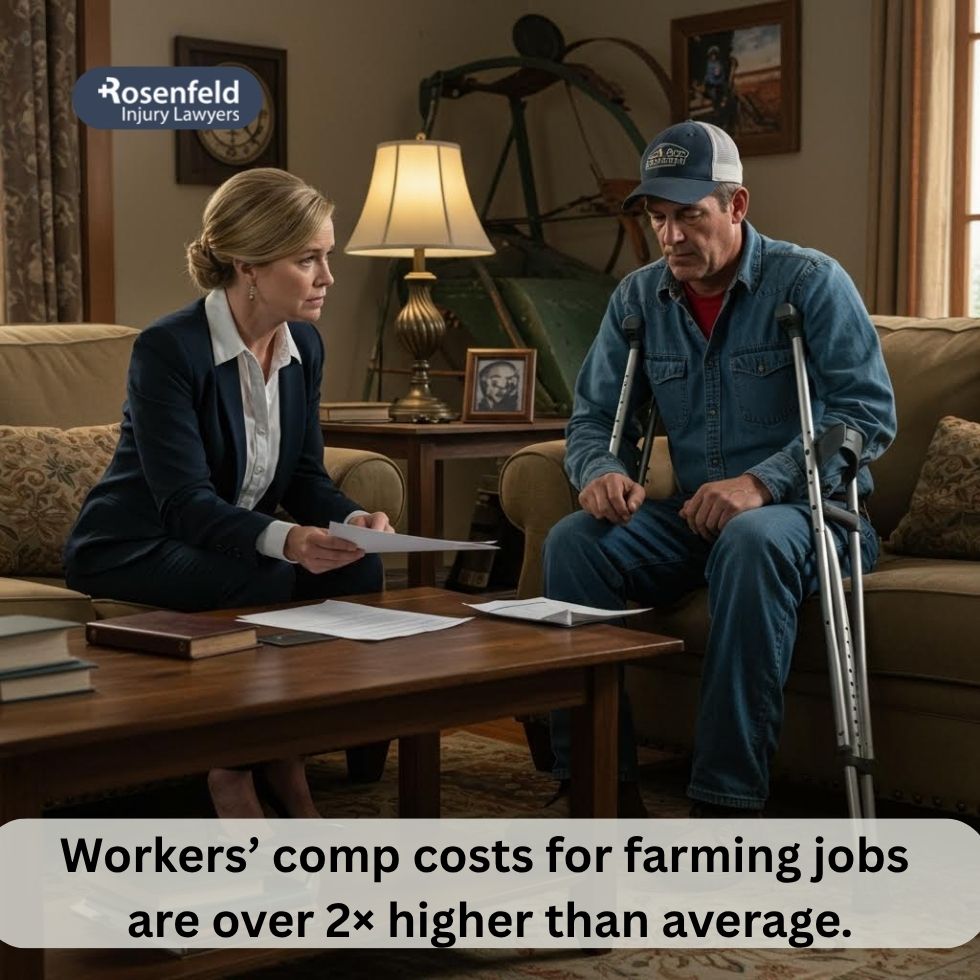
Some farm workers are covered, but not every agricultural enterprise is subject to the Illinois Workers’ Compensation Act. The agricultural exemption in 820 ILCS 305/3 applies to certain farms based on the amount of agricultural labor performed. The specific facts of the farm and employment relationship should be reviewed to determine whether coverage applies.
If a farm has no workers’ compensation insurance, the first question is whether the farm is legally required to carry coverage. An exempt agricultural enterprise may not be subject to the Act. If the farm should have provided coverage, other remedies may be available, depending on the circumstances.
Immigration status does not automatically answer whether an injured agricultural worker has a potential legal claim. Different federal and state laws have different coverage rules. Workers should not assume that being undocumented eliminates every possible remedy, but the specific employment and injury circumstances should be reviewed by an attorney.
You may still have legal rights if you were paid in cash. Cash payment alone does not determine whether someone is an employee. Keep records of your hours, payments, work duties, supervisors, and communications. Those records can help determine the actual employment relationship and whether workers’ compensation or another claim may apply.
An employer may not retaliate against a worker in circumstances protected by applicable law. Federal protections under the MSPA and H-2A program prohibit certain retaliation for exercising protected rights. Other employment laws may also apply. Document threats, termination, reduced hours, or other adverse actions after reporting an injury.
H-2A workers have legal protections relating to their temporary agricultural employment, and they may have potential injury claims depending on the applicable state and federal laws and the facts. H-2A status does not mean a worker should automatically assume an injury cannot be pursued.
Workers comp for farm workers in Illinois can depend on the agricultural exemption, the worker’s employment status, and the circumstances of the injury.
You must act quickly if you’ve been hurt while performing agricultural work. A personal injury lawsuit has a statute of limitations of just two years (735 ILCS 5/13-202). Additionally, you can only file for workers’ compensation within three years of the accident or two years after your last payment from the employer, whichever is later (820 ILCS 305/6).
Our work accident attorneys in Chicago are passionate about helping agricultural workers obtain fair compensation after a work-related accident. We work on a contingency fee basis, meaning you owe us nothing unless we win your case. We do not use success-rate or “best firm” claims in this page copy.
Contact us today to schedule a free, no-obligation legal consultation with a Chicago work injury attorney.
 Legally Reviewed By
Attorney Jonathan Rosenfeld
Content legally reviewed by Jonathan Rosenfeld The information on this page has been legally reviewed by Attorney Jonathan Rosenfeld, founder and managing partner of Rosenfeld Injury Lawyers LLC. With extensive experience representing injured workers across Illinois, Mr. Rosenfeld is dedicated to helping workplace accident victims pursue the maximum compensation available under the law. His extensive legal knowledge and commitment to client advocacy ensure that the information provided is accurate, reliable, and aligned with current legal standards.