
Experienced Attorneys
Committed to Protecting the
Rights of Injured Workers
Committed to Protecting the
Rights of Injured Workers



Reviewed by Jonathan Rosenfeld, Illinois work injury attorney
At IL Work Injury Lawyer, we represent construction workers injured in slip and fall accidents. Our Chicago construction slip and fall lawyer can help you understand your legal options after a fall caused by hazardous conditions on a job site.
Whether you were hurt on a large commercial project or a small residential build, we know how to handle the legal process and fight for fair compensation in both workers’ compensation claims and personal injury lawsuits.
Workers’ compensation and third-party claims are different. Workers’ compensation generally covers eligible medical care and wage benefits without requiring proof of fault. A claim against a negligent contractor or property owner may allow recovery for additional losses, including pain and suffering.
Past results depend on the facts of each case and do not guarantee a similar outcome.
We are recognized among the top-rated Chicago construction injury lawyers for our results in slip and fall cases, including construction site accidents. Our team has earned honors from Super Lawyers, Best Lawyers in America, and maintains excellent client ratings on Avvo.
Our team investigates the circumstances of each fall, gathers available evidence, identifies potentially responsible parties and evaluates the available workers’ compensation and third-party claims.
We work to protect injured workers’ interests while pursuing compensation supported by the facts and applicable law.
Our approach may include reviewing site photographs, incident reports, witness statements, safety records and the responsibilities of contractors working at the site.
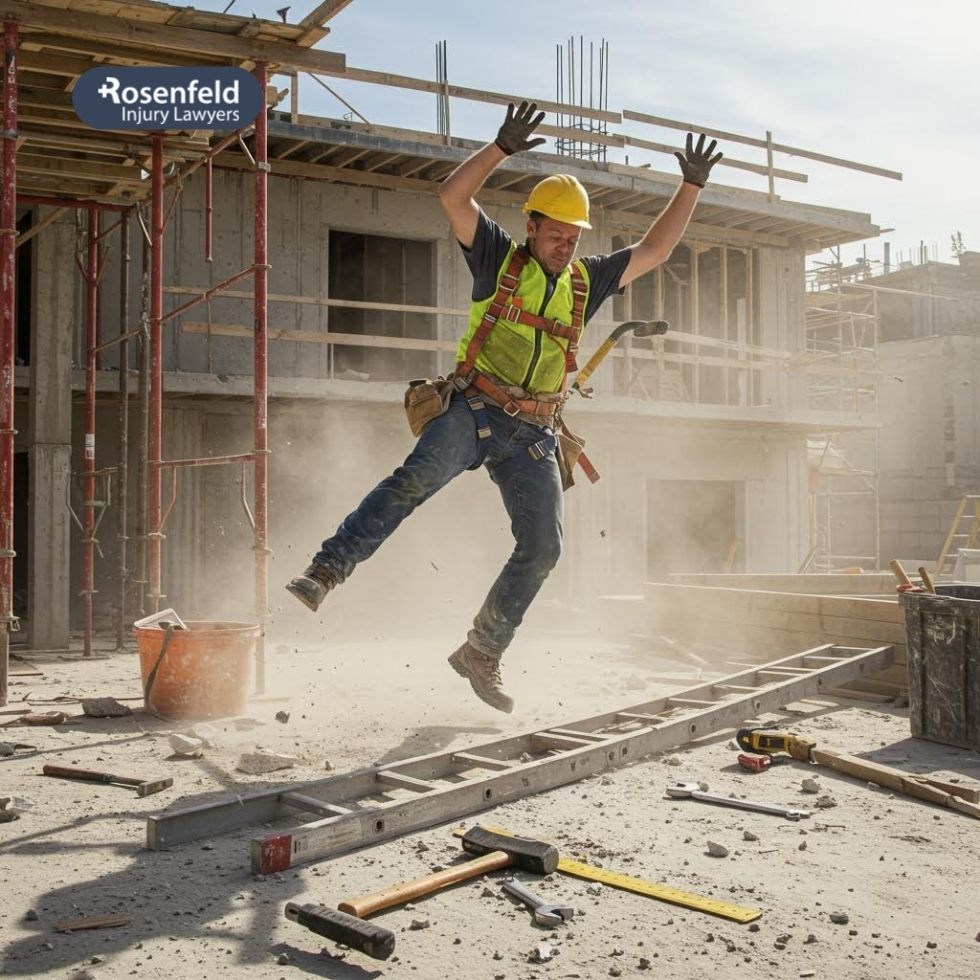
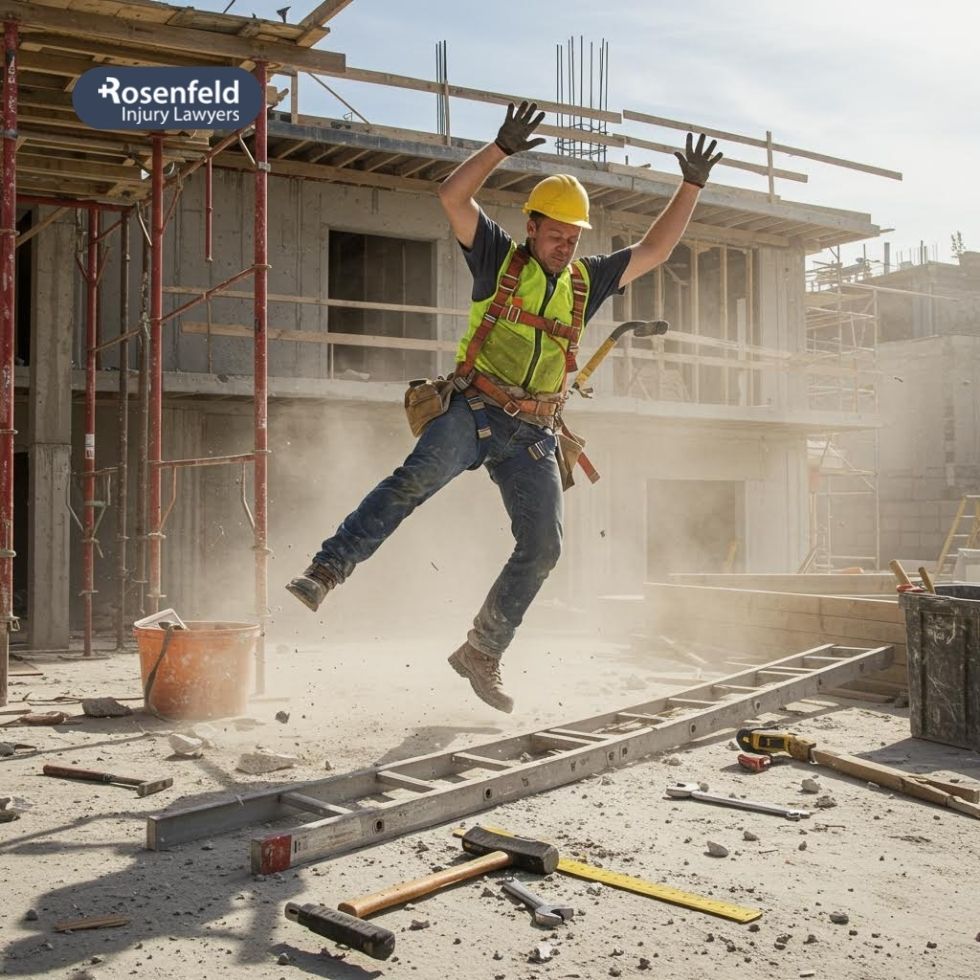
A construction site slip and fall can happen when workers encounter wet surfaces, loose materials, unsafe walkways or other hazards that have not been properly addressed.
| Hazard | What it can look like | Relevant safety rule |
| Debris and clutter | Scrap lumber, nails, tools, cords or building materials left in walkways | OSHA construction housekeeping standard, 29 CFR 1926.25(a) |
| Wet or slippery surfaces | Rain, snow, mud, spills, wet paint or fresh concrete | 29 CFR 1926.1052(a)(7) addresses slippery stair surfaces; other hazards depend on the circumstances |
| Uneven surfaces | Unfinished flooring, loose materials, uneven pavement or changes in walking level | Applicable safety requirements depend on the specific condition |
| Unsafe stairs | Incomplete stairs, inconsistent steps or missing required handrails | 29 CFR 1926.1052 |
| Poor lighting or blocked routes | Dark stairwells, obstructed passageways or blocked exits | Applicable requirements may include 29 CFR 1926.34 |
| Unprotected floor openings | Uncovered holes, loose covers or temporary flooring that shifts under a worker | 29 CFR 1926.501(b)(4) and 1926.502(i) |
| Weather-related hazards | Ice, snow, standing water or mud tracked into work areas | The applicable duty depends on the location and circumstances |
When unsafe work-zone conditions cause a fall, a construction zone injury attorney may investigate which company created the hazard, who controlled the area and whether reasonable safety measures were taken.
OSHA requires construction floor openings to be protected as applicable with covers or guardrails. When a worker fell through a temporary floor or stepped into an uncovered hole, the circumstances may support a claim against a contractor or another company responsible for the opening.
Under 29 CFR 1926.500(b), a hole is a gap or void at least 2 inches across in its smallest dimension. OSHA addresses fall protection around holes under 29 CFR 1926.501(b)(4), including protection against tripping or stepping into holes and additional protection for holes more than 6 feet above a lower level.
Under 29 CFR 1926.502(i), hole covers must support at least twice the maximum intended load, be secured against displacement, and be marked with “HOLE” or “COVER” or be color-coded.
A cover made from unsecured plywood or planks can shift or break under a worker’s weight. Another trade may remove a cover and fail to replace it, leaving an opening exposed. Responsibility depends on the evidence, including who created or removed the cover and who controlled the work area.
Photos of the opening, cover, warning markings and surrounding work area may help establish what happened. These falls can cause serious injuries, including fractures of the hip or pelvis and back or spinal injuries. For falls through skylights, see our page on skylight falls.
Falls from height involve different hazards and safety requirements. OSHA’s construction fall-protection rules under 29 CFR Part 1926, Subpart M generally address fall hazards at 6 feet or more, subject to the applicable work and equipment requirements.
Learn more about Chicago ladder accident lawyer services, roof fall injuries, scaffolding falls and scissor lift falls. You can also read about OSHA’s Fatal Four. If falling debris caused the incident rather than a slip or trip, see our page on struck-by falling debris.
Construction falls can cause injuries ranging from painful sprains to permanent disabilities. Common injuries include:
Some injuries become more apparent hours or days after a fall. Prompt medical evaluation can help identify the injury and document its connection to the accident.
The compensation available after a construction fall depends on whether you pursue workers’ compensation, a third-party personal injury claim or both.
| Workers’ compensation benefits | Potential third-party damages |
| Reasonable and necessary medical care covered under the law | Medical expenses and other losses recoverable under applicable law |
| Temporary total disability benefits, generally calculated at two-thirds of average weekly wage subject to statutory rules | Lost wages and reduced future earning capacity |
| Permanent disability benefits where applicable | Pain and suffering |
| Vocational rehabilitation where applicable | Disability and disfigurement |
| Other benefits available under Illinois workers’ compensation law | Loss of a normal life and, in qualifying cases, wrongful-death damages |
Workers’ compensation generally does not pay pain and suffering. Those damages may be available through a successful third-party lawsuit, but they must be supported by the facts and applicable law.
The value of a claim depends on the severity of the injury, medical evidence, time away from work, lasting limitations, available insurance and the evidence of liability. Read more about construction workers’ compensation and construction accident settlements in Illinois.
The U.S. Bureau of Labor Statistics reported 370 fatal injuries from falls, slips and trips among construction and extraction workers in 2024, out of 1,032 fatal injuries in those occupations.
These are national figures for construction and extraction occupations, not figures limited to Chicago. Fatal falls often involve a fall to a lower level, while same-level slips and trips also cause nonfatal workplace injuries. See our construction accident statistics page for more information.
Several laws may apply to a construction fall, depending on the location, hazard and parties involved.
The Illinois Workers’ Compensation Act generally provides benefits for qualifying work-related injuries without requiring an injured worker to prove employer negligence. It also generally makes workers’ compensation the exclusive remedy against the employer, subject to limited exceptions.
The Illinois Premises Liability Act, 740 ILCS 130/2, addresses duties owed by property owners and occupiers to people lawfully on the premises. A subcontractor’s employee may have a claim against a property owner when the legal requirements are met, even though the employee generally cannot bring an ordinary negligence claim against their own employer.
OSHA construction standards may also help identify the safety requirements relevant to a fall. Whether a particular violation establishes civil liability depends on the facts and applicable law.
Suing for slip and fall at work in Illinois generally means bringing a claim against a negligent third party rather than your own employer. Depending on the circumstances, a worker may have a claim against a general contractor, another subcontractor, a property owner or another responsible company.
Workers’ compensation is generally a no-fault system for eligible workplace injuries. A third-party lawsuit is different: the worker must establish the defendant’s legal duty, breach, causation and damages.
A general contractor is not automatically liable just because it oversees a project. Under Carney v. Union Pacific R.R. Co., 2016 IL 118984, general oversight alone is insufficient to establish liability based on retained control. The evidence must support the required degree of control over the work or safety condition involved.
A property owner may also owe a duty of reasonable care under the Illinois Premises Liability Act, depending on the circumstances. Evidence about the hazard, inspection and repair practices, site responsibilities and control of the area can be important.
If an injured worker receives workers’ compensation and later recovers from a third party, the compensation insurer may assert a lien under 820 ILCS 305/5(b). Statutory adjustments for attorney fees and costs may apply. Employer contribution issues may also arise under Kotecki v. Cyclops Welding Corp., 146 Ill. 2d 155 (1991).
A slip and fall at work lawyer can assess whether you have a third-party claim in addition to workers’ compensation. Learn more about a construction accident lawsuit.
Depending on the facts, potentially responsible parties may include:
The fact that a company worked on the same project does not by itself establish liability. The evidence must connect that company’s conduct or legal responsibility to the hazard and resulting injury.
| Claim type | General deadline |
| Third-party personal injury lawsuit | Generally 2 years from the injury under 735 ILCS 5/13-202, subject to exceptions |
| Wrongful-death action | Generally 2 years from the date of death under 740 ILCS 180/2, subject to exceptions |
| Workers’ compensation notice | Generally within 45 days under 820 ILCS 305/6(c), subject to exceptions |
| Workers’ compensation claim | Generally 3 years from injury or 2 years after the last compensation payment, whichever is later, under 820 ILCS 305/6(d) |
These are general rules; special circumstances can change the deadline. For more information, see Illinois workers’ comp statute of limitations.
Report the accident in writing as soon as possible. Illinois workers’ compensation law generally requires notice within 45 days, subject to exceptions.
You generally cannot sue your own employer for negligence when workers’ compensation applies. However, you may have a claim against a negligent general contractor, subcontractor, property owner or other third party. Liability depends on the facts, including who controlled the hazard and whether that party’s conduct caused the fall.
Workers’ compensation generally covers eligible work-related injuries without requiring you to prove that someone else was at fault. Benefits and eligibility depend on the circumstances and Illinois law. A separate third-party lawsuit has different requirements and may be affected by comparative fault.
Responsibility may fall on a contractor that created the opening, removed its cover or controlled the work area, depending on the evidence. OSHA’s construction rules address protection around holes under 29 CFR 1926.501(b)(4) and cover requirements under 29 CFR 1926.502(i).
A third-party personal injury lawsuit generally has a two-year deadline. Workers’ compensation has separate notice and filing rules, including a general 45-day notice requirement and a claim deadline of three years from the injury or two years after the last compensation payment, whichever is later. Exceptions may apply.
The workers’ compensation insurer may have a lien against a third-party recovery under 820 ILCS 305/5(b). Statutory adjustments for attorney fees and costs may apply. The amount owed depends on the settlement or judgment and the circumstances.
If you were hurt in a construction site fall, a Chicago construction slip and fall lawyer can review the circumstances, explain your options and help determine whether workers’ compensation, a third-party claim or both may be available.
IL Work Injury Lawyer offers a free consultation to discuss your accident and potential claim. If you have questions about your legal options, contact our team to discuss the next steps.
Learn more about working with a Chicago construction accident lawyer.
Attorney fees and case costs should be explained during your consultation, including the terms that would apply if the firm accepts your case.
 Legally Reviewed By
Attorney Jonathan Rosenfeld
Content legally reviewed by Jonathan Rosenfeld The information on this page has been legally reviewed by Attorney Jonathan Rosenfeld, founder and managing partner of Rosenfeld Injury Lawyers LLC. With extensive experience representing injured workers across Illinois, Mr. Rosenfeld is dedicated to helping workplace accident victims pursue the maximum compensation available under the law. His extensive legal knowledge and commitment to client advocacy ensure that the information provided is accurate, reliable, and aligned with current legal standards.