
Experienced Attorneys
Committed to Protecting the
Rights of Injured Workers
Committed to Protecting the
Rights of Injured Workers



Last updated: September 24, 2026
Reviewed by Attorney Jonathan Rosenfeld
Most serious injuries in a hay baler accident happen when a worker is caught in the machine while clearing a jam, or when clothing is caught by an unguarded PTO shaft. Liability may rest with the farm employer, the equipment manufacturer, or both. A hay baler accident lawyer at our firm can identify every party responsible for your injuries.
Hay balers are large machines that play a crucial role on Illinois farms to create bales of hay. However, when they are operating or being pulled by a tractor to make bales, they can be extremely hazardous for various reasons, such as untrained operators, entanglement in faulty components with no guard, or poor driving techniques. Hay baler accidents can cause serious injuries to operators or bystanders.
Our Chicago farm injury attorneys know what it takes to pursue legal action against the at-fault party in a hay baler-related incident. Whether you are considering a workers’ compensation claim or a personal injury lawsuit, our team will help you recover compensation.
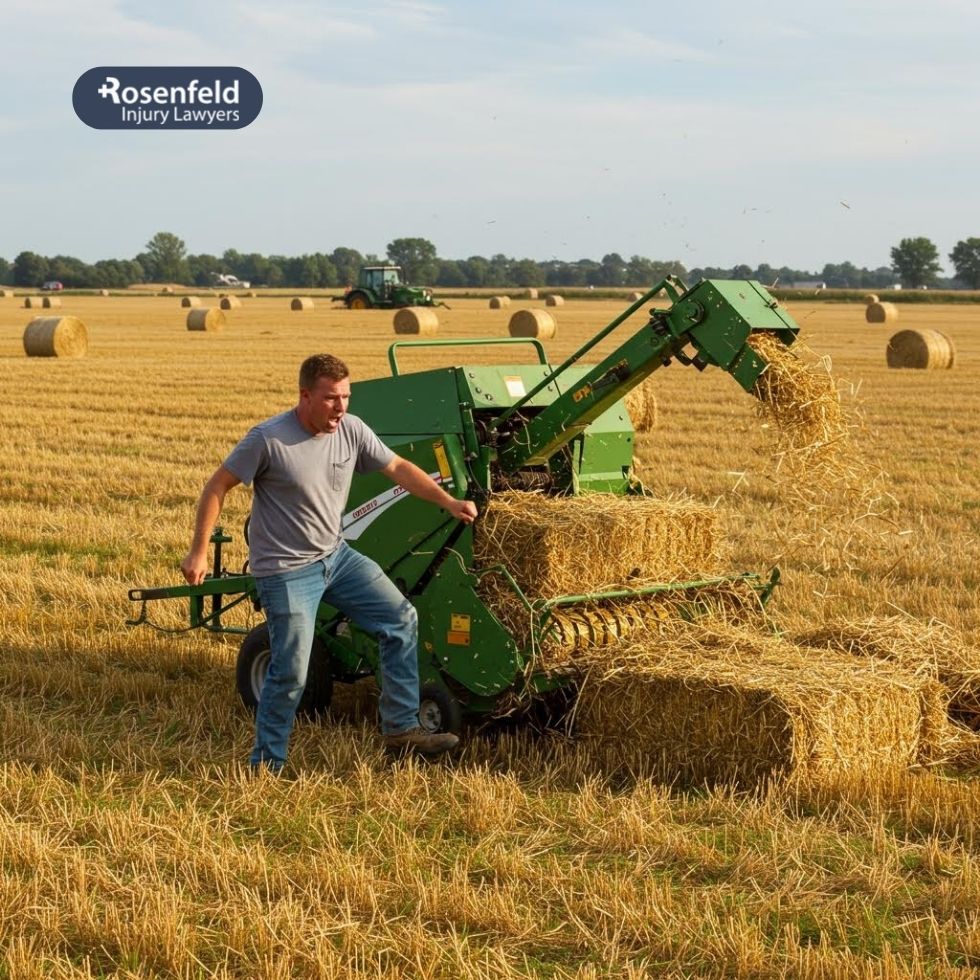
When you seek compensation for injuries caused by farm equipment, you need a law firm with experience in this industry.
Disclaimer: Some of the settlements and verdicts posted on the firm’s website may have been realized by the firm using a co-counsel relationship with other attorneys and law firms. Past results are not an indication of future performance.
Our firm is uniquely positioned to help you navigate a complex hay baler accident claim. Our attorneys are recognized among the top 5% of legal professionals by Super Lawyers, and we maintain an A+ rating from the Better Business Bureau.
Several issues can cause farming accidents involving hay balers:
Injuries also differ by type of baler. A round baler accident often involves entanglement in the belts and rollers that form the bale, or an injury while net wrap is being fed into the chamber. A square baler carries different risks. Its plunger compresses the hay with great force, and its knotter ties each bale, so plunger and knotter injuries often happen when a worker reaches in to fix a missed tie. Knowing which machine was involved helps show how the hay baler accident happened and who is responsible for it.
The most common serious baler injury happens when a worker reaches into the pickup or feed area to clear a jam while the machine is still running. Hay wraps around a roller, the feed stops moving, and pulling the clump free by hand seems like the fastest fix. That moment is where most baler entanglement begins.
The pickup and feed rollers pull crop material into the machine faster than a person can react. Once a glove, sleeve, or hand is caught, the rollers keep pulling. There is rarely time to let go or reach a shutoff, and the result is often a crushed or amputated hand or arm.
Balers must be shut off and locked out before anyone clears a jam. That means disengaging the power take-off, stopping the tractor engine, removing the key, and waiting for every moving part to stop. As noted in the list above, bypassed safety interlocks or lockout/tagout failures are among the causes of these accidents.
Under OSHA 29 CFR 1928.57, farm employers must instruct workers to stop the engine and wait for all machine movement to stop before unclogging equipment. If an employer pushed workers to keep the baler running to save time, or never trained them to shut it down first, that points to employer fault rather than simple operator error.
The power take-off (PTO) shaft transfers power from the tractor to the baler. It spins the entire time the baler runs, and PTO entanglement can happen in a fraction of a second. A loose sleeve, a jacket cord, or long hair touches the PTO shaft and is wrapped around it before the worker can pull away.
PTO shields exist to prevent this contact. In practice, shields are often removed for repairs or after damage and never replaced. A missing shield can turn a routine task into a catastrophic farm equipment accident. The same danger is not limited to balers. Many augers are also PTO-driven, and exposed shafts play a role in some grain auger injuries.
OSHA 29 CFR 1928.57 requires guarding on farm equipment. In plain terms, the PTO shaft and other moving parts that transmit power must be covered by shields or guards, so workers cannot come into contact with them during normal operation.
If an employer knew a shield was missing and kept the baler in service, that is strong evidence of fault. If the factory shielding was inadequate or easy to defeat, a product liability claim against the manufacturer may also be possible.
If you are injured in a hay baler accident, the consequences could be severe. Common farm accident injuries include:
A hay baler amputation is among the most serious of these outcomes, and it often ends a worker’s ability to return to farm work. Our firm also represents workers who have suffered other amputation injuries caused by machinery and cutting equipment.
The two primary categories of losses are economic and non-economic losses:
These may be awarded in hay baler accidents caused by gross negligence, intentional misconduct, or violations of the Occupational Safety and Health Administration (OSHA) regulations.
Hay baler accidents can lead to significant settlements, particularly when victims suffer serious or permanent injuries. The average settlement for farm accident cases involving hay balers range from $118,600 to $10.2 million, with an average of $2.56 million.
Several factors affect what a hay baler claim is worth:
Although hay baler accidents are rare, they can result in substantial settlements. The average settlement for farm accident cases involving hay balers is $2.56 million. Settlements range from $118,600 to $10.2 million. Factors that can influence your claim include the severity of the injury, liability, insurance coverage, and legal damages.
Accident type: Hay baler belt entanglement resulting in a hay baler amputation (product liability claim against the manufacturer).
In 1995, Harry was using a large baler when he noticed a strange squealing noise when it was powered up. Harry pulled himself up to inspect the top of the hay baler when the exposed belts on the machine pulled his left arm into the machinery and severed it at the elbow after it was trapped briefly. He sued the hay baler manufacturers for failing to design a guard for exposed machinery. Harry was awarded $10.2 million.
Accident type: Hay baler entanglement resulting in the amputation of both arms (product liability claim against the manufacturer).
In 1998, James was using an older hay baler on his farm. He suffered amputations in both of his arms when they got caught in the machine. He sued the manufacturer for a defective product, while the manufacturer claimed James was misusing the machinery. The case was settled pre-trial for $2.45 million.
Disclaimer: Some of the settlements and verdicts posted on the firm’s website may have been realized by the firm using a co-counsel relationship with other attorneys and law firms. Past results are not an indication of future performance.
Whether your arms became entangled in exposed components or someone else was misusing the machine, a hay baler accident case can be complex. IL Work Injury Lawyer can guide you through the legal process to overcome various challenges, such as:
Because a baler injury often involves several claims at once, it helps to work with a farm accident lawyer who understands how workers’ compensation, product liability, and third-party lawsuits fit together. As your baler accident lawyer, we coordinate each claim so that one does not weaken another.
Since 2020, there have been 32 reported injuries resulting from hay baler accidents (Source: OSHA Accident Investigation Search, January 2020 to July 2026). Farming injury statistics reveal that 12 of these cases resulted in a death (Source: OSHA Accident Investigation Search, January 2020 to July 2026).
Though moving parts in hay balers can cause devastating injuries, there are only a few locations where hay baler accidents are likely to occur:
Under the Workers’ Compensation Act (820 ILCS 305), a person can seek benefits if they get injured on the job due to hay baler accidents. However, agricultural employers with fewer than 400 working days per quarter in a calendar year are not required to provide workers’ compensation insurance for employees.
Multiple state laws can impact a farm accident personal injury lawsuit. The Wrongful Death Act (740 ILCS 180/) allows surviving family members to seek compensation if their loved one dies due to someone else’s negligence.
Under product liability laws (735 ILCS 5/2-21), companies that manufacture or sell dangerous products can be held liable for legal damages. Property owners must take reasonable steps to maintain safe premises for lawful guests (740 ILCS 130/).
Lastly, violating OSHA standards, such as those found in 1928.57(d)(2)(iii), can make various parties liable for hay baler accidents that cause injuries.
If you have been injured in a hay baler accident as an operator or bystander, you have two years from the date of the incident to pursue damages from the at-fault party (735 ILCS 5/13-202).
Liability plays a key role in the outcome of compensation claims in Illinois. Here are some entities that may be responsible for the hazards that caused your accident:
If the at-fault party hires legal counsel, these lawyers will use tactics to undermine your claim and reduce the payout. Some common defenses include:
We can counter these defenses with expert testimony, witness statements, and OSHA records.
IL Work Injury Lawyer will provide essential legal services, including:
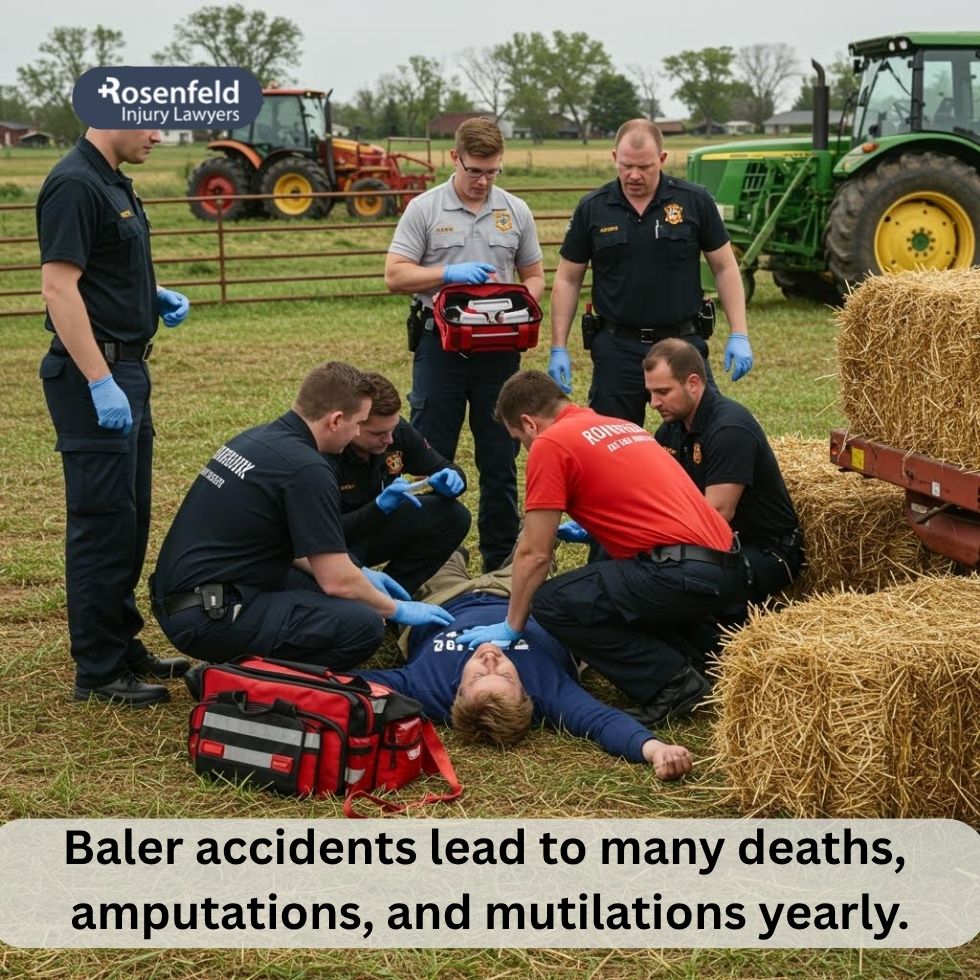
We work on a contingency fee basis, so you owe nothing unless we win.
Farm workers, bystanders, and surviving family members can file hay baler accident claims, depending on the circumstances of the case.
Most hay baler injuries happen when a worker reaches into the pickup or feed area to clear a jam while the machine is still running, or when clothing is caught by an unguarded PTO shaft. Missing shields, skipped lockout/tagout steps, and poor training are frequent contributing factors.
Yes. A missing PTO shield is strong evidence of fault. It can support a claim against the farm, especially where the farm is not covered by workers’ compensation, and a product liability claim against the manufacturer if the factory shielding was inadequate. Photograph the missing shield before anyone replaces it.
Often, yes. Illinois workers’ compensation covers many farm workers hurt by balers, but under the agricultural exemption, agricultural employers with fewer than 400 working days per quarter in a calendar year are not required to provide coverage. Our guide to workers’ compensation for farm workers explains this rule. Without coverage, a lawsuit may be available.
Our Chicago work injury law firm is prepared to guide you through the claims process and secure compensation, whether you are suffering from lacerations, amputations, crush injuries, or other consequences. You pay nothing unless we win, and our 98% success rate speaks for itself.
You can also take advantage of a free consultation to ask questions about the legal process and your hay baler accident. Contact us today to schedule your free case evaluation.
 Legally Reviewed By
Attorney Jonathan Rosenfeld
Content legally reviewed by Jonathan Rosenfeld The information on this page has been legally reviewed by Attorney Jonathan Rosenfeld, founder and managing partner of Rosenfeld Injury Lawyers LLC. With extensive experience representing injured workers across Illinois, Mr. Rosenfeld is dedicated to helping workplace accident victims pursue the maximum compensation available under the law. His extensive legal knowledge and commitment to client advocacy ensure that the information provided is accurate, reliable, and aligned with current legal standards.