
Experienced Attorneys
Committed to Protecting the
Rights of Injured Workers
Committed to Protecting the
Rights of Injured Workers



If you injured your back, shoulder or another part of your body while lifting at a rail yard, station or maintenance site, a railroad lifting injury lawyer can help you understand your rights under the Federal Employers’ Liability Act (FELA).
Railroad workers, including carmen, track workers, conductors, brakemen and machinists, may suffer injuries from one heavy lift or years of repetitive work. Unlike workers’ compensation, FELA requires proof that the railroad’s negligence played a part in causing the injury. The railroad does not have to be primarily at fault.
Our railroad lifting injury lawyers offer free consultations to discuss your injury, the work involved and your legal options.
Reviewed by Jonathan Rosenfeld, Illinois work injury attorney
Publish these results only after confirming that they are the firm’s own cases and that the facts and amounts are accurate.
$1,900,000: Trenton, a railroad worker servicing Ogilvie Center Metra trains, suffered back injuries due to lifting heavy loads. We recovered compensation based on the railroad company’s failure to offer him proper safety equipment.
$945,670: Susan developed a shoulder injury from overuse at the LaSalle Street Station. Our experienced attorneys proved that the company doctor did not provide adequate medical treatment, resulting in diminished earning capacity.
Prior results do not guarantee a similar outcome. Each case is different.
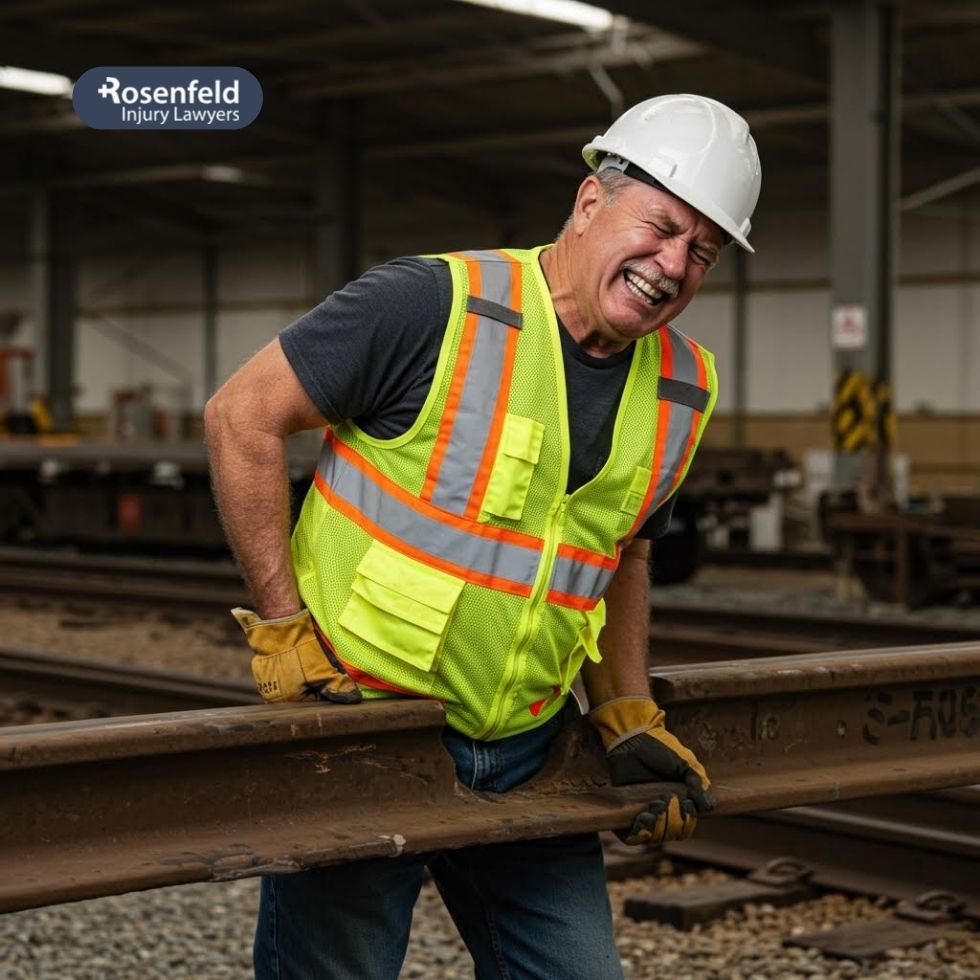
A heavy lifting injury lawyer may handle claims involving strenuous tasks that railroad employees perform during routine operations, repairs and track maintenance.
| Railroad craft | Typical lifting tasks | Potential injuries |
| Carmen | Coupler knuckles, brake shoes and air hoses | Back and shoulder injuries |
| Track and maintenance-of-way workers | Ties, tie plates, spikes, rail anchors and ballast | Strains, hernias and back injuries |
| Conductors and brakemen | Replacing knuckles, aligning drawbars and handling hand brakes | Back, arm and shoulder injuries |
| Machinists and shop workers | Locomotive parts and tools | Tendon injuries and strains |
A standard railroad coupler knuckle weighs about 80 pounds. The appropriate equipment, crew size and working conditions can therefore matter when assessing whether a lift was reasonably safe.
Chicago-area railroad work takes place at facilities including Proviso Yard, Cicero Yard and Metra yards. Learn more about railyard accidents.
A lifting injury may support a FELA claim when railroad negligence contributes to unsafe work conditions. Potential problems include:
The NIOSH Revised Lifting Equation uses 51 pounds as its starting load constant under ideal conditions. The recommended limit decreases with factors such as twisting, reaching and repeated lifting. This is an ergonomics benchmark, not a legal weight limit.
Common lifting-related injuries include:
A railroad back injury lawyer can assess whether railroad negligence contributed to the condition. A railroad worker back injury may qualify even if the worker had a preexisting medical problem.
Repeated lifting may contribute to disc damage, chronic back pain and shoulder conditions over time. These cumulative injuries may qualify under FELA when railroad negligence played a part in causing the condition.
Under Urie v. Thompson, 337 U.S. 163 (1949), the discovery rule can affect when the three-year filing period begins. The relevant date generally depends on when the worker knew or reasonably should have known about the injury and its connection to railroad work.
Learn more about cumulative trauma and repetitive strain injuries.
You may sue your railroad employer under FELA, 45 U.S.C. §§ 51–60, if its negligence played any part, even the slightest, in causing your injury. You must establish the required connection between the railroad’s negligence and your injury, but you do not have to prove that the railroad was mostly at fault.
| Rule | Meaning for a lifting injury | Source |
| Safe workplace | The railroad must exercise reasonable care to provide a reasonably safe workplace, including suitable staffing and equipment. | 45 U.S.C. § 51 |
| Causation | Railroad negligence need only play a part in causing the injury under FELA’s standard. | Rogers v. Missouri Pacific R.R. Co. (1957); CSX Transportation v. McBride (2011) |
| Comparative fault | The worker’s negligence may reduce damages but does not automatically bar recovery. | 45 U.S.C. § 53 |
| Assumption of risk | “Lifting is part of the job” is not, by itself, a defence under FELA. | 45 U.S.C. § 54 |
| Contracts limiting liability | Agreements that attempt to exempt a railroad from FELA liability are generally void. | 45 U.S.C. § 55 |
| Federal safety statutes | Qualifying Safety Appliance Act or Locomotive Inspection Act violations can create liability without separate proof of negligence. | 49 U.S.C. §§ 20302, 20701; 45 U.S.C. § 53 |
A defective coupler or hand brake that forces a worker into an unsafe lift may raise issues under federal railroad safety laws. However, adjusting a misaligned drawbar is not automatically a Safety Appliance Act violation. See Norfolk & Western Railway Co. v. Hiles, 516 U.S. 400 (1996).
FELA requires proof of railroad negligence but can provide damages for losses such as lost earnings and pain and suffering. Workers’ compensation generally does not require proof of fault but pays benefits under a statutory system. Learn more about FELA vs. workers’ comp.
If you are not a railroad employee, different rules may apply. See workers’ comp lifting injury claims or construction lifting injuries.
A FELA claim is brought against the railroad that employs the injured worker, which may include Metra, Amtrak, BNSF, Union Pacific, CN, CSX, Norfolk Southern or a short-line railroad.
A separate Illinois negligence or product liability claim may be possible against an outside company, such as a manufacturer of defective lifting equipment or a contractor whose work created the hazard. That claim is distinct from the FELA claim against the railroad.
The railroad may argue that you used improper lifting techniques. Under FELA’s comparative-fault rule, your share of responsibility may reduce damages, but it does not automatically defeat the claim.
Medical records and evidence of changed symptoms can help establish whether work aggravated an existing injury. A railroad may be responsible for an aggravation caused by its negligence.
Medical opinions, the timeline of symptoms and evidence of your regular duties may help establish the connection between your work and the injury.
FELA abolishes assumption of risk as a defence. A railroad generally cannot avoid liability simply by arguing that heavy lifting is an ordinary part of railroad work.
Witness statements, crew-size records and job briefings may help establish how the lift was performed. Follow medical restrictions and keep accurate records of treatment and limitations.
Report the injury promptly and describe the task accurately, including crew size, equipment available and any missing lifting aids. Seek medical care and keep treatment records, work restrictions and records of time off. Consider legal advice before providing a recorded statement.
The Federal Railroad Safety Act protects covered employees from certain forms of retaliation for reporting work-related injuries or following a treating physician’s orders. See 49 U.S.C. § 20109. A retaliation complaint generally must be filed with OSHA within 180 days, subject to the applicable statutory requirements.
Depending on the evidence and the losses caused by the railroad’s negligence, FELA damages may include:
FELA does not impose a general statutory cap on damages for an ordinary covered personal injury claim. Recovery depends on the evidence and applicable law.
Railroad Retirement Board sickness benefits may need to be repaid from a FELA recovery under 45 U.S.C. § 362(o). The potential lien should be considered when evaluating a settlement.
Case value may depend on the need for surgery, permanent restrictions, ability to return to the worker’s railroad craft, age, expected years to retirement and strength of the negligence evidence. Learn more about FELA settlements and how FELA settlements are calculated.
FELA cases may be filed in an appropriate state or federal court under 45 U.S.C. § 56. Federal law generally prevents a railroad from removing a FELA case filed in state court to federal court under 28 U.S.C. § 1445(a).
Chicago-area cases may be filed in the Circuit Court of Cook County or the U.S. District Court for the Northern District of Illinois. Madison and St. Clair counties may also be relevant, depending on the circumstances. Venue depends on the facts and applicable law; no particular court or county guarantees a better result.
Workers considering a FELA claim in Madison County, Illinois, should have the appropriate venue assessed before filing.
Under 45 U.S.C. § 56, a FELA lawsuit generally must be filed within three years. For a cumulative lifting injury, the discovery rule can affect when the period begins, based on when the worker knew or reasonably should have known about the injury and its work-related connection.
Retaliation complaints have a separate deadline, generally 180 days. Read more about the FELA statute of limitations.
Our team investigates the circumstances of a lifting injury by gathering work records, medical assessments and other relevant evidence.
Depending on the case, this may include crew and staffing records, job briefings, maintenance records for lifting equipment, co-worker statements, medical opinions and an ergonomics review of the task. This evidence can help establish whether the railroad failed to take reasonable safety measures and whether that failure contributed to the injury.
Yes. Under FELA, you may bring a claim against your railroad employer if its negligence played any part in causing the injury. You must establish the required connection between the negligence and your injury, but the railroad does not have to be primarily at fault.
A condition that develops gradually from repeated lifting may qualify as a FELA injury. The deadline generally depends on when you knew or reasonably should have known about the injury and its connection to railroad work. Learn about cumulative trauma and repetitive strain injuries.
The Federal Railroad Safety Act prohibits certain forms of retaliation against covered workers who report work-related injuries or follow a treating physician’s orders. A retaliation complaint generally must be filed with OSHA within 180 days, subject to statutory requirements.
Railroad Retirement Board sickness benefits may be subject to repayment from a FELA recovery under 45 U.S.C. § 362(o). The amount depends on the benefits paid and the circumstances, so the potential lien should be considered when evaluating a settlement.
Our FELA attorneys work on a contingency-fee basis. Ask the firm to explain its fee agreement and any case costs before signing, including what you may owe if the case does not result in a recovery.
Our railroad lifting injury lawyers help railroad workers understand their rights and pursue compensation for injuries caused by unsafe lifting conditions. We offer a free consultation and handle qualifying cases on a contingency-fee basis.
Contact us today to discuss your lifting injury and learn more about working with a Chicago FELA lawyer.
 Legally Reviewed By
Attorney Jonathan Rosenfeld
Content legally reviewed by Jonathan Rosenfeld The information on this page has been legally reviewed by Attorney Jonathan Rosenfeld, founder and managing partner of Rosenfeld Injury Lawyers LLC. With extensive experience representing injured workers across Illinois, Mr. Rosenfeld is dedicated to helping workplace accident victims pursue the maximum compensation available under the law. His extensive legal knowledge and commitment to client advocacy ensure that the information provided is accurate, reliable, and aligned with current legal standards.