
Experienced Attorneys
Committed to Protecting the
Rights of Injured Workers
Committed to Protecting the
Rights of Injured Workers



Earning a forklift operator certification is not just about passing a test; it’s about meeting the OSHA standards that keep workplaces safe.
The Occupational Safety and Health Administration requires that all forklift operators be trained, evaluated, and officially documented as qualified before they can operate a powered industrial truck. These rules are part of OSHA Standard 1910.178, which applies in warehouses, factories, shipping yards, and other work environments.
This forklift operator certification process requires formal instruction, practical training, and a workplace performance evaluation so operators can demonstrate that they can safely operate the equipment and respond to workplace hazards.
Certification is the employer’s responsibility under OSHA. The employer must ensure that an operator has successfully completed the required training and evaluation before allowing the operator to operate the truck, except as permitted for training purposes.
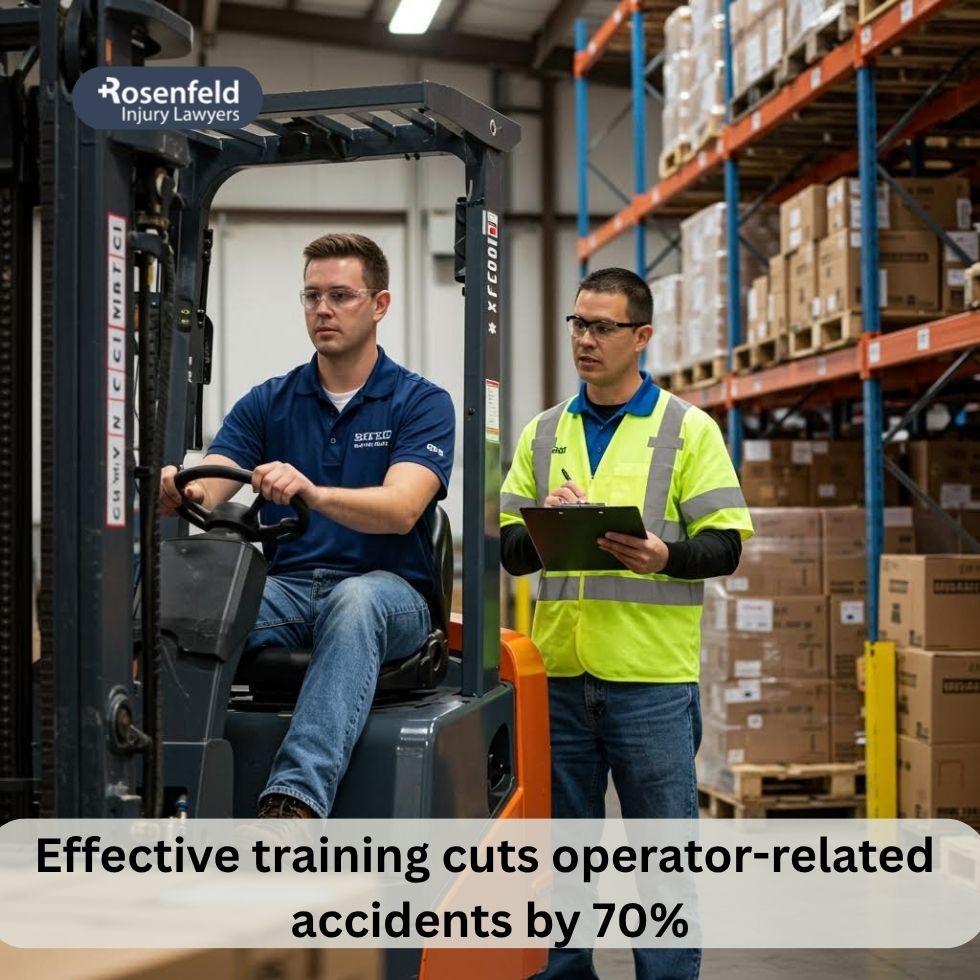
Under 29 CFR 1910.178(l), forklift operator certification involves three mandatory components:
1. Formal instruction. OSHA permits formal instruction through methods such as lectures, discussions, interactive computer learning, videos, or written materials under 29 CFR 1910.178(l)(2)(ii).
2. Practical training. The operator must complete demonstrations and practical exercises appropriate to the powered industrial truck and workplace under 29 CFR 1910.178(l)(2)(ii).
3. Workplace performance evaluation. The operator’s performance must be evaluated in the workplace by a person with the knowledge, training, and experience to train operators and evaluate their competence under 29 CFR 1910.178(l)(2)(ii)-(iii).
Forklift operators carry a big responsibility. Beyond moving materials, they must ensure each powered industrial truck is in safe working order through a pre-shift vehicle inspection. OSHA stresses that operators must know their forklift’s load capacity, understand forklift types, and follow the manufacturer’s guidelines.
According to 29 CFR 1910.178(l), only trained and competent operators are permitted to operate a powered industrial truck. The employer must ensure the operator has successfully completed the required training and evaluation before allowing the operator to operate the truck.
A certified forklift operator is expected to avoid unsafe driving, report equipment defects immediately, and respond appropriately if observed operating unsafely. The employer must ensure the operator has successfully completed the required training and evaluation before allowing the operator to operate the truck.
For Illinois workplaces, 820 ILCS 219, the Illinois Occupational Safety and Health Act, incorporates federal occupational safety and health standards into Illinois requirements, subject to the statute’s provisions concerning alternate state standards. Employers covered by the Act must comply with applicable occupational safety and health standards. Forklift training requirements in Illinois may therefore involve both the federal OSHA requirements and applicable Illinois workplace-safety requirements.
How to get forklift certified generally involves these six steps:
A valid forklift certification starts with training that satisfies OSHA’s requirements, combining formal instruction, practical training, and a performance evaluation. OSHA does not approve individual training programs or providers; instead, 29 CFR 1910.178(l) establishes the required elements of the training program.
Formal training covers operating instructions, truck controls, maintenance checks, and hazard awareness. Practical exercises let operators practice maneuvering, stacking, and traveling in different conditions. This is where trainees learn to properly operate a powered industrial vehicle in tight spaces, handle unusual loads, and adjust for any changes.
Once all stages are complete, the employer must provide forklift certification with the operator’s name, the training required, the date of training, and the date of the evaluation.
OSHA mandates that training include a mix of hands-on training, formal instruction, and a workplace evaluation to ensure users possess the skills for safe operation. According to 29 CFR 1910.178(l), every powered industrial truck operator must receive instruction on both truck-related topics and workplace-related topics.
Truck-related training topics include:
Workplace-related topics cover:
If an operator was previously trained in a required topic and has been evaluated as competent, additional training in that area is not required. Trainees may operate a forklift only under the direct supervision of a qualified trainer and in conditions that don’t endanger themselves or others.
A forklift certification course typically follows this sequence:
An online-only course generally covers only the formal-instruction portion of the OSHA training requirement. OSHA also requires practical training and an evaluation of the operator’s performance in the workplace, so completing an online course by itself does not satisfy all elements of the required training and evaluation.
The key question is not whether a course is online or in person, but whether the complete training program includes the formal instruction, practical training, and workplace evaluation required by 29 CFR 1910.178(l).
Some employers offer training on-site, while others allow trainees to learn at their own pace or own time with online modules before in-person testing.
The forklift certification cost varies based on the course provider, location, and whether it’s an online forklift certification or an in-person program.
As of 2026, published pricing commonly falls around $20-$120 for online formal instruction, $150-$400 or more for in-person instruction, $500-$1,500 or more for an on-site trainer visit, and roughly $150-$500 for some community-college programs. Prices vary by provider, location, group size, and what portions of the required training are included.
| Training format | Approx. 2026 price range | What it may include |
| Online formal instruction | $20-$120 per operator | Formal instruction only; practical training and workplace evaluation may be separate |
| In-person class | $150-$400+ per operator | Classroom/formal instruction and, depending on the provider, practical components |
| Employer-provided on-site training | $500-$1,500+ per group | Trainer-led instruction and potentially practical training/evaluation, depending on the arrangement |
| Community college | $150-$500 | Program-dependent classroom and practical instruction |
These are market-price ranges, not prices established by OSHA. The existing “under $100 to several hundred” summary can remain, but it should be understood as a general estimate rather than a fixed requirement.
OSHA places the responsibility for providing compliant training and ensuring operator competence on the employer. However, 29 CFR 1910.178(l) does not establish a specific dollar amount or expressly state that the employer must pay every training-related expense.
OSHA does not issue a government “forklift license” like a driver’s license. Instead, the employer must certify that each operator has been trained and evaluated as required by 29 CFR 1910.178(l)(6). The certification record must include the operator’s name, training date, evaluation date, and the identity of the person or persons who conducted the training or evaluation.
A wallet card issued by a training provider is not an OSHA-issued license.
OSHA’s powered industrial truck standard does not require an operator to hold a state driver’s license to operate a forklift. Operators must be competent and properly trained and evaluated under the applicable OSHA requirements.
OSHA’s forklift standard does not itself establish a general minimum age of 18, but federal child-labor rules restrict minors from operating many power-driven hoisting apparatus, including forklifts. The applicable child-labor rules should therefore be reviewed when workers under 18 are involved.
A forklift certificate is issued after an operator successfully completes a certification course and final exam. More precisely, OSHA requires the employer to certify that the operator has been trained and evaluated. A separate written “final exam” is not identified as a mandatory component of 29 CFR 1910.178(l).
According to 29 CFR 1910.178(l)(6), employers must provide certification documentation once an operator has been trained and evaluated. This documentation must include:
The certification record should identify the relevant equipment or truck types on which the operator was trained and evaluated.
Employers must maintain the required certification information and update it when additional training or evaluations are performed.
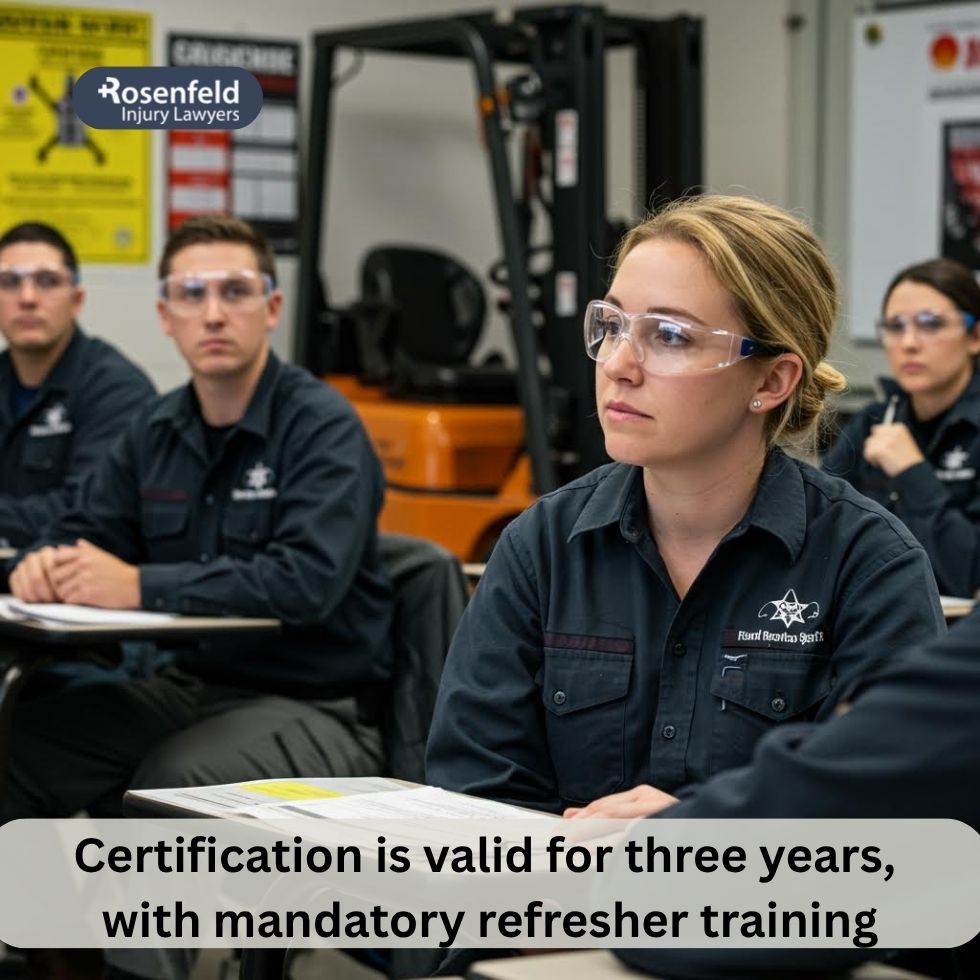
OSHA does not state that a forklift certification simply “expires” after three years. Instead, 29 CFR 1910.178(l)(4)(iii) requires the employer to evaluate each powered industrial truck operator’s performance at least once every three years. Refresher training is also required when specified events occur, including unsafe operation, an accident or near-miss, an evaluation showing unsafe operation, assignment to a different type of truck, or a workplace change affecting safe operation.
Many workers ask, “Does forklift certification expire?” The more accurate answer is that operators must receive the required refresher training when specified conditions occur and must have their performance evaluated at least once every three years. Under 29 CFR 1910.178(l)(4), refresher training, along with an evaluation of its effectiveness and must be given when:
In addition, OSHA requires each operator’s performance to be evaluated at least once every three years to confirm they remain properly trained.
When an operator lacks required training or the employer cannot produce required certification records, the circumstances may raise questions about whether the employer complied with 29 CFR 1910.178(l). Missing records, an overdue three-year evaluation, or the absence of a required workplace evaluation can be important evidence when investigating how an accident occurred. OSHA’s standard places the responsibility for ensuring operator competence and certification on the employer.
An OSHA citation can be relevant evidence of a workplace safety violation, but a citation does not automatically establish civil liability for an injured worker’s claim. A separate injury claim must be evaluated under the applicable workers’ compensation or civil-liability rules and the facts of the accident.
The forklift operator is not automatically personally liable simply because the operator was uncertified. OSHA places the certification obligation on the employer, although an individual operator’s conduct may still be relevant to the facts and legal issues in a particular case.
For an employee injured in the course of employment, workers’ compensation may provide benefits regardless of who caused the accident. A separate third-party claim may also be possible when a person or company other than the worker’s employer may be legally responsible. Learn more about filing a forklift accident lawsuit and workers’ compensation for forklift injuries.
After an incident, an injured worker may want to preserve or request relevant records, including the training certificate, evaluation date, identity of the trainer or evaluator, equipment or truck type covered by the certification, and any refresher-training records. These documents may help establish what training and evaluation occurred before the accident.
At our Illinois law firm, we understand that forklift operator certification isn’t just a piece of paper, but proof that an operator has the skills to handle a powered industrial truck safely and in compliance with OSHA forklift regulations. When employers cut corners on forklift training, skip hands-on training, or fail to provide certification, they put workers and the public at risk. Our job is to hold them accountable.
Consider Luis, a warehouse worker on Chicago’s South Side. He had never been given proper forklift certification or formal instruction, yet was told to unload lift trucks on a busy dock. Without knowing the correct safety procedures, he lost control, and the load toppled, crushing his leg. We proved the employer violated OSHA requirements and obtained a $3.2 million settlement to cover his medical care, lost wages, and long-term rehab.
Then there’s Tasha, who completed an online forklift certification through a third-party provider, but her employer never offered the practical training OSHA demands. While moving pallets in narrow aisles, she collided with shelving, suffering head and neck injuries. We demonstrated that the training program lacked the certification course elements needed for safe operation, securing $1.9 million to support her recovery and future needs.
We also helped Raymond, a construction supply yard worker in Cicero, who was injured when a co-worker and not a certified forklift operator, was seen operating a powered industrial truck in an unsafe manner. The machine struck Raymond, causing multiple fractures. We showed the employer had failed to keep certification records or enforce OSHA-compliant forklift certification standards, resulting in a $2.7 million settlement.
Prior results do not guarantee or predict a similar outcome. The facts, injuries, evidence, applicable law, and results of each case are different.
The time varies because OSHA does not prescribe one universal course length. The employer’s training program must provide the formal instruction, practical training, and workplace performance evaluation necessary to establish competence. The amount of training can depend on the truck type, workplace hazards, and the operator’s prior relevant training and experience.
An operator becomes certified after completing the required formal instruction and practical training and successfully completing a workplace performance evaluation. The employer must certify that the operator has completed the required training and evaluation and maintain the required certification information.
Costs vary by provider and format. As of 2026, published market ranges include roughly $20-$120 for online formal instruction, $150-$400 or more for in-person instruction, and $500-$1,500 or more for some on-site group training. These figures are estimates, not OSHA-mandated prices.
The total cost depends on whether the quoted price includes all required elements. An online course may cover only formal instruction, while practical training and workplace evaluation may require additional arrangements. Employers should verify that the complete program satisfies 29 CFR 1910.178(l) rather than relying on a certificate from an online course alone.
OSHA requires the employer to ensure that operators receive the required training, evaluation, and certification, but 29 CFR 1910.178(l) does not set a specific training fee or expressly state who must pay every training expense. Employment agreements, wage laws, and other applicable requirements may affect payment questions.
An online-only certificate does not by itself satisfy all OSHA forklift operator-training requirements because OSHA requires practical training and a workplace performance evaluation in addition to formal instruction. An online component may be part of compliant formal instruction, but the complete program must satisfy 29 CFR 1910.178(l).
If you’ve been injured in Illinois because an employer failed to ensure proper forklift operator certification or ignored OSHA standards for powered industrial truck operators, you don’t have to face the recovery process alone. Our Chicago forklift accident lawyer team has the experience, resources, and determination to uncover the truth, hold negligent parties accountable, and fight for the compensation you deserve.
Contact us for a free consultation and speak with a work injury attorney in Chicago who understands occupational safety, OSHA regulations, and the unique challenges of Chicago-area workplaces. We work on a contingency fee basis, so you pay nothing unless we win your case.
 Legally Reviewed By
Attorney Jonathan Rosenfeld
Content legally reviewed by Jonathan Rosenfeld The information on this page has been legally reviewed by Attorney Jonathan Rosenfeld, founder and managing partner of Rosenfeld Injury Lawyers LLC. With extensive experience representing injured workers across Illinois, Mr. Rosenfeld is dedicated to helping workplace accident victims pursue the maximum compensation available under the law. His extensive legal knowledge and commitment to client advocacy ensure that the information provided is accurate, reliable, and aligned with current legal standards.