



Can You Sue After a Forklift Accident at Work in Illinois? When Workers’ Comp Is Not Your Only Option


Can I sue for a forklift accident at work? In Illinois, you may be able to pursue a lawsuit after a workplace forklift accident, but it depends on who caused the injury. Workers’ compensation generally covers injuries caused by your employment, while a separate claim may be available when a third party, defective equipment, or another responsible party caused the accident.
Forklift accidents can cause crushing injuries, fractures, traumatic brain injuries, amputations, and fatal injuries.
According to the U.S. Department of Labor’s Occupational Safety and Health Administration, 84 workers died in incidents involving forklifts and other powered industrial trucks in 2024, based on the latest Bureau of Labor Statistics data. OSHA also reported 5,186 severe forklift injuries from 2015 through 2024.
For an injured worker, however, the question is not simply how the accident happened. It is also who may be legally responsible for it. If your employer is responsible, workers’ compensation will generally be the primary path to benefits. But if a third party contributed to the accident, you may have a separate personal injury claim.
Understanding that distinction can make a big difference in the legal options available after a forklift accident.
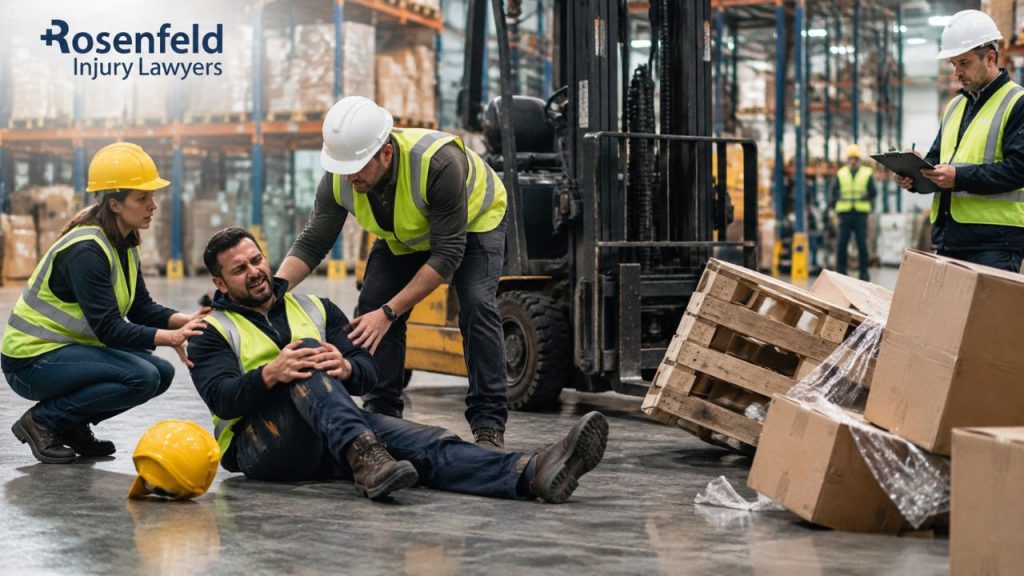
Does workers’ compensation cover a forklift accident?
Yes. If you are injured in a forklift accident while performing your job, the injury may qualify for Illinois workers’ compensation benefits. These benefits can cover necessary medical treatment and may provide compensation for certain periods of lost wages or disability.
Illinois workers’ compensation generally does not require an injured employee to prove that the employer was negligent. The focus is on whether the injury arose out of and in the course of employment.
But receiving workers’ compensation does not necessarily mean you have no other legal claim.
Can I sue my employer for a forklift accident?
Usually, an employee cannot bring a standard personal injury lawsuit against the employer for an injury covered by the Illinois Workers’ Compensation Act. Section 5 of the Act generally prevents an employee from recovering damages from the employer outside the workers’ compensation system, subject to limited exceptions.
This is why the identity of the party responsible for the forklift accident matters.
Evidence that an employer failed to provide proper training, supervision, maintenance, or workplace safety may still be relevant to a workers’ compensation claim. It may also help an attorney determine whether another company or individual has separate legal responsibility.
When can I sue a third party after a forklift accident?
A third-party lawsuit may be possible when someone other than your employer caused or contributed to your injuries. Illinois law expressly allows an injured employee to pursue damages against another person whose conduct created legal liability, even when workers’ compensation is also payable.
Depending on the circumstances, a potentially responsible third party could include:
- A forklift manufacturer
- A company responsible for equipment maintenance
- A contractor working at the same facility
- A subcontractor
- A property owner or other responsible business
- Another company’s employee or operator
For example, if a defective forklift component caused the machine to malfunction and injure you, the facts may support a claim against a manufacturer or another party involved in the equipment’s design, sale, or maintenance.
If another company’s employee operated a forklift and struck you while both companies were working at the same location, that relationship may also require investigation.
What can I recover after a forklift accident?
The potential recovery depends on whether you have a workers’ compensation claim, a third-party personal injury claim, or both.
Workers’ compensation can provide benefits for necessary medical care related to a covered workplace injury. Illinois law also provides different forms of compensation depending on the nature and extent of the employee’s disability.
A successful third-party personal injury claim may provide a different range of damages under Illinois law. Depending on the claim, those damages can include losses that are not generally available through workers’ compensation, such as pain and suffering.
What should I do after a forklift accident?
Report the accident to your employer, seek appropriate medical attention, and preserve information about what happened.
Illinois law requires notice of a workplace accident to be given to the employer as soon as practicable and no later than 45 days after the accident, subject to statutory exceptions. The law also establishes deadlines for filing a workers’ compensation claim with the Illinois Workers’ Compensation Commission.
Do not rely only on an employer’s accident report. If surveillance footage, forklift records, photographs, witness information, or other evidence exists, preserving it may be important in determining who was responsible.
How long do I have to file a forklift accident claim?
Workers’ compensation and third-party lawsuits can have different deadlines.
Under Illinois workers’ compensation law, you generally must file an application with the Illinois Workers’ Compensation Commission within three years after the accident if no compensation has been paid, or within two years after the last payment of compensation if compensation has been paid, subject to the statute’s requirements and exceptions.
A separate third-party personal injury claim may be governed by different statutes of limitation. Because the applicable deadline depends on the legal claim and circumstances, waiting to investigate a forklift accident can put important rights at risk.
How Can an Illinois Forklift Accident Lawyer Help?
Determining can I sue for a forklift accident at work requires more than asking whether you were injured on the job. The key question is who may be legally responsible for the accident.
An attorney can investigate the accident, identify potentially responsible third parties, review equipment and maintenance records, examine the circumstances surrounding the injury, and determine how a third-party claim may interact with your workers’ compensation benefits.
IL work injury lawyers evaluate workplace injury claims, including forklift accidents and potential third-party lawsuits.
Frequently Asked Questions
Generally, Illinois workers’ compensation is the primary remedy against an employer for a covered workplace injury. Limited exceptions exist, so an attorney should review the specific circumstances before concluding that a lawsuit against the employer is unavailable.
Potentially, if a defective forklift or component contributed to the accident and the legal requirements for a product liability claim are met. The evidence must establish the nature of the defect and the connection between the defect and the injury.
Yes, potentially. Illinois law allows an injured employee to pursue a legally responsible third party even when workers’ compensation benefits are available, although a third-party recovery can affect reimbursement obligations connected to the workers’ compensation claim.
Important evidence may include accident reports, medical records, photographs, surveillance footage, witness information, forklift inspection and maintenance records, and operator training records.
 Legally Reviewed By
Attorney Jonathan Rosenfeld
Content legally reviewed by Jonathan Rosenfeld The information on this page has been legally reviewed by Attorney Jonathan Rosenfeld, founder and managing partner of Rosenfeld Injury Lawyers LLC. With extensive experience representing injured workers across Illinois, Mr. Rosenfeld is dedicated to helping workplace accident victims pursue the maximum compensation available under the law. His extensive legal knowledge and commitment to client advocacy ensure that the information provided is accurate, reliable, and aligned with current legal standards.