
Experienced Attorneys
Committed to Protecting the
Rights of Injured Workers
Committed to Protecting the
Rights of Injured Workers



Workers compensation for construction workers in Illinois may provide medical benefits, wage replacement, and disability benefits after a work-related injury or illness. Construction workers generally must notify their employer within 45 days of an injury. Depending on the circumstances, a separate third-party claim against a general contractor, property owner, subcontractor, or another responsible party may also be possible.
Working on a construction site comes with plenty of risks in Illinois. Fortunately, if you get hurt or sick while working in this state, you can file for workers’ compensation benefits. This is a type of insurance most employers must carry to provide benefits to injured workers. Construction workers’ compensation claims can provide medical and disability benefits when a work-related injury or illness meets the requirements of the Illinois Workers’ Compensation Act. Additionally, workers’ comp in Illinois is a no-fault system.
IL Work Injury Lawyer is a Chicago-based law firm providing legal services for clients statewide. Our attorneys can guide you through the claims process to secure maximum benefits. Our attorneys can guide you through the claims process and help you understand your options for workers compensation for construction workers in Illinois. If you need assistance with a construction injury, you can also review our Chicago construction accident attorney resource.
If you get hurt while working on a construction project, you should be eligible for benefits under your employer’s workers’ comp policy. You may qualify for the following benefits:
Workers’ compensation can provide construction injury compensation for medical care and qualifying disability, but it does not generally provide damages for pain and suffering or punitive damages. Workers’ compensation also does not replace an injured worker’s full wages. Temporary total disability benefits are generally calculated at 66 2/3% of the employee’s average weekly wage, subject to statutory requirements and limits.
Unlike personal injury claims, you do not have to prove negligence under Illinois law to receive these benefits. Every business in the state, with some exceptions, must pay for this insurance under state law 820 ILCS 305.
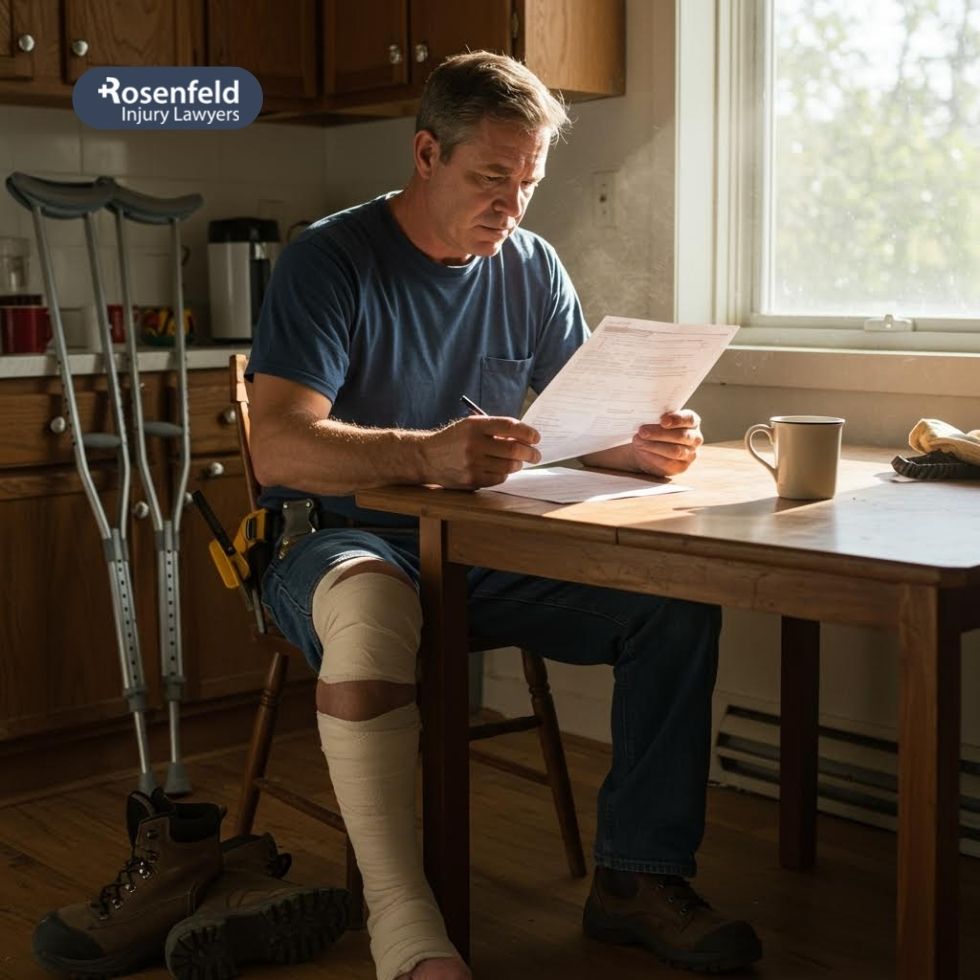
Construction companies are legally obligated to obtain workers’ comp insurance under state law 820 ILCS 305/4. Construction is specifically included among the extra-hazardous enterprises covered by the Illinois Workers’ Compensation Act. Construction companies must also follow applicable safety requirements. Workers who want to learn more about workplace safety standards can review our OSHA construction regulations resource.
Employers must also follow the notice and insurance requirements established by the Act. Workers can check whether an employer has workers’ compensation coverage through the Illinois Workers’ Compensation Commission (IWCC).
In most cases, any injury or illness that occurs over the course of your duties can make you eligible for workers’ compensation insurance coverage. On a construction site, this could include:
Construction workers may also have claims involving cutting and amputation injuries, depending on the circumstances of the accident.
Even minor accidents can lead to worker injuries that cause long-term health problems.
A subcontractor may be able to bring a claim against a general contractor or another third party, but the answer depends on the parties involved and the facts of the accident. A worker generally cannot sue their own employer for damages covered by the Workers’ Compensation Act because of the exclusive remedy rule. A separate claim may exist against a responsible third party.
For example, a general contractor, property owner, another subcontractor, or equipment manufacturer may be a separate party whose conduct contributed to the injury. A third-party lawsuit is different from a workers’ compensation claim because the injured worker generally must establish the third party’s legal liability.
| Workers’ compensation | Third-party lawsuit |
| Who you claim against | Your employer’s workers’ compensation coverage |
| Must fault be proven? | Generally, no |
| Pain and suffering | Generally not available under workers’ compensation |
| Potential defendants | General contractor, property owner, another subcontractor, manufacturer, or other responsible third party |
| Deadline | Workers’ compensation deadlines differ from civil claims |
| Civil claim limitation | 735 ILCS 5/13-202 generally provides a two-year limitation period for personal injury actions |
A third-party construction accident lawsuit may therefore provide a separate path to damages that are not available through workers’ compensation. The applicable deadline and legal theory should be reviewed based on the specific facts.
There is a fine line between employees and independent contractors. Generally, independent contractors are not eligible for benefits from workers’ compensation through the employer. This can lead to coverage disputes when accidents happen on construction projects. Problems can also arise when employees or independent contractors are misclassified.
The specific standards that define a construction employee can be found in state law 820 ILCS 305/1(b). Still, it essentially boils down to the amount of control a construction company has over the worker. If the employer has more control over setting hours and determining procedures, the worker is most likely a hired employee.
However, if the worker is able to choose their hours, complete tasks as they see fit, and work for multiple contractors at once, they are probably classified as an independent contractor. This would mean the worker is ineligible for workers’ comp.
For a 1099 construction worker, workers comp eligibility does not depend only on the label used for payment. Illinois law examines the actual working relationship and other statutory factors when determining whether a worker is an employee. Union workers may also have additional benefits that interact with workers’ compensation, depending on the applicable agreement and circumstances.
Undocumented construction workers may still be entitled to workers’ compensation benefits in Illinois. Illinois courts have held that workers covered by the Act are not excluded from workers’ compensation benefits solely because of immigration status. The Illinois Appellate Court has specifically addressed entitlement to workers’ compensation benefits regardless of immigration status.
Immigration status can involve additional legal considerations, so an injured worker should not assume that an employer’s statements about immigration status determine whether a workers’ compensation claim can be made. Workers also have protections against retaliation for exercising rights under the Illinois Workers’ Compensation Act. Section 4(h) addresses interference, discrimination, threats, and discharge connected to the exercise of workers’ compensation rights.
Attorney review is recommended for this section before publication because immigration-related claims can involve overlapping state and federal considerations.
If you want to apply for benefits because your construction employment is affected by the injuries, you must follow the appropriate process for your employer and the state of Illinois.
The 45-day notice requirement is separate from the deadline for filing an Application for Adjustment of Claim with the IWCC. Section 6(d) generally provides three years after the date of accident or two years after the last payment of compensation, whichever is later, subject to exceptions and the specific facts of the claim.
A workers comp claim denied by an insurer is not necessarily the end of the process. Common disputes can involve whether the injury occurred in the course of employment, whether notice was timely, the worker’s employment classification, medical evidence, or compliance with treatment requirements.
If a claim remains disputed, an injured worker may pursue the matter before the Illinois Workers’ Compensation Commission. The appropriate procedure depends on the type of dispute and the stage of the claim.
Our top-rated law firm in Chicago has the experience needed to support your construction claim. We have an A+ grade from the Better Business Bureau and serve as contributing authors to the National Law Review.
Here are some workers’ compensation settlements we have secured in the past:
Prior results do not guarantee or predict a similar outcome. Each workers’ compensation claim is evaluated based on its individual facts, evidence, applicable law, and other circumstances.
Workers’ compensation can cover reasonable and necessary medical treatment, temporary disability benefits, permanent disability benefits, vocational rehabilitation in qualifying circumstances, and other benefits provided by Illinois law. The specific benefits available depend on the injury, medical evidence, disability, average weekly wage, and applicable provisions of the Workers’ Compensation Act.
Workers’ compensation generally does not provide pain and suffering damages or punitive damages, and wage replacement is not necessarily equal to the worker’s full wages. A separate third-party claim may provide access to different categories of damages when another party’s negligence or wrongful conduct caused the construction accident.
A subcontractor may be able to bring a third-party lawsuit against a general contractor when the general contractor is legally responsible for the injury and is not protected by the exclusive remedy provisions applicable to the worker’s own employer. The facts, contractual relationships, and applicable defenses should be reviewed before pursuing the claim.
Possibly. Being paid as a 1099 contractor does not by itself determine whether a construction worker is an employee under Illinois law. The actual working relationship and statutory requirements matter. A worker who has been incorrectly classified as an independent contractor may have grounds to dispute the classification and seek workers’ compensation benefits.
Yes, Illinois case law recognizes workers’ compensation rights for covered employees regardless of immigration status. An injured worker’s immigration status does not by itself eliminate workers’ compensation eligibility. Because immigration and employment issues can overlap, workers should have the specific circumstances reviewed before relying on a general statement about available benefits.
Illinois generally requires an injured worker to notify the employer within 45 days of an accidental injury. That notice period is separate from the deadline for filing an Application for Adjustment of Claim with the IWCC. Section 6(d) generally provides three years from the accident or two years from the last compensation payment, whichever is later, subject to exceptions.
At IL Work Injury Lawyer, we work on a contingency fee basis, which means you pay nothing unless we win. Additionally, you can ask questions about your construction employer or claim status during a free consultation. Our firm handles workers’ comp claims in the construction industry across Illinois. Our team also handles workers compensation for construction workers in Illinois involving disputed claims, workplace injuries, and related third-party issues.
Contact us today to schedule your free case evaluation.
 Legally Reviewed By
Attorney Jonathan Rosenfeld
Content legally reviewed by Jonathan Rosenfeld The information on this page has been legally reviewed by Attorney Jonathan Rosenfeld, founder and managing partner of Rosenfeld Injury Lawyers LLC. With extensive experience representing injured workers across Illinois, Mr. Rosenfeld is dedicated to helping workplace accident victims pursue the maximum compensation available under the law. His extensive legal knowledge and commitment to client advocacy ensure that the information provided is accurate, reliable, and aligned with current legal standards.