
Experienced Attorneys
Committed to Protecting the
Rights of Injured Workers
Committed to Protecting the
Rights of Injured Workers



When a loved one dies in a fatal forklift accident at a warehouse, loading dock, or construction site, families may have questions about who is responsible and how to pursue financial recovery. A forklift wrongful death lawyer can investigate whether a third party, such as another company’s operator, an equipment manufacturer, or a property owner, contributed to the death. You may be able to file a wrongful death lawsuit alongside workers’ compensation death benefits. Contact our team for a free consultation.
Our firm has reported the following case results. Before publication, the firm should confirm that each result involved a fatality and that the facts and amounts are accurate.
Our firm reports settling 5,000 cases over 25 years and securing more than $490 million in compensation.
Prior results do not guarantee a similar outcome.
Workers’ compensation death benefits are generally no-fault payments made through an employer’s coverage to eligible dependents. A forklift accident wrongful death lawsuit is a negligence claim against a responsible third party, such as another company or a product manufacturer. When the facts support both routes, a family may pursue workers’ compensation benefits and a third-party wrongful death claim, although liens and other rules may affect the final recovery.
| Issue | Workers’ compensation death benefits | Wrongful death lawsuit |
| Who pays? | Generally the employer’s workers’ compensation insurer | A liable third party or its insurer |
| Must negligence be proved? | Generally no | Yes, the claimant must establish a legally actionable basis for liability |
| What losses are covered? | Statutory benefits for eligible dependents and burial expenses | Qualifying family losses such as lost support, services, society, grief, sorrow, and mental suffering |
| Deadline | Special statutory deadlines apply | Generally two years from death, with exceptions and other rules |
Under 820 ILCS 305/7, benefits may include two-thirds of the worker’s average weekly wage for eligible dependents, generally for 25 years or until $500,000 has been paid, whichever is greater, plus burial expenses up to $8,000. Read more about Illinois workers’ compensation death benefits. Confirm the current statutory wording and any applicable exceptions before publication.
The Illinois Workers’ Compensation Act generally makes workers’ compensation the exclusive remedy against an employer for a covered workplace death. A family therefore usually investigates third parties whose own negligence or defective products contributed to the incident. A fatal forklift accident lawyer can review the worksite, contracts, equipment, and employment relationships to identify potential claims.
| Potential party | Possible issue to investigate |
| Another company’s forklift operator and employer | Unsafe driving, inadequate training, failure to watch for pedestrians, or unsafe practices at a shared dock or job site |
| Forklift or attachment manufacturer | A design, manufacturing, or warning defect; product claims may be subject to the statute of repose in 735 ILCS 5/13-213 |
| Property owner or occupier | A dangerous property condition that contributed to the death, subject to the applicable premises-liability rules, including 740 ILCS 130 |
| Maintenance, repair, or rental company | Negligent inspection, repair, servicing, or equipment handling |
| General contractor or subcontractor | Its own unsafe conduct or failure to address hazards within its legal responsibilities on a construction site |
Temporary workers require a closer look at the employment arrangement. Illinois law has specific workers’ compensation rules for borrowed employees and employees supplied by staffing agencies. Whether a staffing agency or host company is protected from suit depends on the applicable facts and law; the family may need to pursue other responsible third parties. Learn more about a temporary worker.
OSHA requirements such as 29 CFR 1910.178 may provide evidence relevant to operator training, forklift use, inspection, and maintenance. A safety violation does not automatically prove civil liability. See our OSHA forklift regulations page.
Under 740 ILCS 180/2, the personal representative of the deceased person’s estate generally files the wrongful death lawsuit for the benefit of the surviving spouse and next of kin. The family members are beneficiaries, but they do not automatically file the action in their individual names. If there is no will or representative, an eligible family member may need to ask the probate court to appoint an administrator.
The court distributes any recovery among eligible beneficiaries according to their respective dependency on the deceased. The personal representative may also bring a survival action under 755 ILCS 5/27-6 to seek damages for losses the deceased experienced before death.
Wrongful death damages under the Illinois Wrongful Death Act may include:
A separate survival action may seek damages for losses belonging to the deceased’s estate, including:
Punitive damages may be available in qualifying cases filed on or after August 11, 2023, where the conduct meets the applicable standard, subject to statutory exceptions, including limits involving government defendants and certain professional-malpractice actions. Illinois has no general statutory cap on wrongful death damages; the applicability of particular damages must be reviewed under current law.
There is no reliable universal average payout for forklift-related wrongful death claims. Potential value depends on factors such as the deceased person’s age and earnings, financial dependents, the family’s losses, evidence of liability, conscious suffering before death, and any workers’ compensation lien. See our forklift accident settlements page for related information.
When a family recovers compensation from a third party, the workers’ compensation insurer may have a statutory lien for benefits it paid. Under 820 ILCS 305/5(b), the lien calculation includes a 25% credit toward attorney fees and an appropriate share of costs. The exact calculation depends on the recovery, benefits paid, costs, and applicable legal rules.
Illustrative example only: Assume a third-party case resolves for $1,000,000, and the workers’ compensation insurer has paid $200,000 in benefits. The lien is not simply deducted in full without adjustments: the statutory attorney-fee credit and the insurer’s share of costs must be calculated. If, purely for illustration, the insurer’s fee credit were $50,000 and its allocated cost share were $5,000, the illustrative lien repayment would be 145,000(200,000 − $50,000 − $5,000). These figures are hypothetical, not a legal calculation for any particular case; actual fee agreements, costs, lien amounts, and statutory application must be checked.
A sued third party may also seek contribution from an employer under principles associated with Kotecki v. Cyclops Welding Corp. The employer’s contribution exposure is generally limited by the applicable workers’ compensation liability rule unless the employer has waived that protection or another legal basis changes the result. The effect depends on the facts, contracts, and current law.
Different claims may have different deadlines. Do not assume one deadline applies to every defendant or proceeding.
| Claim type | General deadline to review |
| Illinois wrongful death claim | Generally two years from the date of death under 740 ILCS 180/2 |
| Claim against a local public entity | Generally one year under 745 ILCS 10/8-101, subject to applicable law |
| Workers’ compensation death claim | Under 820 ILCS 305/6(d), generally three years from the accident or two years from the last compensation payment, whichever is later |
| Product-related claim | The statute of repose under 735 ILCS 5/13-213 may also apply |
These are general rules, not a determination of the deadline in a particular case. Exceptions and claim-specific rules may change the analysis, so seek legal advice promptly.
Operator error, unstable loads, unsafe site conditions, or equipment defects can cause a fatal forklift accident. Common scenarios include:
Explore related situations involving consumers hit by forklifts, loading dock accidents, warehouse accidents, and construction site forklift collisions. See our page on common causes of forklift-related accidents.
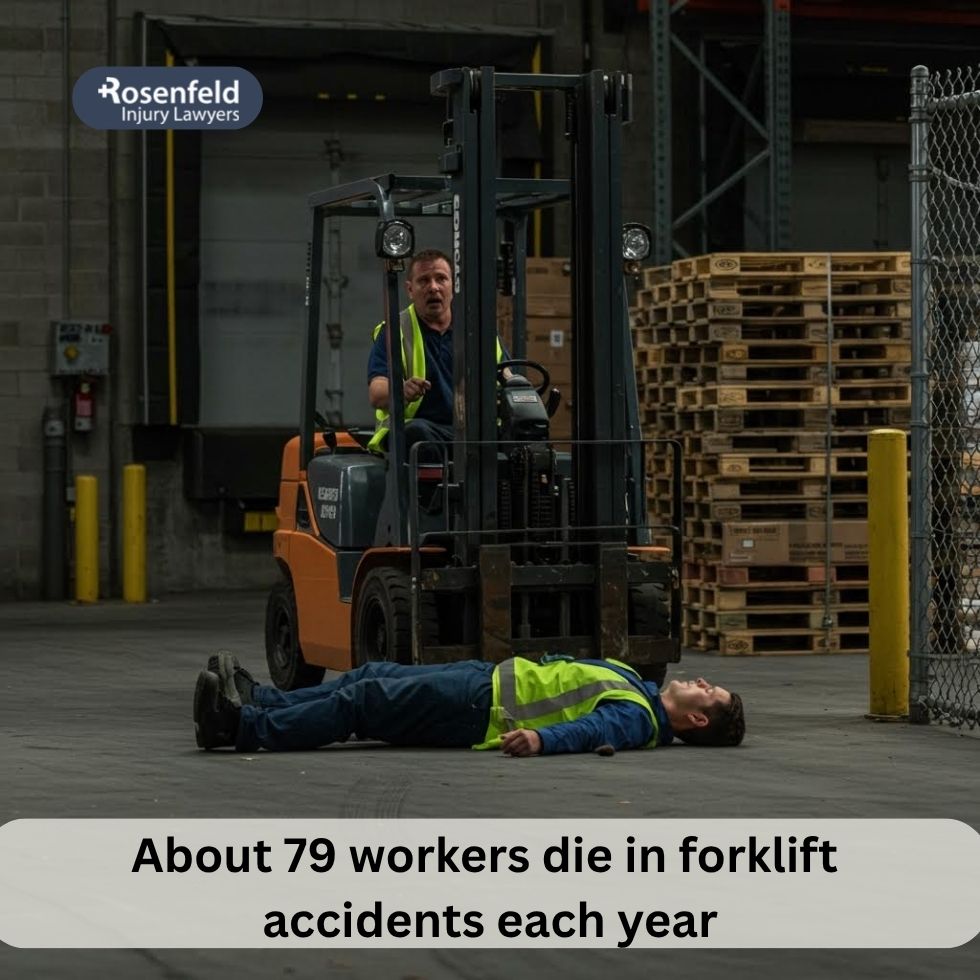
The National Safety Council’s Injury Facts reports 84 worker deaths involving forklifts, order pickers, or powered platform trucks nationwide in 2024. For more information, visit our forklift accident statistics page and read about how many forklift deaths occur each year.
Defendants and insurers may challenge liability in several ways. Evidence can help address these arguments:
A forklift wrongful death attorney can help coordinate the legal and practical steps that may follow a workplace death:
For information about a separate injury claim, see our forklift accident lawsuit page.
The deceased person’s personal representative generally files the action under the Illinois Wrongful Death Act for the benefit of the surviving spouse and next of kin. If no representative has been appointed, the family may need to go through probate or determine whether a special administrator is available.
The Illinois Workers’ Compensation Act generally makes workers’ compensation the exclusive remedy against an employer for a covered workplace injury or death. A family may still have a claim against another company or third party whose negligence or product caused the death.
Potentially, yes. Eligible dependents may pursue workers’ compensation death benefits while the estate’s personal representative brings a claim against a responsible third party. A workers’ compensation lien and other legal rules may affect the third-party recovery.
The staffing agency and host company may have specific rights and obligations under Illinois workers’ compensation law. Whether either can be sued depends on the employment relationship and applicable legal protections. Other companies or product manufacturers may also need to be investigated.
The general Illinois wrongful death deadline is two years from the date of death, but shorter deadlines may apply to claims involving local public entities. Product claims and workers’ compensation proceedings have separate rules. Get advice promptly to identify the deadlines for your circumstances.
If your family lost a loved one in a forklift accident, our team can help you understand the potential claims, investigate third-party responsibility, and navigate the estate process. We offer a free consultation and handle eligible cases on a contingency-fee basis, meaning attorney fees are not owed unless we recover compensation under the fee agreement. Call 312-757-7348 to discuss your options with our Chicago work injury lawyers.
 Legally Reviewed By
Attorney Jonathan Rosenfeld
Content legally reviewed by Jonathan Rosenfeld The information on this page has been legally reviewed by Attorney Jonathan Rosenfeld, founder and managing partner of Rosenfeld Injury Lawyers LLC. With extensive experience representing injured workers across Illinois, Mr. Rosenfeld is dedicated to helping workplace accident victims pursue the maximum compensation available under the law. His extensive legal knowledge and commitment to client advocacy ensure that the information provided is accurate, reliable, and aligned with current legal standards.