
Experienced Attorneys
Committed to Protecting the
Rights of Injured Workers
Committed to Protecting the
Rights of Injured Workers



Forklift accident causes include inadequate operator training, unsafe driving, overloaded or unstable loads, defective equipment, poor maintenance, unsafe workplace conditions, and pedestrian traffic. Forklifts are essential for loading trucks and stacking merchandise, but these hazards can lead to serious workplace injuries. Understanding why an accident occurred can help identify the safety failures involved and the parties who may be responsible.
If you are injured in a forklift accident, workers’ compensation may cover medical expenses and qualifying wage benefits, regardless of fault. A separate third-party lawsuit may also be possible if someone other than your employer, such as an equipment manufacturer, outside maintenance contractor, or another company, contributed to the accident. The cause matters because it can determine which claims are available under Illinois law.
See our latest forklift accident statistics for current data on the scope of these incidents.
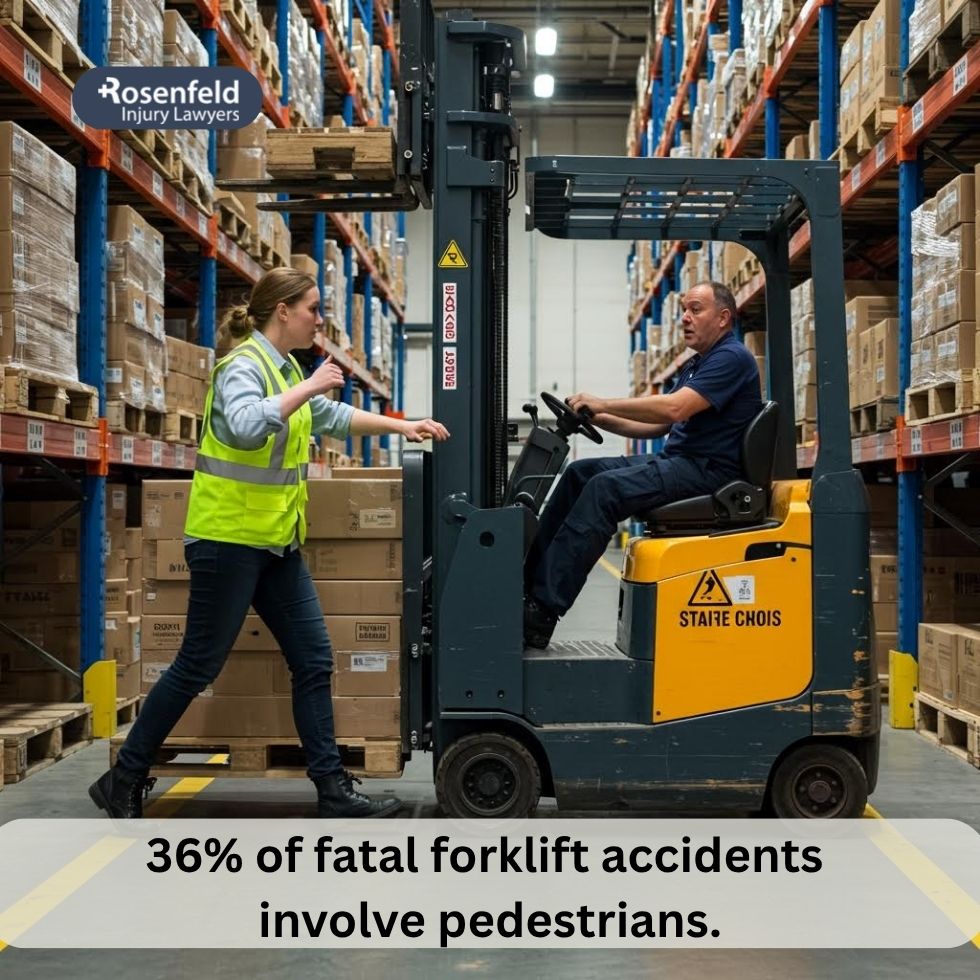
Operator-related forklift accident causes include inadequate training, unsafe driving, impaired operation, and improper load handling. These actions can endanger both forklift operators and workers nearby. However, the legal responsibility depends on whether the operator works for the injured person’s employer or a separate company.
If someone operates a forklift without adequate training, the employer may be violating 29 CFR 1910.178(l), which requires training and evaluation before an employee operates a powered industrial truck independently. Operators must be evaluated at least once every three years, and refresher training is required in specified circumstances, including an accident, near miss, unsafe operation, or relevant workplace change. Federal child labor rules, rather than this OSHA training standard, generally prohibit workers under 18 from operating forklifts in nonagricultural employment.
Private employers generally fall under federal OSHA requirements, so 820 ILCS 219 should not be cited as the training mandate for private workplaces. If an inadequately trained operator injures a co-worker, workers’ compensation generally provides the remedy against the employer. A separate claim may be available against an outside company that negligently trained or supplied the operator. For more information, see forklift operator training requirements and our article on an untrained forklift operator accident.
Even trained operators can cause accidents by speeding through narrow aisles, turning too sharply, carrying unauthorized passengers, or failing to warn pedestrians at blind corners. These behaviors can cause collisions, tip-overs, and falling loads.
OSHA’s powered industrial truck standard addresses specific hazards in separate provisions, including unauthorized passengers under 29 CFR 1910.178(m)(3) and horn use and slowing down at obstructed cross aisles under 1910.178(n)(4). If unsafe operation causes an injury, an investigation can help establish whether the employer’s workers’ compensation coverage applies and whether a separate company may be liable in a third-party claim.
Using a forklift while impaired by drugs or alcohol can seriously compromise judgment, reaction time, and vehicle control. An impaired operator may strike another worker, drop a load, or overturn the forklift.
If a co-worker causes the accident, Illinois workers’ compensation generally prevents a separate negligence lawsuit against that co-worker. A claim against a different company may be possible if its employee caused the incident. Punitive damages are not a workers’ compensation benefit; in a third-party lawsuit, they require a legally sufficient basis and court approval under 735 ILCS 5/2-604.1. If the injured worker was impaired, intoxication may also affect eligibility for workers’ compensation benefits under 820 ILCS 305/11.
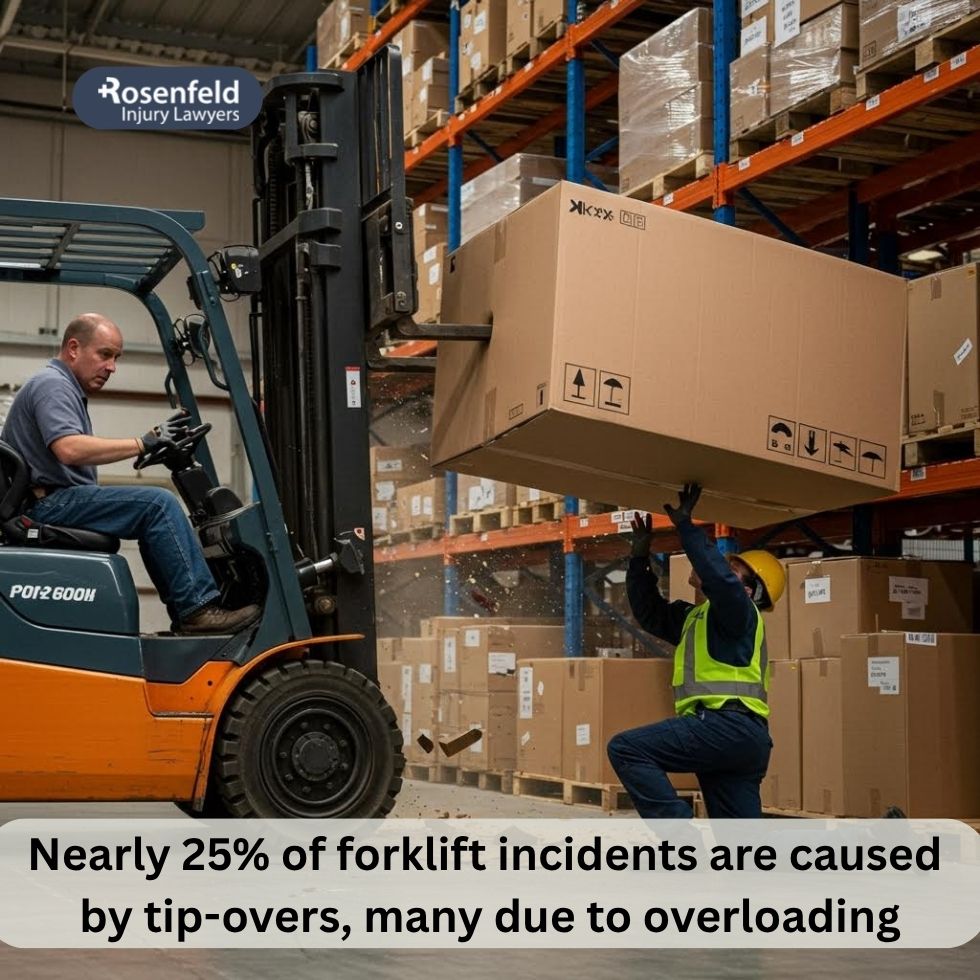
Forklifts move palletized cargo and other heavy materials, but an unstable, off-center, or excessive load can cause a tip-over or falling-object accident. Operators must account for the forklift’s rated capacity, load center, and the stability of the materials being transported.
OSHA’s load-handling requirements appear in 29 CFR 1910.178(o). A load that exceeds the truck’s rated capacity or blocks the operator’s view can endanger nearby workers. Depending on the circumstances, responsibility may rest with the operator, the employer, or an outside shipper or loader that improperly prepared the cargo. Learn more with our forklift weight capacity calculator.
Mechanical defects and inadequate maintenance are important forklift accident causes. Brake failures, steering problems, hydraulic leaks, damaged mast chains, faulty backup alarms, or defective seatbelts can prevent a forklift from operating safely.
Mechanical failures may result from defective design, manufacturing problems, worn components, or inadequate repairs. A malfunctioning brake or hydraulic system, for example, may cause a collision, dropped load, or loss of control.
If a defective forklift or component causes an injury, a product liability claim may be available against a manufacturer, distributor, or seller. The Illinois statute of repose, 735 ILCS 5/13-213, can limit the time to bring a product liability action based on when the product was first sold or first used. A claim against an outside repair company may also be possible if negligent maintenance contributed to the incident.
Following OSHA forklift regulations can help reduce mechanical risks. Under 29 CFR 1910.178(q)(7), forklifts must be examined before being placed in service, at least daily, or after each shift when used around the clock. Under 1910.178(q)(1), unsafe trucks must be removed from service until repaired.
If an outside maintenance contractor or rental company negligently services or supplies unsafe equipment, it may face a third-party claim. An injured employee generally seeks benefits from their employer’s workers’ compensation coverage rather than suing the employer for ordinary negligence.
Workplace forklift hazards include slippery or uneven floors, obstructed aisles, poorly designed docks, unsafe ramps, inadequate lighting, and insufficient separation between vehicles and pedestrians. A property owner, general contractor, or other outside company may be responsible when its own negligence contributes to an accident.
Spilled liquids, debris, damaged flooring, and uneven surfaces can cause a forklift to skid, lose balance, or overturn.
Under the Premises Liability Act, 740 ILCS 130, a property owner or occupier may be liable for qualifying injuries caused by unsafe premises. This may apply when the responsible property owner or occupier is not the injured worker’s employer, such as a separate company’s warehouse or loading area.
Cluttered aisles, high stacks of materials, blind corners, and attachments that obstruct the operator’s view can increase collision risks. Poorly arranged warehouse traffic routes may also expose pedestrians to moving forklifts. See our information about warehouse forklift accidents.
Loading docks are common locations for forklift incidents. Damaged dock plates, unsecured ramps, unstable trailer floors, and steep grades can cause forklifts to slide, roll backward, or fall from an elevated surface.
Under 29 CFR 1910.178(k)(1), truck brakes must be set and wheel chocks placed under the rear wheels when trailers are boarded by forklifts, subject to the standard’s provisions. Depending on the circumstances, an outside property owner, dock operator, or contractor may be responsible for an unsafe loading area.
Not all forklift accidents are caused solely by the person operating the vehicle. Pedestrian traffic, poor communication, inadequate safety controls, and supervision failures can contribute to incidents. The identity of any legally responsible party depends on the working relationships and the specific safety failure involved.
Pedestrians may enter forklift travel paths when walkways are not marked, blind corners lack warnings, or workers and drivers do not communicate effectively. Loads that block the operator’s view can further increase the risk.
OSHA requires drivers to slow down and sound the horn at cross aisles and other locations where vision is obstructed under 29 CFR 1910.178(n)(4). A worker struck by a forklift generally may claim workers’ compensation. A third-party claim may be available if the driver works for another company. Customers and delivery drivers who are not the employer’s employees may have direct injury claims. Read more about customers hit by forklifts or workers hit by a forklift at work.
Poor supervision can allow unsafe driving, inadequate training, or ignored hazards to continue. Supervisors may fail to address blocked routes, insufficient lighting, or unsafe operating practices.
For an injured employee, a supervisor’s failure to enforce safety procedures does not usually create a separate negligence lawsuit against the employer. However, records of ignored hazards may help explain the accident and support a workers’ compensation claim or a separate claim against a responsible third party.
Weather conditions can make outdoor forklift operations particularly dangerous. Snow, ice, rain, and standing water can reduce traction, while poor lighting can make hazards harder to see.
Employers and site operators should account for conditions that affect safe forklift use. Depending on who controlled the hazardous area, an unsafe surface or failure to address a known site condition may support a claim against a non-employer property owner or contractor. The applicable OSHA requirements depend on the particular hazard and work activity.
Understanding common forklift accidents helps explain how an incident occurred and which evidence may be relevant to a claim. The same event can have more than one cause, such as an overloaded pallet combined with a sharp turn or a damaged dock plate.
A tip-over occurs when a forklift loses stability and begins to overturn forward, backward, or sideways. A forklift rollover can happen when an operator turns too quickly, travels with a raised load, or moves across an uneven surface.
Common forklift tip over causes include:
A missing or defective seatbelt may contribute to the severity of an operator’s injuries if the forklift overturns. Operators who jump from a tipping forklift can be crushed beneath it. Depending on the evidence, a defective restraint or negligent maintenance may support a claim against an equipment manufacturer or outside repair company. If your forklift overturned at work, workers’ compensation may cover qualifying benefits, and a third-party claim may also be possible.
Caught-in or caught-between incidents occur when a worker becomes trapped in machinery or pinned between a forklift and a wall, rack, pallet, or other object. These incidents may involve unsafe maneuvering, inadequate guarding, restricted workspaces, or poor coordination between workers and equipment operators.
Serious forklift injuries can include crush injuries, fractures, and amputations. Visit our page about forklift injuries for more information about the harm these incidents can cause.
Struck-by incidents occur when a moving forklift hits a pedestrian, worker, vehicle, or fixed object. Limited visibility, blind corners, unmarked pedestrian routes, and inadequate warnings can contribute to these collisions.
The cause may involve unsafe driving, poor site layout, or inadequate traffic controls. An injured employee may have a workers’ compensation claim and, where a separate company contributed to the incident, a possible third-party claim.
When cargo slips off a forklift’s forks, nearby workers, customers, or spotters may be struck by falling materials. Overloading, unstable pallets, improper load positioning, and sudden movements can contribute to these incidents.
If a load fell from a forklift and hit you, responsibility may depend on who loaded the cargo, who operated the truck, and whether defective equipment or unsafe procedures contributed to the fall. Non-employee victims may have direct claims against responsible parties. Learn more about forklift accidents involving consumers.
A collision, sudden movement, or tip-over can throw an operator from the vehicle, particularly when a seatbelt is not used. The operator may then be struck by the forklift or falling cargo.
The investigation should consider whether the restraint was available and functioning, whether the forklift was properly maintained, and whether the operator was following safe procedures. Those facts can help identify a possible equipment defect or outside party’s negligence.
Forklifts may collide with shelving, walls, machinery, other vehicles, or workers when operators cannot see clearly or fail to control the vehicle. Falling merchandise may create additional hazards after an impact.
Training records, site layout, vehicle inspections, and witness accounts may help establish whether unsafe operation, defective equipment, or another company’s conduct contributed to the collision.
Forklifts can fall from docks or trailers when dock plates are unsecured, trailer floors are damaged, or trailers move during loading. Operators may be ejected or trapped in the resulting crash.
These incidents may involve failures by the company controlling the dock, a trailer owner, an outside contractor, or another party responsible for securing the loading area.
Fuel leaks, improper refueling, electrical faults, and battery-related hazards can cause fires or other dangerous incidents. OSHA addresses fuel handling under 29 CFR 1910.178(f) and battery-related requirements under 1910.178(g).
The cause may point to improper maintenance, unsafe fuel handling, defective components, or inadequate workplace procedures. Equipment and maintenance records can help clarify what happened.
A thorough forklift accident analysis examines the equipment, workplace conditions, operator training, and events leading up to the incident. Identifying the cause can help determine whether workers’ compensation, a third-party negligence claim, a product liability claim, or more than one type of claim may be available.
Important evidence may include:
OSHA inspection records may provide additional information about safety violations. See our guide to OSHA forklift violations. Preserve any available evidence and seek advice promptly because records and video footage may not be retained indefinitely.
The specific forklift accident causes matter because Illinois generally treats workers’ compensation and third-party lawsuits as separate legal routes. Workers’ compensation usually provides benefits without requiring proof that the employer was negligent. A third-party lawsuit may be available against a separate company or product manufacturer whose negligence or defective product contributed to the accident.
| Cause | Who may be responsible | Potential claim |
| Inadequate operator training | Employer or a separate company responsible for training or supplying the operator | Workers’ compensation; possible third-party negligence claim |
| Speeding, horseplay, or impaired driving | Employer for workers’ compensation purposes; a separate employer may face a third-party claim | Workers’ compensation; possible third-party claim |
| Overloaded or unstable cargo | Employer, outside shipper, or company that loaded the pallet or trailer | Workers’ compensation; possible third-party claim |
| Defective brakes, hydraulics, mast, alarm, or seatbelt | Manufacturer, distributor, or seller | Workers’ compensation; possible product liability claim |
| Skipped inspections or negligent repairs | Employer for workers’ compensation purposes; outside maintenance contractor or rental company may be liable separately | Workers’ compensation; possible third-party negligence claim |
| Unsafe floors, docks, ramps, or lighting | Responsible outside property owner, occupier, or general contractor | Workers’ compensation; possible premises liability or construction negligence claim |
| Pedestrian struck in a shared work area | Employer for workers’ compensation purposes; a separate driver’s employer or other responsible company may face a claim | Workers’ compensation; possible third-party claim |
This table provides general examples, not a determination of fault in an individual case. Illinois law generally bars an employee from suing their own employer or a co-worker for ordinary workplace negligence when the Workers’ Compensation Act applies. A narrow exception may apply when an employer specifically intended the injury. See 820 ILCS 305/5(a) and Meerbrey v. Marshall Field & Co., 139 Ill. 2d 455 (1990).
For more information about a potential forklift accident lawsuit, the available claims depend on the facts, the parties involved, and the applicable filing deadlines.
Illinois workers’ compensation generally covers reasonable and necessary medical care and qualifying wage-loss benefits for work-related injuries, without requiring the worker to prove employer negligence. It does not provide damages for pain and suffering. A third-party lawsuit may allow recovery of additional damages, including pain and suffering and losses not fully addressed by workers’ compensation, if another party is legally responsible.
If an injured worker recovers from a third party, the workers’ compensation insurer may have a lien against that recovery under 820 ILCS 305/5(b). The statute provides for reimbursement subject to its rules, including a deduction for attorney fees and a share of costs. How the lien is calculated depends on the case.
Filing deadlines differ between workers’ compensation claims and civil lawsuits. Review our Illinois workers’ compensation statute of limitations page for an overview, and learn about filing a forklift workers’ compensation claim.
There is no single cause for every incident. Operator error, inadequate training, unstable loads, mechanical failures, and unsafe work areas can all contribute. Historically, a June 2001 NIOSH Alert, Publication 2001-109, identified overturns as the leading cause of forklift-related deaths, accounting for about 25% of those deaths in the data it examined. See our forklift accident statistics page for current information.
A forklift may tip over when an operator turns too sharply, travels with a raised load, exceeds the rated capacity, or moves across uneven ground. Sloped surfaces and unstable loading docks can also contribute. The investigation should consider the load, vehicle condition, operating practices, and surrounding work area.
Generally, no. If Illinois workers’ compensation law applies, benefits are usually the remedy against your employer for a work-related injury caused by inadequate training or other workplace negligence. However, you may have a separate claim against an outside company if its negligence contributed to the accident.
Responsibility depends on why the load fell. The operator, a company that improperly loaded the cargo, or a manufacturer responsible for defective equipment may be liable, depending on the evidence. An injured employee may qualify for workers’ compensation, while a non-employee may have a direct injury claim against responsible parties.
The employer may investigate the incident, and OSHA may investigate when its jurisdiction and reporting or enforcement criteria apply. Depending on the circumstances, equipment specialists, maintenance contractors, insurers, and attorneys may also examine records, video, witness accounts, and physical evidence to determine the cause.
If you were injured in a forklift accident in Illinois, understanding what happened can help you identify your options. Our team can review the circumstances, explain workers’ compensation benefits, and assess whether a claim against a third party may be available.
At IL Work Injury Lawyer, we work on a contingency fee basis. This means there are no upfront costs for our services under our contingency arrangement, and attorney fees are owed only if we recover compensation for you. Illinois workers’ compensation attorney fees are generally subject to statutory limits under 820 ILCS 305/16a. You will also receive a free consultation to discuss your situation and potential next steps.
Contact our team to schedule a free case evaluation with an Illinois work injury law firm. We can discuss your accident, available claims, and applicable deadlines without making assumptions about the outcome of your case.
 Legally Reviewed By
Attorney Jonathan Rosenfeld
Content legally reviewed by Jonathan Rosenfeld The information on this page has been legally reviewed by Attorney Jonathan Rosenfeld, founder and managing partner of Rosenfeld Injury Lawyers LLC. With extensive experience representing injured workers across Illinois, Mr. Rosenfeld is dedicated to helping workplace accident victims pursue the maximum compensation available under the law. His extensive legal knowledge and commitment to client advocacy ensure that the information provided is accurate, reliable, and aligned with current legal standards.