Experienced Attorneys
Committed to Protecting the
Rights of Injured Workers
Committed to Protecting the
Rights of Injured Workers



A forklift is a valuable piece of equipment for many businesses in Illinois. Also known as powered industrial trucks, forklifts can pose risks to workers, customers, and pedestrians if not used properly. One violation that is frequently cited in workplace injuries is exceeding the forklift weight capacity.
Every forklift is designed with a specific lifting capacity for safe operation. When a forklift operator or employer violates the lifting capacity, it can lead to a rollover, tip-over, or other type of accident.
IL Work Injury Lawyer can provide legal assistance if you have been hurt in a forklift accident that was caused by weight issues. Our Chicago forklift injury law firm will investigate your claim, gather evidence, and fight for maximum compensation to cover legal damages, including lost wages, medical expenses, disability, emotional distress, and more.
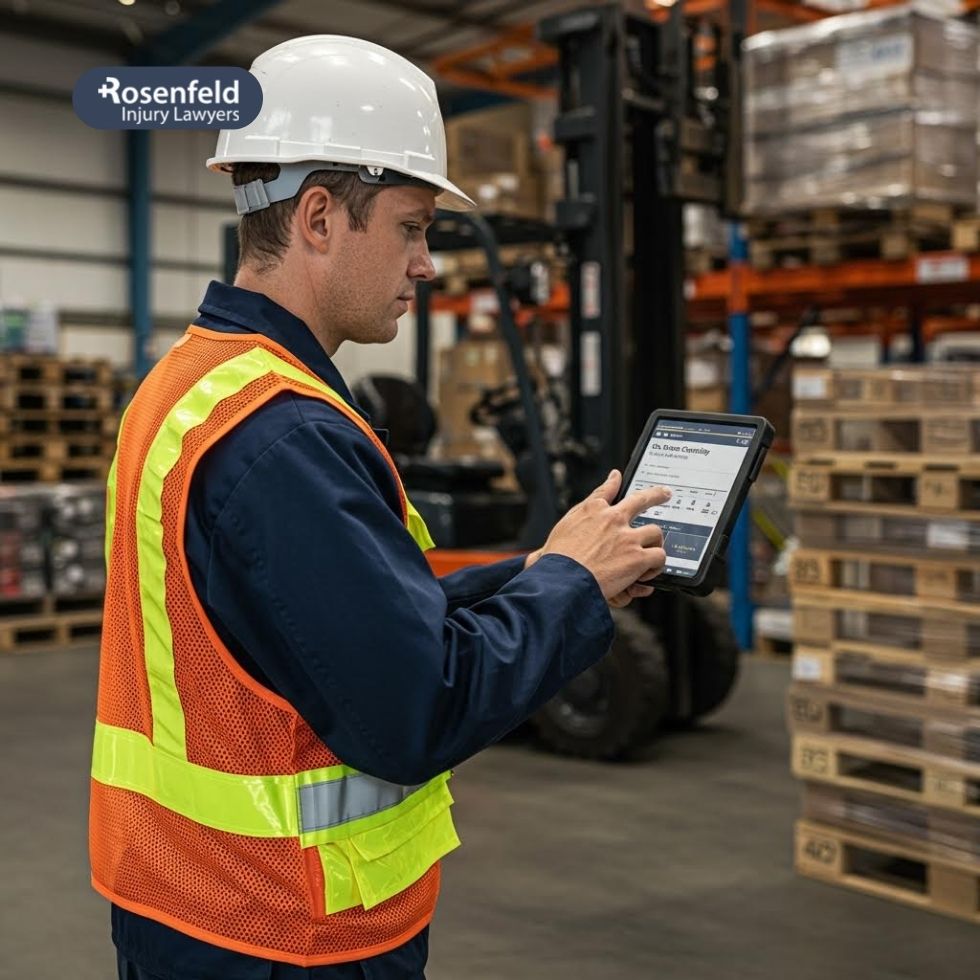
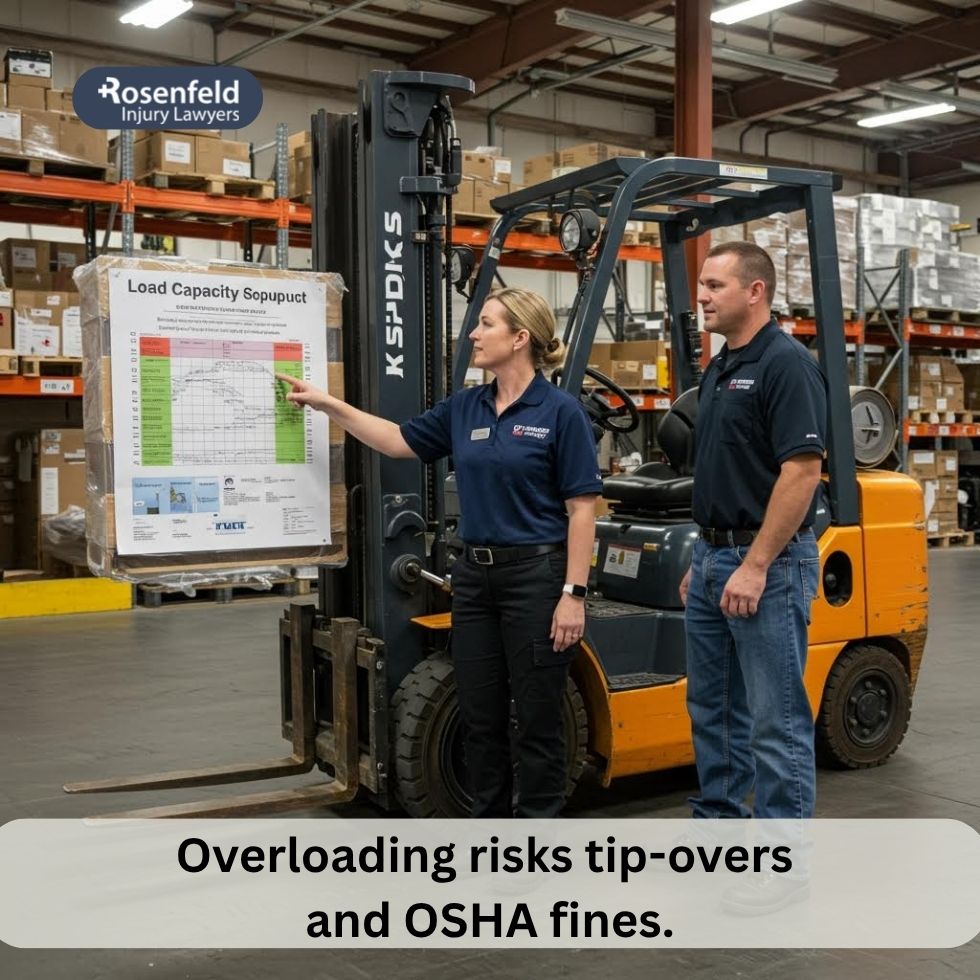
A forklift’s load capacity refers to the maximum weight it can safely maintain without tipping over or becoming unstable. There are several classes of forklifts (Class I-VII), each with a specific lifting capacity determined by its center of gravity, rated load center, lift height, and design.
Standards for powered industrial trucks in Illinois are governed by the Occupational Safety and Health Administration (OSHA). Under OSHA code 29 CFR 1910.178, forklift manufacturers and operators must follow numerous ordinances.
For example, how much weight a lift can safely hold must be clearly labeled on the product. Any changes that may affect the load capacity of the lift truck must be made with the manufacturer’s written approval.
A forklift also cannot be driven over a ramp or docking plate if its weight would exceed the capacity of that surface, which is possible for an overloaded forklift.
When a manufacturer designs a forklift, they calculate its lifting capacity based on several factors, including the load center of gravity, the weight of the forklift, the weight distribution, and the machine’s design. Using these variables, the maker will determine the maximum load moment, which is the highest possible weight the truck could lift before it becomes unstable.
Generally, the smallest class of forklifts can handle a weight capacity of at least 3,000 lbs. High-capacity forklifts can manage up to 70,000 lbs. It depends on the specific manufacturer and type of equipment.
Whatever weight a forklift can safely lift, it is essential to avoid misusing or overloading the machine. Improper use can make the forklift unbalanced, increasing the risk of an accident that causes severe injuries.
If a job requires larger forklifts, the company is responsible for providing the right forklift for the task at hand.
The center of gravity of the forklift affects how much weight can be added to the fork and where it can be placed. Think of it like a seesaw. If there is a large user at the very end of the seesaw, it will tip that way faster and harder. However, if this same person moves much closer to the pivot point of the seesaw, it will be easier to balance with weight on the other side.
Forklifts work in a similar way. When there is no load, the center of gravity is further back in the machine. Once weight is added to the fork, the center of gravity moves. Engineers calculate the load capacity based on the amount of forklift weight and its distance from the load center.
There is also a concept called the triangle of stability. This triangle is formed by the front wheels (pneumatic tires) of the forklift and the center of its rear axle. If the center of gravity stays within this triangle, the forklift is less likely to tip forward from the load weights and can safely carry the load.
Different attachments will affect the machine’s load capacity. Some common tools include clamps, rotors, and booms. Since these attachments are typically heavier than the fork, they reduce the forklift’s safe carrying capacity.
An operator who fails to account for this may end up violating the adjusted load center and capacity. Even if the weight of the cargo is within the limits, it may still be an overloaded forklift because of the additional weight of the attachments. This can lead to increased accident risks.
In addition to maximum forklift weight capacity, forklifts also have a maximum lift height. If you lift the load too high on the forklift, stability decreases.
The chance of a tip-over or dropped load will increase, which could cause serious crush injuries or head injuries from falling materials.
Every operator should be aware of the equipment’s limitations. If the operator does not know the maximum forklift capacity, they could be placing others at risk. An overloaded forklift is more likely to tip, lose steering traction, or drop loads unexpectedly.
The machine will also be less stable when using ramps, inclines, or uneven warehouse floors. The heavier the equipment is, the more likely it is to cause an accident on these precarious surfaces.
Overloading a forklift is one of the leading causes of common workplace injuries from powered industrial trucks. Fortunately, these incidents are largely preventable through improved training practices, effective supervision, and regular maintenance.
Knowing how much weight a forklift can lift will reduce the risk of severe injuries in warehouses, construction sites, and other business settings.
Here are some examples of how improper loading practices can lead to dangerous forklift accidents:
The most common cause of forklift accidents is negligent training, followed closely by poor supervision and rushed work in fast-paced environments.
OSHA regulations govern the proper use of a forklift in Illinois, including the rated capacity and who is authorized to operate the equipment.
Here are some state laws and OSHA regulations that may play a role in a forklift injury case:
If an operator or another entity violates the OSHA-rated capacity of a forklift and causes an injury, this could lead to a third-party negligence lawsuit or premises liability claim. An injury claim can result in additional compensation beyond a workers’ compensation claim.
Even high-capacity forklifts can become unstable due to overloading or if the weight is not evenly distributed. Determining who is liable for the mistakes will play an important role in your compensation, whether you are filing for forklift injury workers’ compensation benefits or a forklift injury lawsuit.
Here are some potential defendants that may be responsible for your losses after a forklift capacity accident:
IL Work Injury Lawyer will investigate fault via OSHA reports, safety risk audits, and witness statements.
If you are an employee who was injured in a lifting capacity accident while on the job, you have several legal options to recover compensation for your losses.
First, consider filing a workers’ compensation claim. You must report the incident within 45 days to your employer to be eligible for lost wages, medical expenses, disability benefits, and vocational rehabilitation costs. Fault is irrelevant in these types of claims, as long as you were not violating protocols or under the influence.
The other option is to seek a third-party injury lawsuit against the negligent entity. Defective equipment, poor practices by other contractors, and pedestrians ignoring warning signs can all contribute to a dangerous situation.
You can recover economic and non-economic damages with a lawsuit, even if you also have workers’ compensation benefits.
At IL Work Injury Lawyer, we know what it takes to win compensation for victims of lifting capacity violations in forklift accidents. Our firm will investigate the incident thoroughly to uncover evidence that supports your claim.
Our legal services include:
Whether your accident was the result of an employee not completing their training, a failure to identify the actual load center, improper weight distribution, or insufficient supervision, our firm will hold the at-fault party accountable.
IL Work Injury Lawyer is ready to guide you through the legal process after you suffer injuries in a forklift load center accident.
Our Chicago work injury law firm operates on a contingency fee basis, meaning you owe nothing unless we successfully resolve your case. Additionally, you can take advantage of a free consultation with a professional lawyer to ask questions about forklift safety and your legal options. Contact us today to schedule your free case evaluation.
Content reviewed by Chicago work accident lawyer Jonathan Rosenfeld of Rosenfeld Injury Lawyers LLC, who holds employers, contractors, and third-party defendants accountable to recover compensation for injured workers, and is a trial lawyer recognized by the Illinois Trial Lawyers Association, the Illinois Workers Compensation Bar Association, and America’s Top 100 High Stakes Litigators.