Experienced Attorneys
Committed to Protecting the
Rights of Injured Workers
Committed to Protecting the
Rights of Injured Workers



Earning a forklift operator certification is not just about passing a test; it’s about meeting the OSHA standards that keep workplaces safe.
The Occupational Safety and Health Administration requires that all forklift operators be trained, evaluated, and officially documented as qualified before they can operate a powered industrial truck. These rules are part of OSHA Standard 1910.178, which applies in warehouses, factories, shipping yards, and other work environments.
This certification process ensures that powered industrial truck operators understand safe operation, can identify hazards, and follow all safety procedures in their job site environment.
Whether the training happens in person or as an online forklift certification, the end goal is for the operator to become forklift certified, proving they are adequately trained and have a sufficient understanding of both the vehicle and the workplace.
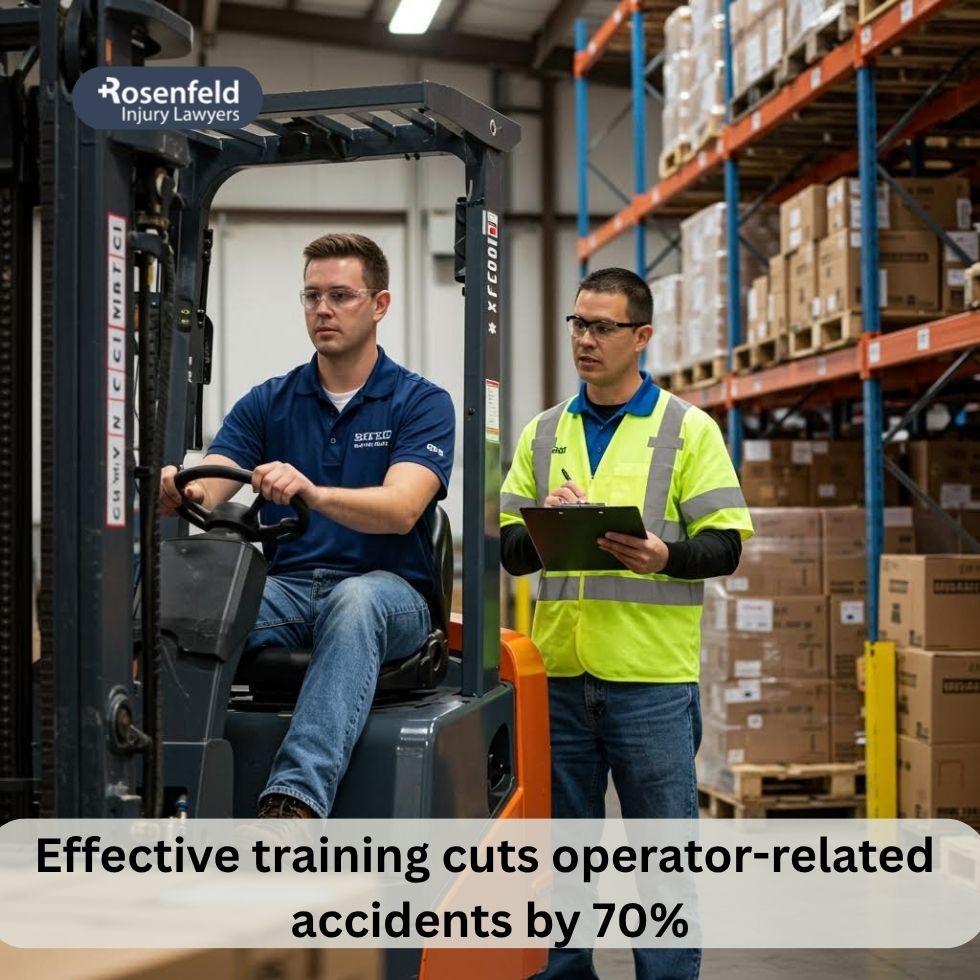
Forklift operators carry a big responsibility. Beyond moving materials, they must ensure each powered industrial truck is in safe working order through a pre-shift vehicle inspection. OSHA stresses that operators must know their forklift’s load capacity, understand forklift types, and follow the manufacturer’s guidelines.
According to 29 CFR 1910.178(l), only trained and competent operators are permitted to operate a powered industrial truck. All powered industrial truck operators must be trained and certified by their organizations before they can legally work.
A certified forklift operator is expected to avoid unsafe driving, report equipment defects immediately, and respond appropriately if observed operating unsafely. Refresher training is required when an operator is involved in an accident, commits driving mistakes, or when workplace changes affect forklift operation.
A valid forklift certification starts with an OSHA-approved training program that combines formal instruction, practical training, and a performance evaluation. OSHA requires this three-part approach to ensure operators are competent in both theory and practice before they’re allowed to operate equipment like lift trucks, aerial lifts, or other industrial truck types.
Formal training covers operating instructions, truck controls, maintenance checks, and hazard awareness. Practical exercises let operators practice maneuvering, stacking, and traveling in different conditions. This is where trainees learn to properly operate a powered industrial vehicle in tight spaces, handle unusual loads, and adjust for any changes.
Once all stages are complete, the employer must provide forklift certification with the operator’s name, the training required, the date of training, and the date of the evaluation.
OSHA mandates that training include a mix of hands-on training, formal instruction, and a workplace evaluation to ensure users possess the skills for safe operation. According to 29 CFR 1910.178(l), every powered industrial truck operator must receive instruction on both truck-related topics and workplace-related topics.
Truck-related training topics include:
Workplace-related topics cover:
If an operator was previously trained in a required topic and has been evaluated as competent, additional training in that area is not required. Trainees may operate a forklift only under the direct supervision of a qualified trainer and in conditions that don’t endanger themselves or others.
A forklift certification course typically follows this sequence:
The OSHA Education Center or other authorized trainers design these courses to meet OSHA compliance rules and to provide certification once all requirements are met. Some employers offer training on-site, while others allow trainees to learn at their own pace or own time with online modules before in-person testing.
The forklift certification cost varies based on the course provider, location, and whether it’s an online forklift certification or an in-person program. While prices range from under $100 for online-only courses to several hundred for on-site training, the expense is minimal compared to the cost of accidents or OSHA penalties.
For employers, covering the certification cost is not just a legal duty, but an investment in occupational safety and productivity.
In the U.S., there is no government-issued “forklift license” like a driver’s license. Instead, OSHA requires that employers provide certification proving each operator has completed the necessary training program and passed both a skills evaluation and final exam. This proof, often called a “forklift operator certificate,” must be kept on file and shown during inspections.
A forklift certificate is issued after an operator successfully completes a certification course and final exam. This document verifies that the operator is properly trained to handle a powered industrial vehicle in their specific workplace.
According to 29 CFR 1910.178(l)(6), employers must provide a certificate once an operator has been trained and evaluated. This documentation must include:
Employers must keep these certificates accessible and update them when certification expires or after refresher training.
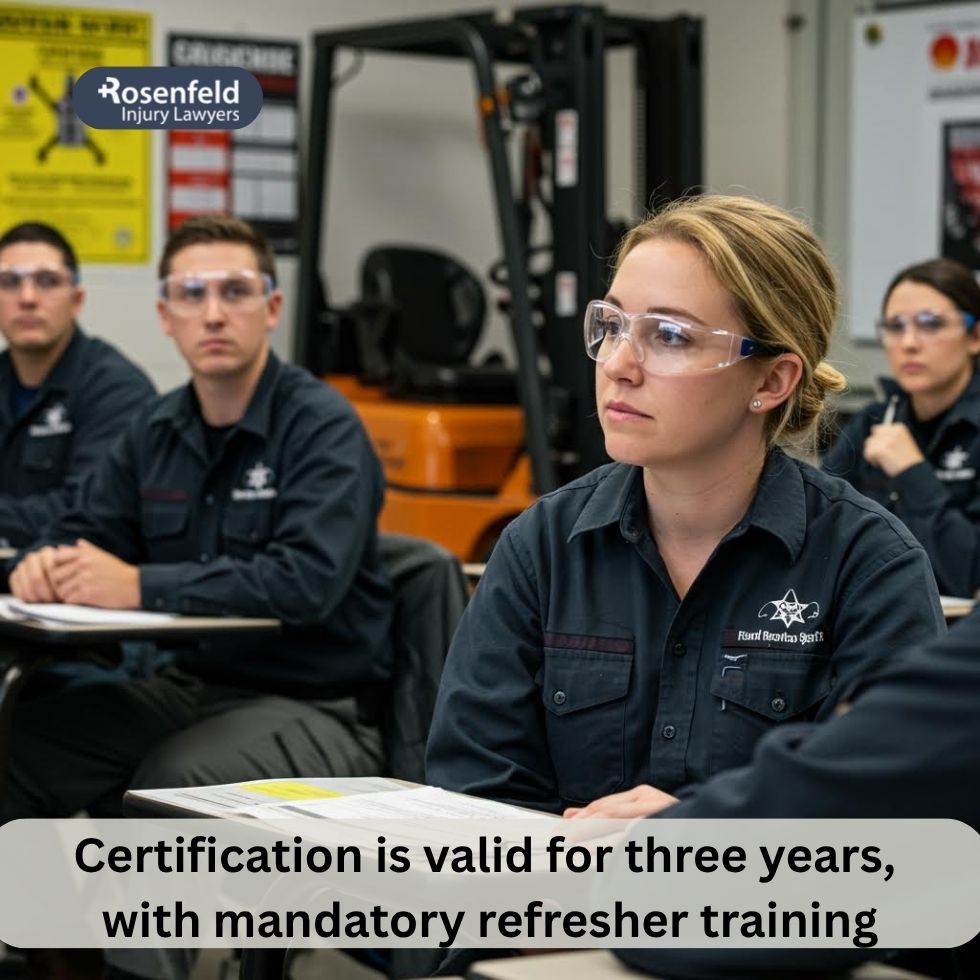
Many workers ask, “Does forklift certification expire?” The answer is yes—OSHA says certification expires after three years, and refresher training is required in certain situations. Under 29 CFR 1910.178(l)(4), refresher training—along with an evaluation of its effectiveness—must be given when:
In addition, OSHA requires each operator’s performance to be evaluated at least once every three years to confirm they remain properly trained.
At our Illinois law firm, we understand that forklift operator certification isn’t just a piece of paper, but proof that an operator has the skills to handle a powered industrial truck safely and in compliance with OSHA forklift standards. When employers cut corners on forklift training, skip hands-on training, or fail to provide certification, they put workers and the public at risk. Our job is to hold them accountable.
Consider Luis, a warehouse worker on Chicago’s South Side. He had never been given proper forklift certification or formal instruction, yet was told to unload lift trucks on a busy dock. Without knowing the correct safety procedures, he lost control, and the load toppled, crushing his leg. We proved the employer violated OSHA requirements and obtained a $3.2 million settlement to cover his medical care, lost wages, and long-term rehab.
Then there’s Tasha, who completed an online forklift certification through a third-party provider, but her employer never offered the practical training OSHA demands. While moving pallets in narrow aisles, she collided with shelving, suffering head and neck injuries. We demonstrated that the training program lacked the certification course elements needed for safe operation, securing $1.9 million to support her recovery and future needs.
We also helped Raymond, a construction supply yard worker in Cicero, who was injured when a co-worker—not a certified forklift operator—was seen operating a powered industrial truck in an unsafe manner. The machine struck Raymond, causing multiple fractures. We showed the employer had failed to keep certification records or enforce OSHA-compliant forklift certification standards, resulting in a $2.7 million settlement.
If you’ve been injured in Illinois because an employer failed to ensure proper forklift operator certification or ignored OSHA standards for powered industrial truck operators, you don’t have to face the recovery process alone. Our Chicago forklift accident lawyer team has the experience, resources, and determination to uncover the truth, hold negligent parties accountable, and fight for the compensation you deserve.
Contact us for a free consultation and speak with a work injury attorney in Chicago who understands occupational safety, OSHA regulations, and the unique challenges of Chicago-area workplaces. We work on a contingency fee basis, so you pay nothing unless we win your case.
Content reviewed by Chicago work accident lawyer Jonathan Rosenfeld of Rosenfeld Injury Lawyers LLC, who holds employers, contractors, and third-party defendants accountable to recover compensation for injured workers, and is a trial lawyer recognized by the Illinois Trial Lawyers Association, the Illinois Workers Compensation Bar Association, and America’s Top 100 High Stakes Litigators.