



OSHA Scaffolding Requirements in Illinois: The Violations Behind Most Scaffold Injuries


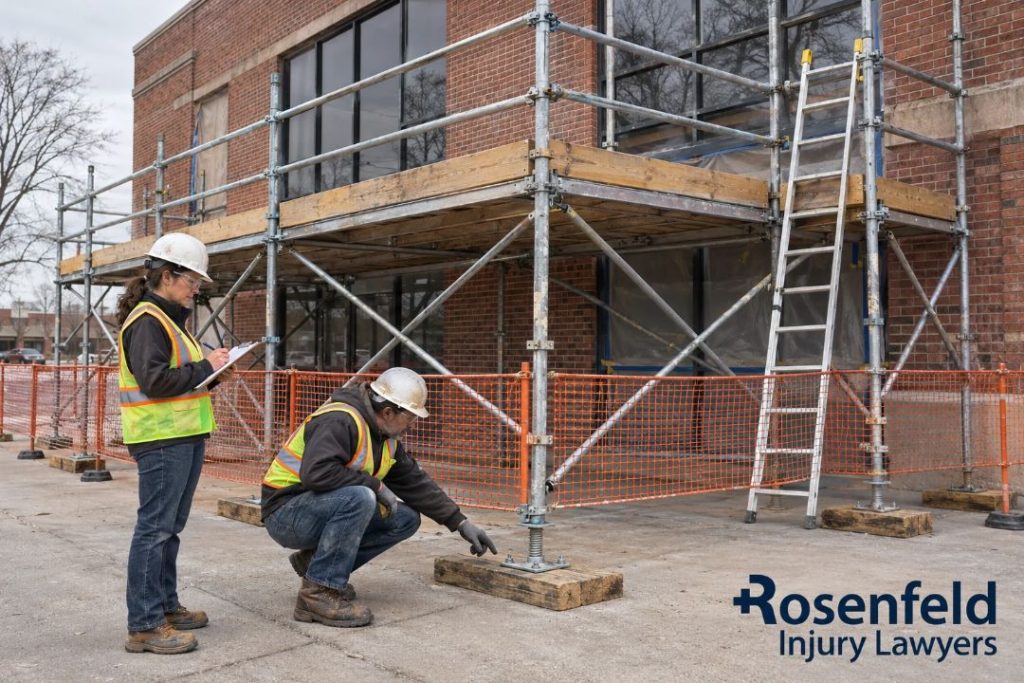
The scaffolding OSHA requirements live in 29 CFR 1926 Subpart L, sections 1926.450 to 1926.454. They set minimums for load capacity, platforms, footing, guardrails, access, inspections, and training. OSHA ranked scaffolding fourth on its preliminary fiscal year 2026 list of most-cited standards. The same few rules get broken again and again in Illinois.
This guide gives each rule, its section number, and the record that proves it. A citation like 1926.451 g1 means paragraph g, item 1 of that section.
What Does OSHA’s Scaffold Standard Cover?
Subpart L covers supported, suspension, and mobile scaffolds used in construction. Section 1926.450 gives scope and definitions. Section 1926.451 holds the general rules. Section 1926.452 covers specific scaffold types, 1926.453 covers aerial lifts, and 1926.454 covers training.
Together, these are the scaffolding OSHA requirements for construction. Appendix A adds nonmandatory specifications.
Who enforces all this in Illinois? Federal OSHA keeps full authority over private-sector workplaces in the state. The Illinois Department of Labor runs a separate state plan for public employees only. So a private contractor on a Chicago high-rise answers to federal OSHA.
OSHA treats scissor lifts as mobile scaffolds. We cover that in our post on how OSHA classifies scissor lifts, so this guide stays on frame and tube scaffolds.
Which Scaffolding Violations Does OSHA Cite Most?
Section 1926.451 ranked fourth on OSHA’s preliminary fiscal year 2026 list of most frequently cited standards. That makes it one of the most common scaffolding violations on any job site. Trade summaries of OSHA data keep pointing to the same five scaffolding OSHA requirements.
- No fall protection above 10 feet, 1926.451 g1.
- Poor footing, with no base plates or mud sills, 1926.451 c2.
- Platforms that are not fully planked, 1926.451 b1.
- No safe way on and off, 1926.451 e1.
- Guardrails that miss the specs, 1926.451 g4.
The order shifts from year to year. Check OSHA’s frequently cited standards search for construction before you quote it. Each rule gets its own section below.
What Are OSHA’s 4-to-1 Rules for Scaffold Load Capacity?
Each scaffold and each component must hold its own weight plus at least four times the maximum intended load, 1926.451 a1. Suspension scaffold rigging must hold at least six times the intended load. Nobody may load a scaffold past its maximum intended load or rated capacity, whichever is less, 1926.451 f1.
Two scaffolding OSHA requirements share the ratio 4 to 1, and people mix them up. The first is capacity, which is the four-times-load rule above. The second is height-to-base width. A supported scaffold taller than four times its smallest base width must be tied, guyed, or braced, 1926.451 c1.
Tie spacing depends on width. Ties go at least every 20 feet vertically for scaffolds three feet wide or less, and every 26 feet for wider ones. Horizontally, the limit is 30 feet.
Intended load counts people, tools, and stacked material. A pallet of block can use up the margin fast. Crews skip these scaffold load capacity rules when they hurry.
What Footing Does a Scaffold Need?
Supported scaffold legs, poles, frames, and uprights must sit on base plates and mud sills or another firm foundation, 1926.451 c2. The ground must carry the loaded scaffold without sinking or shifting.
Loose objects cannot hold up a scaffold or its planks. Barrels, boxes, loose brick, and concrete blocks are banned, 1926.451 c2.
In our experience, the usual failure points are ground that thaws after a freeze, fresh backfill, and uneven slabs. Chicago winters make the first one a real risk. A scaffold that was level on Monday can lean by Thursday.
What Are the Platform and Planking Requirements?
Platforms must be fully planked or decked between the front uprights and the guardrail supports, 1926.451 b1. Gaps are tight. Most scaffold planking requirements come down to the numbers below:
| Requirement | Rule | Section |
| Fully planked | Planked or decked between front uprights and guardrail supports | 1926.451 b1 |
| Gaps | No more than 1 inch between planks or next to uprights | 1926.451 b1 |
| Width | At least 18 inches for most platforms and walkways | 1926.451 b2 |
| Distance from work | Front edge no more than 14 inches from the work face, unless guardrails or fall arrest are used 1 | 1926.451 b3 |
| Overlap | Only over supports, at least 12 inches unless restrained | 1926.451 b7 |
Some scaffold types have narrower width limits, and a few spots around uprights allow wider gaps. Read the full text of 1926.451 b before you rely on a number.
Cracked, split, or overloaded planks cause real trouble. So do missing planks.
When Is Fall Protection Required on a Scaffold?
Every worker on a scaffold more than 10 feet above a lower level needs protection from guardrails, a personal fall arrest system, or both, depending on scaffold type, 1926.451 g1. Workers on single-point and two-point adjustable suspension scaffolds need both.
Why 10 feet and not 6 feet?
General construction fall protection starts at six feet under Subpart M. Scaffolds use their own trigger at 10 feet. Both rules apply on a real job site, so a crew can comply with one and fall out of step with the other. We cover the wider picture in OSHA’s Fatal Four.
How high must guardrails be?
The toprail on a scaffold placed in service after January 1, 2000 must sit between 38 and 45 inches high, 1926.451 g4. Older supported scaffolds may use 36 to 45 inches.
| Component | Requirement | Section |
| Toprail height | 38 to 45 inches, or 36 to 45 inches on older supported scaffolds | 1926.451 g4 |
| Midrail | About halfway between toprail and platform | 1926.451 g4 |
| Toprail strength | At least 200 pounds, or 100 pounds on single and two-point suspension scaffolds | 1926.451 g4 |
| Midrail strength | At least 150 pounds | 1926.451 g4 |
| Toeboards | At least 3.5 inches high | 1926.451 h4 |
Cross bracing can serve as a toprail when its crosspoint sits between 38 and 48 inches above the platform. That is the scaffold guardrail height rule people forget.
What about erectors and dismantlers?
A competent person must decide whether fall protection is feasible and safe for workers who build or take down a scaffold, 1926.451 g2. Falling object protection falls under 1926.451 h. That includes toeboards, screens, debris nets, and canopies. We explain the injury side in our page on falling debris.
How Must Workers Get On and Off a Scaffold?
Access is required when a platform sits more than two feet above or below the point of access. Workers may not climb cross braces, 1926.451 e1.
Approved methods include hook-on or attachable ladders, stair towers, ramps and walkways, integral prefabricated frames, and direct access from another surface. Ladder basics overlap with our guide to OSHA ladder rules on Illinois job sites.
Who Must Inspect a Scaffold, and When?
A competent person must inspect scaffolds and components for visible defects before each work shift and after anything that could affect structural integrity, 1926.451 f3. Think of wind, impact from a crane, or a load shift. That covers most scaffold inspection requirements in one sentence.
OSHA defines a competent person as someone who can spot existing and predictable hazards and has authority to fix them fast. A qualified person has a recognized degree or certificate, or deep knowledge and training, and has shown the ability to solve problems on the subject. The two terms are not the same.
A competent person also handles these jobs.
- Directs erection, moving, dismantling, and alteration, 1926.451 f7.
- Decides on fall protection for erectors, 1926.451 g2.
- Approves work during storms or high winds, with fall arrest or wind screens, 1926.451 f12.
Federal OSHA does not require a specific written inspection form for supported scaffolds, as far as we can tell from the standard. Many contractors still use tag systems and checklists. Those tags often become the best proof of what was checked.
What Training Does OSHA Require for Scaffold Work?
Section 1926.454 sets two training tiers. Workers who use a scaffold must be trained by a qualified person. Workers who erect, move, dismantle, repair, maintain, or inspect one must be trained by a competent person.
| Who | Trained by | Must cover |
| Anyone working on a scaffold | A qualified person | Electrical, fall and falling object hazards, proper use, load limits and other Subpart L rules |
| Erectors, dismantlers, repairers and inspectors | A competent person | Scaffold hazards, correct procedures for that scaffold type, design criteria, intended load and other Subpart L rules |
Retraining is required in three cases. A site change creates a hazard the worker was not trained on. The type of scaffold or protection changes. Or the worker’s performance shows lost skill, 1926.454 c. These scaffold training requirements exist so that nobody learns on the job at height.
What Are the Power Line, Weather and Debris Rules?
Keep scaffolds well away from power lines. Insulated lines under 300 volts need at least 3 feet of clearance. Lines from 300 volts to 50 kilovolts need at least 10 feet, 1926.451 f6. Higher voltages need more room. See our page on construction electrocution accidents for what goes wrong.
Weather and housekeeping rules matter too.
- No work on a scaffold covered with snow, ice or other slippery material, except to remove it, 1926.451 f8.
- No work in storms or high winds unless a competent person approves and workers are protected, 1926.451 f12.
- No debris build-up on platforms, 1926.451 f13.
Which Records Prove Each Requirement?
After a scaffold fall, the first question is what was in place. Every one of the scaffolding OSHA requirements leaves a trail, if anyone kept it.
| Requirement | Record to look for |
| Capacity and 4 to 1 | Load rating, erection drawings |
| Pre-shift inspection | Inspection tags, checklists |
| Training | Certificates, sign-in rosters |
| Planks, rails, base plates, access | Dated photos |
| Weather stops | Weather logs, daily reports |
An OSHA violation does not by itself decide who pays. Responsibility depends on Illinois law and who controlled the scaffold. Our post on who is liable for a scaffolding accident in Illinois covers that. For the wider rule set, see our summary of OSHA construction safety regulations.
FAQs About Scaffolding OSHA Requirements
Core scaffolding OSHA requirements include a load capacity of at least four times the intended load and firm footing. Scaffolds also need full planking, guardrails, safe access, competent person inspections, and trained workers under 1926.451 and 1926.454.
Fall protection starts at 10 feet above a lower level. Workers need guardrails, a personal fall arrest system, or both, depending on scaffold type, under 1926.451 g1.
A competent person must inspect it before every work shift. Another inspection is needed after any event that could affect structural integrity, such as a strike or high wind, 1926.451 f3.
It means two things. A scaffold must carry four times its maximum intended load. A supported scaffold taller than four times its base width must be tied, guyed or braced.
Workers trained by a competent person on scaffold hazards and procedures. A competent person must also direct the work and decide on fall protection for the crew.
How Can You Check a Scaffold Against the Rules?
If you were hurt on a scaffold, start by writing down what you saw. Note the planks, rails, footing, and access. A Chicago scaffolding accident lawyer can help you sort out which records matter. At Illinois Work Injury Lawyer, we offer a free consultation and take cases on contingency, so you pay no fees unless we win. Call 312-757-7348 to talk through your scaffolding OSHA requirements questions.
This post is general information, not legal advice.
 Legally Reviewed By
Attorney Jonathan Rosenfeld
Content legally reviewed by Jonathan Rosenfeld The information on this page has been legally reviewed by Attorney Jonathan Rosenfeld, founder and managing partner of Rosenfeld Injury Lawyers LLC. With extensive experience representing injured workers across Illinois, Mr. Rosenfeld is dedicated to helping workplace accident victims pursue the maximum compensation available under the law. His extensive legal knowledge and commitment to client advocacy ensure that the information provided is accurate, reliable, and aligned with current legal standards.