



Do You Need a Harness on a Scissor Lift? What OSHA Actually Requires


Do you need a harness on a scissor lift? In most cases, no. OSHA treats scissor lifts as work platforms covered by the scaffold standard, so a compliant guardrail system generally provides the required fall protection. You may need a personal fall arrest or restraint system when guardrails are not provided or cannot protect the worker, or when the manufacturer or employer requires additional protection.
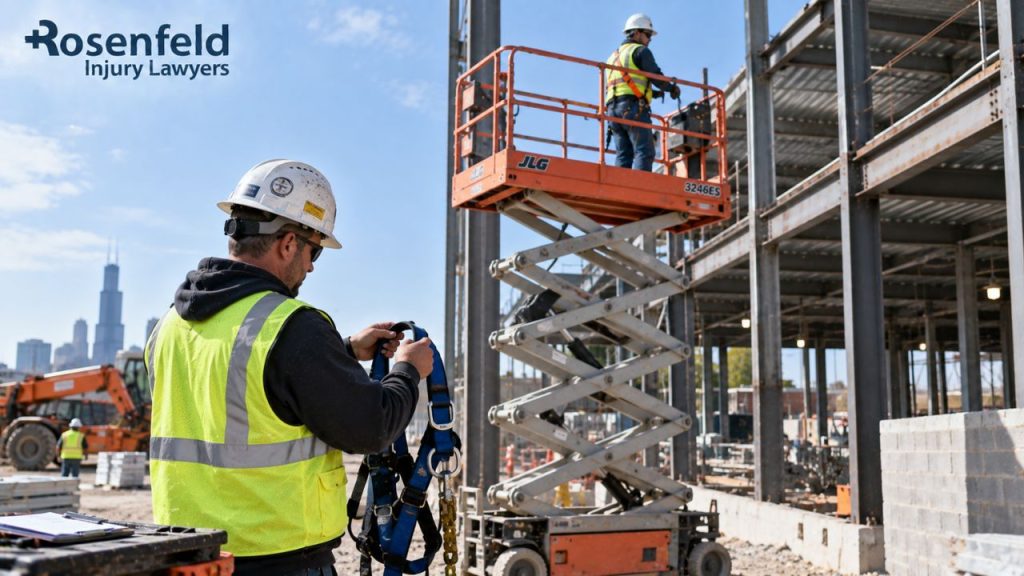
Do You Need a Harness on a Scissor Lift Under OSHA Rules?
No, not automatically. The equipment falls under the scaffold standard rather than the aerial lift standard, so OSHA does not require every operator to wear a harness.
Guardrails that meet height and strength requirements count as adequate protection on their own. Workers still need training, and employers must keep the guardrail system properly maintained and in place. Missing, damaged, or incomplete guardrails can create a serious fall hazard on Illinois job sites.
Why Does OSHA Treat a Scissor Lift as a Scaffold Instead of an Aerial Lift?
A scissor lift raises and lowers a platform vertically, while an aerial lift such as a boom lift uses a boom to position the platform. OSHA regulates aerial lifts under a separate standard, and workers operating from aerial lifts must use the fall protection required by that standard.
When Do Guardrails Satisfy OSHA’s Fall Protection Standard?
Guardrails satisfy the standard when they are complete, properly installed, and rated to withstand the forces required by the scaffold rule. Toprails, midrails, or other compliant intermediate members must meet OSHA’s guardrail requirements.
Workers also have to do their part. Standing on the platform floor and never climbing onto the rails preserves the protection the guardrails provide.
Is a Scissor Lift the Same as a Boom Lift for Harness Rules?
No. A boom lift always requires tie-off under OSHA’s aerial lift standard, no matter how solid its guardrails look. Scissor lifts are subject to different fall protection requirements, even though both machines are commonly called lifts on a job site.
When Is a Harness Actually Required on a Scissor Lift?
A personal fall protection system may be required or appropriate in several situations:
- The required guardrail system is missing, damaged, or cannot provide the necessary protection
- The manufacturer’s operating instructions require personal fall protection
- The equipment or task requires workers to use a personal fall arrest or restraint system
- A site-specific safety plan or contractor policy establishes stricter requirements than OSHA’s minimum
Select and use the specific fall protection system according to OSHA requirements, the equipment manufacturer’s instructions, and the job conditions.
What Happens If Guardrails Are Missing or Damaged?
If a required guardrail is missing, damaged, or removed, the employer must address the fall hazard before allowing work to continue. Depending on the circumstances, this may require repairing the guardrail or using an appropriate personal fall protection system.
What Type of Fall Protection System Works Best on a Scissor Lift?
When a harness is required or chosen as an extra precaution, a full-body harness connected to a short lanyard anchored at a manufacturer-rated point is the accepted approach. A body belt may be used in a restraint system in appropriate circumstances, but personal fall arrest systems require equipment that meets OSHA’s applicable requirements. The specific system should be selected based on the equipment, task, and manufacturer’s instructions.
What Causes Most Scissor Lift Falls in Illinois?
Common factors include operating on uneven or sloped ground, exceeding the lift’s rated weight capacity, moving the lift while a worker is elevated, and gaps in operator training. Rushed timelines and crowded warehouse floors, where the lift has little room to maneuver, tend to make these hazards worse.
What Should You Do After a Scissor Lift Fall or Accident?
Get medical care first, even if an injury seems minor. Then report the incident to a supervisor, photograph the lift and surrounding area, and collect contact information from anyone who witnessed what happened. These steps protect your health and your ability to pursue workers’ compensation benefits for the medical bills and lost wages tied to the accident.
Can You File a Claim If OSHA Rules Were Violated?
Yes. A missing guardrail, a lack of operator training, or ignoring a manufacturer’s harness requirement can all count as OSHA violations that strengthen a work injury claim. Illinois workers’ compensation does not require proving fault, but OSHA violations can still support a third-party claim against a contractor, property owner, or equipment manufacturer when someone besides your employer contributed to the accident.
Talk to a Chicago Work Injury Lawyer About Your Scissor Lift Accident
A fall from a scissor lift can mean fractures, head trauma, or worse, along with mounting medical bills. If you were hurt because a guardrail was missing, a lift was poorly maintained, or you were never properly trained, an Illinois Work Injury Lawyer can review what happened and explain your options for compensation. Contact us today for a free consultation.
Frequently Asked Questions
Usually not. OSHA generally allows compliant guardrails to provide fall protection on scissor lifts, although personal fall protection may be required when guardrails cannot provide the necessary protection or additional protection is required.
OSHA’s scaffold fall protection standard, 29 CFR 1926.451(g), applies to scissor lifts. A compliant guardrail system generally provides the required fall protection.
Fall protection is required when working from an aerial lift, and OSHA’s rules require workers to use the appropriate personal fall protection specified for the equipment and circumstances. The requirements differ from those governing scissor lifts.
Yes. Employers, manufacturers, and site safety plans can set stricter rules than OSHA’s minimum, and workers must follow whichever standard applies on that job.
Seek medical care, report the accident, and document the missing guardrail with photos. Then speak with a work injury attorney about your claim.
 Legally Reviewed By
Attorney Jonathan Rosenfeld
Content legally reviewed by Jonathan Rosenfeld The information on this page has been legally reviewed by Attorney Jonathan Rosenfeld, founder and managing partner of Rosenfeld Injury Lawyers LLC. With extensive experience representing injured workers across Illinois, Mr. Rosenfeld is dedicated to helping workplace accident victims pursue the maximum compensation available under the law. His extensive legal knowledge and commitment to client advocacy ensure that the information provided is accurate, reliable, and aligned with current legal standards.