



Why Cranes Fail: Load Charts, Ground Conditions and Other Crane Accident Causes


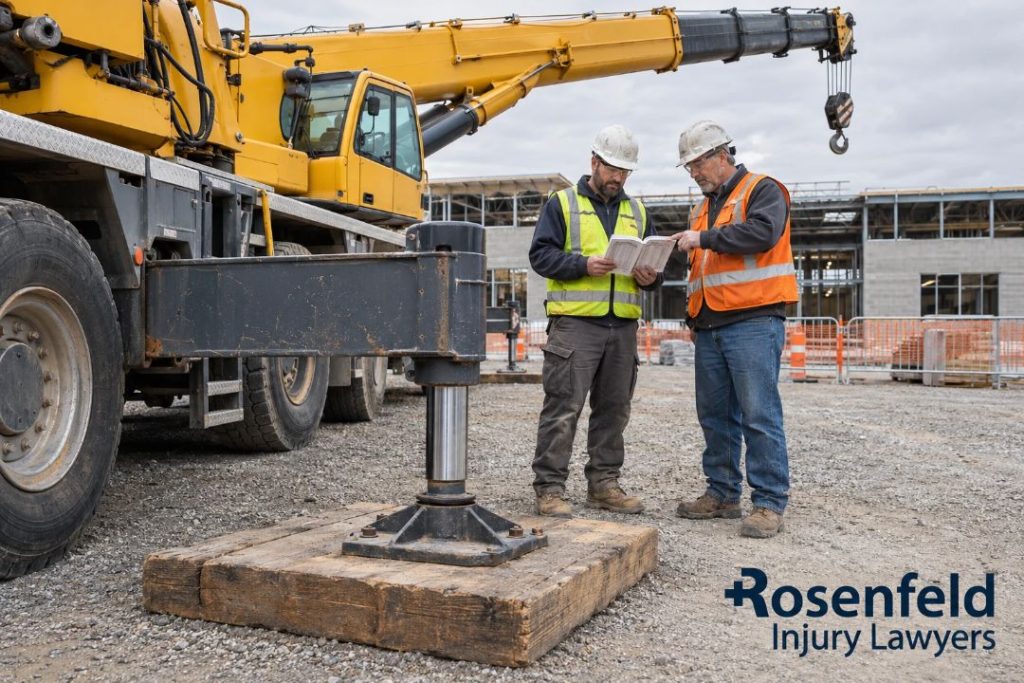
Most crane accident causes come down to a short list of technical failures: a lift beyond the load chart, weak ground, wind, two-blocking, bad rigging, and power line contact. An unqualified operator or a disabled safety device usually makes each one worse. Federal crane rules in 29 CFR 1926 Subpart CC address every item on that list. In Chicago, operators also need a City license. This guide explains how each failure happens and which rule is meant to stop it.
What Are the Most Common Crane Accident Causes?
The most common causes are overloading, poor ground support, wind, two-blocking, rigging failures, contact with power lines, and unqualified operators. Most start with a planning or setup mistake, not a sudden machine breakdown.
The Bureau of Labor Statistics counted 297 crane-related worker deaths from 2011 to 2017, about 42 a year. Just over half involved a worker struck by an object or equipment. Illinois recorded 14, tied with California for fourth among states.
These common causes of crane accidents show up again and again:
- Overloading and load chart errors
- Poor ground and outrigger setup
- Wind and weather
- Two-blocking
- Rigging failures and dropped loads
- Power line contact
- Unqualified operators and missed inspections
- Assembly and disassembly errors
How Does a Load Chart Limit a Lift?
A load chart lists how much weight a crane can lift in each setup. Capacity is not one number. Capacity drops as the load moves farther out and shifts with boom length, boom angle, counterweight, and outrigger position.
Radius is the distance from the crane’s center of rotation to the load. Small changes matter. Swing a load out a few extra feet and the crane may be working past its rating. That is why overloading ranks among the leading crane accident causes.
| Change in the lift | What happens to capacity | Illustrative example |
| Load moves farther out | Capacity falls fast | 40,000 pounds at a short reach, 12,000 pounds at a long reach |
| Boom gets longer | Capacity falls at the same radius | Longer boom, lower rating |
| Outriggers not fully extended | The full-extension chart no longer applies | Wrong chart, tipping risk |
These numbers are illustrative only. Crews must use the chart for the exact crane and setup.
Two limits sit behind every chart. At short radius, the boom or structure usually limits the load. At long radius, the crane tips before the steel gives out.
Crews get it wrong in familiar ways:
- Using the wrong chart for the configuration.
- Forgetting to subtract the hook block, slings, spreader bars, and a stowed jib.
- Underestimating the weight of the load.
- Booming down or swinging out to a longer radius mid-lift.
- Side-loading or dragging a load.
Section 1926.1417 requires load charts to be readily available in the cab and bars operating beyond rated capacity. Section 1926.1416 requires a boom angle or radius indicator the operator can read. It also requires a load-weighing device, load moment indicator, or limiter on most cranes built after March 29, 2003, with a rated capacity over 6,000 pounds.
How Do Ground Conditions and Outriggers Fail?
Ground fails when it can’t support the crane and load together. Soft soil, buried voids, and small outrigger pads can let one corner sink, causing the crane to tip.
Ground problems often hide in plain sight:
- Soft or saturated soil
- Recent backfill
- Buried voids such as basements, vaults, utility tunnels, tanks and sewers
- Slopes
- Freeze and thaw
- Outrigger pads that are too small
- Outriggers not fully extended or not set as the chart assumes
Section 1926.1402 says ground must be firm, drained, and graded enough, with mats, cribbing, or blocking where needed, to meet the manufacturer’s support and level rules. The controlling entity must ensure ground preparations are in place. It must tell the crane user and operator about known hazards below the setup area, such as voids, tanks, or utilities.
Cranes with outriggers built after November 8, 2011 need an outrigger position monitor. Dense downtown sites often put crane pads over or beside old foundations, vaults, and utility corridors. Those hidden voids are among the harder crane accident causes to spot before a lift.
How Does Wind Affect a Crane?
Wind adds side load and can swing a suspended load. That increases stress on the boom, even when the weight is within the chart. Large flat loads catch the most wind.
Panels, glass, HVAC units, and formwork act like sails. Manufacturers publish crane wind limits for each model. Section 1926.1417 requires the competent person to adjust the equipment or operations for wind, ice, and snow, because those conditions change stability and rated capacity. On lakefront and high-rise sites, gusts at height can run stronger than at ground level.
What Is Two-Blocking on a Crane?
Two-blocking happens when the hook block or overhaul ball is pulled into the boom tip. The hoist line can part, dropping the block and the load. It usually happens when the boom is telescoped out or lowered without paying out enough hoist line, or when the operator hoists too far.
An anti-two-block device prevents this, making two-blocking one of the more preventable causes of crane accidents. Under section 1926.1416, telescopic boom cranes built after February 28, 1992 need a device that automatically prevents damage. Lattice boom cranes built after that date need one that prevents damage or warns the operator. Lattice cranes built after November 8, 2011 need one that automatically prevents damage and load failure at every point where two-blocking can occur. Some crane types are exempt.
A broken or bypassed device is a key fact to check after an incident. Operational aids of this kind generally must be repaired within 7 calendar days, with temporary measures in place.
What Rigging Failures Drop Loads?
Rigging fails when the sling, hardware, or hitch cannot handle the real forces on the load. Common culprits include the wrong sling, steep angles, damaged gear, and unbalanced loads. The load then falls on whoever is below, which is why rigging belongs among the crane accident causes that endanger ground crews.
- Wrong sling or hardware for the weight
- Sling angles that multiply tension
- Worn or damaged slings
- Unprotected sharp edges
- Off-center loads
- No tag lines
Angles deserve extra respect. Measured from the horizontal, a 30-degree angle makes each leg of a two-leg sling carry about twice its share of the weight.
Section 1926.1425 keeps workers out of the fall zone of a suspended load, with limited exceptions. Slings and hardware must also meet section 1926.251, and many rigging tasks call for a qualified rigger. For the injury side of dropped loads, see our guide on being struck by a falling object on a job site.
How Close Can a Crane Get to Power Lines?
For lines up to 350 kV, OSHA generally requires every part of the crane, load line, and load to stay 20 feet away. Table A allows shorter distances at lower voltages. The other choice is to have the utility de-energize and ground the line.
Before work near lines, the employer must identify the work zone. Table A sets 10 feet for lines up to 50 kV, 15 feet over 50 to 200 kV, and 20 feet over 200 to 350 kV. Lines over 350 kV carry longer distances.
When using the 20-foot or Table A option, section 1926.1408 adds encroachment prevention steps:
- A planning meeting with the operator and crew
- Non-conductive tag lines
- An elevated warning line or barricade
- At least one of a proximity alarm, dedicated spotter, range control warning device or range limiter
These crane power line clearance rules exist because contact can electrocute workers on the ground. We cover that risk in our article on electrocution on a construction site.
Who Can Operate a Crane in Chicago?
An operator needs federal certification or licensing, and in Chicago, a City crane operator license too. Employers must also evaluate each operator on the equipment they will run. Inspections and signal persons complete the picture. Gaps here are among the quietest causes of crane accidents.
OSHA Operator Certification
Section 1926.1427 requires employers to make sure operators are trained, certified or licensed, and evaluated. Crane operator certification comes from an accredited testing body, is based on equipment type and capacity, and lasts 5 years. The employer pays for it. The employer must also document each operator’s skills. Equipment rated 2,000 pounds or less, derricks, and sideboom cranes are excluded.
Chicago Crane Operator License
A Chicago crane operator license is required to operate a crane on any work that needs a building permit. The Board of Crane Operator Examiners issues it through the Department of Buildings under Chapter 4-288 of the Municipal Code. Each license lists the equipment classes the operator may run. National certification does not replace it. A license lasts one to five years, so the date matters.
Inspections and Signal Persons
Section 1926.1412 requires a competent person to inspect the crane each shift and monthly, and a qualified person to inspect it annually. When the operator’s view is blocked, sections 1926.1419 and 1926.1428 require a qualified signal person.
What Other Causes Lead to Crane Failures?
Crane failures also come from assembly mistakes, deferred maintenance, and crowded sites. These causes get less attention but cause just as much harm.
- Assembly and disassembly errors, such as pulling pins or counterweights in the wrong order. Section 1926.1404 requires an assembly and disassembly director.
- Maintenance put off and defects ignored.
- Rotating-body hazards, where Section 1926.1424 requires barricades around accessible areas. We explain the wider issue in our post on swing radius hazards around cranes and backhoes.
When Does a Technical Failure Point to Fault?
A broken safety rule can support a claim, but it does not decide one on its own. Illinois Pattern Jury Instruction Civil 60.01 lets a jury treat a regulation violation as evidence of negligence, not automatic proof.
Workers’ compensation is no-fault and usually the only claim you have against your employer. A crane lift often involves several companies, though, and one may face a separate claim. Our guides explain who is responsible for a crane accident and when you can sue instead of only claiming workers’ comp.
Crane Accident FAQs
In federal data, being struck by a load or equipment accounts for just over half of crane deaths. Overloading, weak ground, and rigging errors often start those events.
Two-blocking is when the hook block is pulled into the boom tip. The hoist line can snap, and the block and load can fall.
Cranes tip when the load pulls harder than the crane’s base can resist. Overloading, long reach, soft ground, poorly set outriggers, and wind are the usual triggers.
Yes. Chicago requires a City crane operator license on permitted work, and national certification does not replace it. OSHA separately requires operators to be certified or licensed.
For lines up to 350 kV, OSHA sets 20 feet unless Table A allows less or the line is de-energized and grounded. Higher voltages need more distance.
Conclusion: What to Do After a Crane Failure
The records usually explain the lift. After an incident, we look for the load chart and lift plan, load moment indicator logs, anti-two-block repair records, inspection logs, and the operator’s certification and City license. These can disappear fast.
If you were hurt, talk to a Chicago crane accident attorney at Illinois Work Injury Lawyer. The consultation is free, and you pay nothing unless we win. Call 312-757-7348, or start with what to do after a construction accident at work in Illinois, and we will help you understand the causes of your crane accident injury.
 Legally Reviewed By
Attorney Jonathan Rosenfeld
Content legally reviewed by Jonathan Rosenfeld The information on this page has been legally reviewed by Attorney Jonathan Rosenfeld, founder and managing partner of Rosenfeld Injury Lawyers LLC. With extensive experience representing injured workers across Illinois, Mr. Rosenfeld is dedicated to helping workplace accident victims pursue the maximum compensation available under the law. His extensive legal knowledge and commitment to client advocacy ensure that the information provided is accurate, reliable, and aligned with current legal standards.