



Struck by a Falling Object on a Job Site: Who Is Liable in Illinois?


Struck by falling object at work cases in Illinois usually open two paths. Workers’ compensation pays your medical bills and part of your wages, no matter who caused the accident. A separate lawsuit may also be possible against a party other than your employer, such as a general contractor, a property owner, or an equipment maker.
What Counts as a Struck-By Accident on a Job Site?
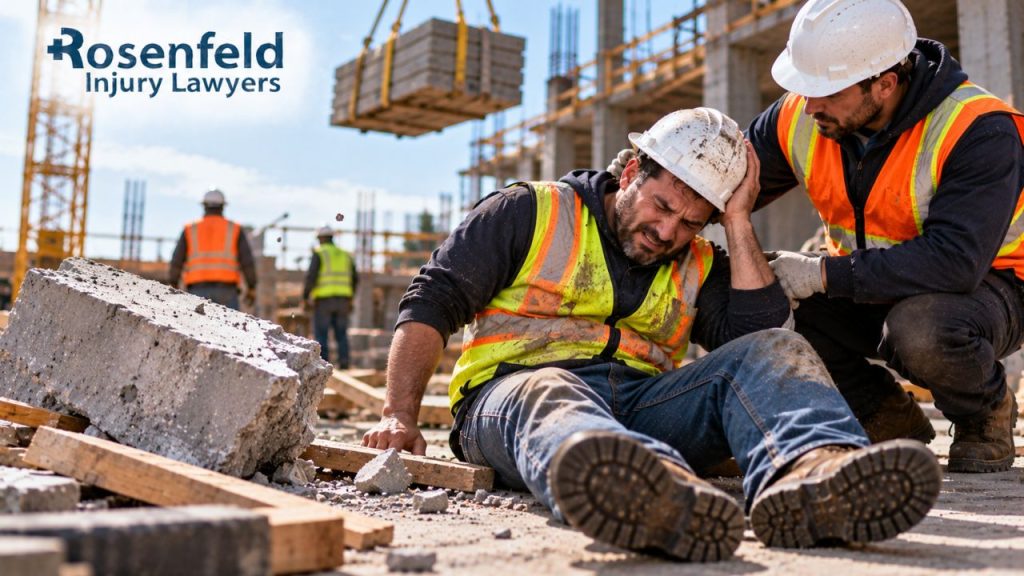
A struck-by accident is any forceful hit from an object or equipment. A dropped tool, a loose brick, or a falling pipe all count. The worker can be on the ground or at height.
OSHA lists struck-by hazards among the Fatal Four in construction, next to falls, electrocutions, and caught-in or caught-between accidents.
Picture a wrench knocked off a scaffold plank, or a crane load that shifts mid-lift. The harm can be lasting, such as a construction brain injury. Our page on falling debris injuries covers common causes.
Can You Sue Your Employer in Illinois?
Usually, no. Illinois workers’ compensation is a no-fault system. Your employer pays benefits, and in return you generally cannot sue the employer for the same injury.
Benefits cover medical care, a share of lost wages, and disability payments, but not pain and suffering. Our guide to workers’ compensation for construction workers in Illinois explains each benefit.
Independent contractors sit outside this system and may sue the responsible company directly.
Who Else Can Be Held Liable?
Several parties can share blame beyond your employer. In struck by falling object at work cases, the usual targets are general contractors, subcontractors, property owners, and manufacturers.
- General contractor: ran the site and set the safety rules.
- Subcontractor: had a crew working overhead.
- Property owner: kept control over site conditions.
- Equipment maker or supplier: supplied gear that failed.
OSHA’s multi-employer policy looks at four roles: the employer that created the hazard, the one that exposed workers to it, the one responsible for fixing it, and the one in control of the site. A controlling contractor can be cited even when its own crew was not hit.
A jury awarded a Lisle ironworker more than $20 million after a steel beam fell during a crane lift, finding the general contractor failed to supervise safety. See our page on crane accident claims. Results depend on the facts of each case.
Which Safety Rules Apply to Falling Objects?
OSHA’s construction rules in 29 CFR Part 1926 require hard hats, falling object protection, and secure material storage. A violation does not decide a case alone, but it often shows where the site failed.
Three rules come up in struck by falling object at work cases:
- Hard hats: Section 1926.100 requires head protection where falling objects are a danger.
- Scaffolds: Section 1926.451 requires toeboards, screens, guardrails, or barricades to protect people below. See our page on scaffolding accident claims.
- Stored materials: Section 1926.250 requires stacked material to be secured against sliding, falling, or collapse.
For the wider rulebook, read our explainer on OSHA construction safety regulations.
What Is the Kotecki Cap?
The Kotecki cap limits how much your employer must pay when another defendant asks it to share the cost. The Illinois Supreme Court set the rule in Kotecki v. Cyclops Welding Corp. The cap generally limits the employer’s contribution to the third-party defendant to the amount of workers’ compensation liability the employer has to the employee.
Say you sue the general contractor. The contractor may try to pull your employer into the case to split the bill. The cap limits your employer’s share, though contracts can waive it.
The cap does not limit what you can recover from the third party. Your employer’s insurer may hold a lien on part of that recovery for benefits already paid. In a struck by falling object at work claim, these details can change what you take home.
How Long Do You Have to File?
Act fast after a struck by falling object at work injury. You must tell your employer about the injury within 45 days. A workers’ compensation claim generally must be filed within three years of the accident or two years after the last benefit payment, whichever is later.
A personal injury lawsuit usually has a two-year deadline. Families facing a loss can read about fatal construction accident claims in Illinois. The construction accident lawsuit process shows what follows filing.
Fault matters too. Illinois reduces your recovery by your share of fault, but you generally cannot recover damages if you are more than 50% at fault.
What Should You Do After a Falling Object Hits You?
Take these steps:
- Get medical care and say the injury happened at work.
- Report it to your employer in writing.
- Photograph the area, overhead work, and the object.
- Collect witness names and numbers.
- Skip recorded insurer statements until you have legal advice.
Falling Object Injury FAQs
Yes. Illinois workers’ compensation covers employees hurt on the job whether or not anyone was careless. It pays medical care and part of your lost wages.
Often, yes. A general contractor that controlled site safety may face a third-party claim, even if you worked for a subcontractor.
Not automatically. Workers’ compensation is no-fault. In a third-party lawsuit, your recovery may be reduced by your share of fault, but you generally cannot recover damages if you are more than 50% at fault.
Report it within 45 days. A workers’ compensation claim generally follows within three years, and a personal injury lawsuit within two years.
Workers’ compensation likely will not cover you. You may still sue a negligent contractor, property owner, or manufacturer directly for a falling object injury.
Need Help Sorting Out Who Is Responsible?
If something fell on you at work, a short call can clarify your options before deadlines pass. At Illinois Work Injury Lawyer, we review the site, the contracts, and the safety record, then explain your path. Consultations are free, and we collect fees only if we recover compensation. Contact us today to request a free consultation, and we will walk through who may owe you for a struck by falling object at work injury.
 Legally Reviewed By
Attorney Jonathan Rosenfeld
Content legally reviewed by Jonathan Rosenfeld The information on this page has been legally reviewed by Attorney Jonathan Rosenfeld, founder and managing partner of Rosenfeld Injury Lawyers LLC. With extensive experience representing injured workers across Illinois, Mr. Rosenfeld is dedicated to helping workplace accident victims pursue the maximum compensation available under the law. His extensive legal knowledge and commitment to client advocacy ensure that the information provided is accurate, reliable, and aligned with current legal standards.