



Backhoe Blind Spots and Swing Radius: Why Ground Workers Keep Getting Struck


A backhoe swing radius accident happens when a rotating excavator or backhoe strikes, crushes, or pins a worker standing inside the machine’s turning path. These incidents remain one of the most preventable and most serious causes of struck-by injuries on Illinois job sites.
The danger comes from factors such as an operator’s blind spots, the strong force of a swinging counterweight or boom, and a work culture that may treat proximity to heavy equipment as normal rather than dangerous.
Federal safety data keeps showing that backhoe and excavator accidents often lead to crush injuries, lost limbs, and even deaths among workers, on-the-ground laborers, and even people who are just passing by and don’t realize they’re in the machine’s path.
Understanding how these accidents happen and who can be held accountable afterward is the first step toward both prevention and recovery.
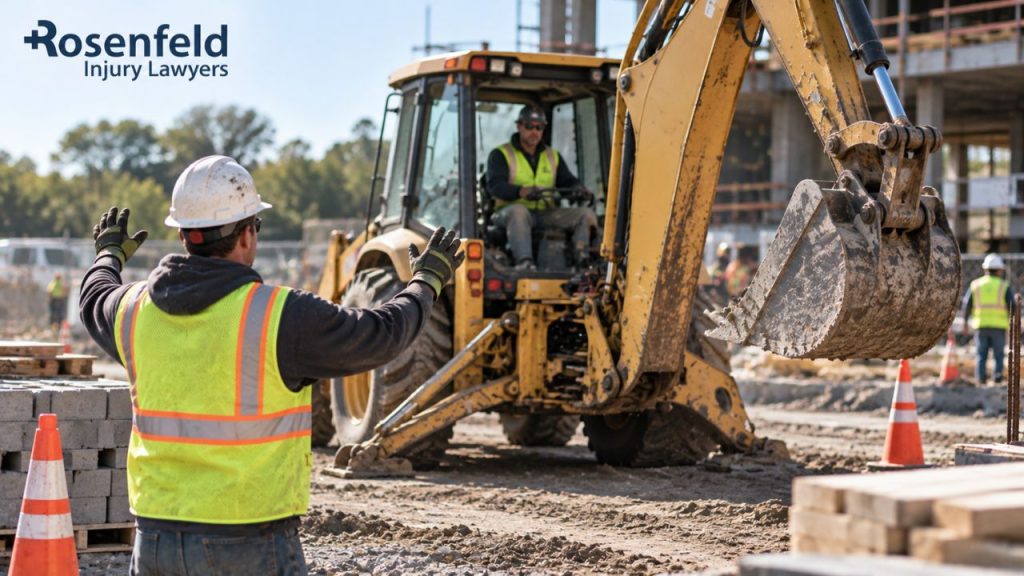
What Is a Backhoe Swing Radius Accident?
The swing radius is the circular area a backhoe’s rotating superstructure covers as it pivots to dig, load, or dump material. Anyone standing inside that arc when the cab, counterweight, or boom swings risks being struck or pinned against a wall, vehicle, or other equipment.
Federal regulators have long treated this hazard seriously. Under OSHA’s construction standards interpretation on barricading the swing radius, employers must apply the same rotating-superstructure precautions used for cranes to backhoes and excavators doing similar lifting or digging work. The rule exists because a swinging counterweight can crush a worker just as easily as a crane’s turning cab.
Why Do Backhoe Blind Spots Put Ground Workers at Risk?
Backhoe operators sit high up on their machines. The counterweight, boom, and cab block a lot of the space behind and to the sides of the equipment. A worker who is crouching down to connect a pipe guides a bucket. Clean-up debris can vanish from the operator’s sight in just a few seconds.
The National Institute for Occupational Safety and Health has made it clear that workers must never stand within the swing radius of an operating excavator even if the machine looks still, a broken attachment or sudden movement can lead to crush injuries.
According to OSHA’s Construction eTool on struck-by hazards, roughly 75 percent of struck-by fatalities on construction sites involve heavy equipment such as backhoes, excavators, and cranes. Ground workers without a clear communication line to the operator face the highest risk.
What Does OSHA Require for Swing Radius Safety?
Federal law under 29 CFR 1926.602 governs the safe operation of earthmoving equipment, including backhoes. Employers must train operators, maintain equipment properly, and keep workers clear of rotating machinery.
Practical safeguards recommended by OSHA’s construction training materials include:
- Barricading the swing radius so ground personnel cannot enter it unnoticed
- Assigning a designated spotter with a clear sightline to the operator
- Requiring visible acknowledgment from the operator before a worker approaches
- Never allowing employees under a suspended load or bucket
- Maintaining functioning backup alarms and mirrors on the equipment
Who Can Be Held Liable After a Backhoe Swing Radius Accident?
Liability in a backhoe accident claim depends on what caused the swing radius failure. If an operator ignored proper communication protocols or failed to confirm workers were clear before rotating the machine, the operator’s employer may be liable through a negligence or third-party claim.
General contractors who fail to enforce site-wide barricading rules can also share responsibility, like equipment owners who fail to maintain backup alarms, mirrors, or hydraulic swing controls.
As Illinois job sites often involve several companies working together, identifying every liable party typically requires investigating training records, maintenance logs, and witness statements. Our firm has represented workers hurt in similar heavy equipment accidents and backhoe accident claims, and we know how to trace fault across contractors, operators, and manufacturers.
What Compensation Is Available for Struck-By Injuries in Illinois?
Workers hurt by a swinging backhoe generally have two potential paths to recovery. A workers’ compensation claim covers medical treatment and a portion of lost wages regardless of fault, but it does not include pain and suffering.
If a third party, such as another contractor or the equipment manufacturer, contributed to the accident, a separate personal injury lawsuit may allow the worker to pursue additional damages, including pain and suffering, disfigurement, and loss of normal life. Families of workers killed in a fatal swing radius incident may also have grounds for a fatal construction accident claim under Illinois law.
How Can Ground Workers and Employers Prevent These Accidents?
Preventing a backhoe swing radius accident starts with treating the rotating superstructure as a hazard zone. An employer should enforce barricades, require radio or hand-signal confirmation before workers enter the area, and inspect backup alarms and mirrors on a regular schedule.
Ground workers should never assume an operator can see them, even when the machine looks idle. Waiting for direct eye contact or a verbal signal before approaching a backhoe and staying alert to nearby excavation accident hazards such as open trenches remains one of the most effective ways to avoid a preventable injury.
Contact IL Work Injury Lawyer
If you or a loved one was hurt in a backhoe swing radius accident, our attorneys can help you understand your legal options and pursue the compensation you deserve. Contact us today for a free consultation about your backhoe swing radius accident claim.
Frequently Asked Questions
A backhoe swing radius accident happens when a rotating excavator or backhoe hits, crushes, or pins a worker standing in the machine’s turning path. These accidents often happen because the operators have limited visibility around the rotating superstructure.
Yes. OSHA has confirmed that the same barricading requirements used for cranes apply to backhoes and excavators performing similar lifting or digging tasks, since a swinging superstructure poses the same crushing hazard.
In most cases, yes. Illinois workers’ compensation covers medical treatment and partial lost wages for employees injured by equipment on the job, regardless of who caused the accident.
In certain cases, you can sue someone other than your employer after a swing radius accident. If a general contractor, equipment manufacturer, or another subcontractor contributed to the accident, you may be able to pursue a third-party personal injury claim in addition to workers’ compensation benefits.