



Cell Tower Climber Fall Protection: Why Subcontracting Decides Who Pays in Illinois


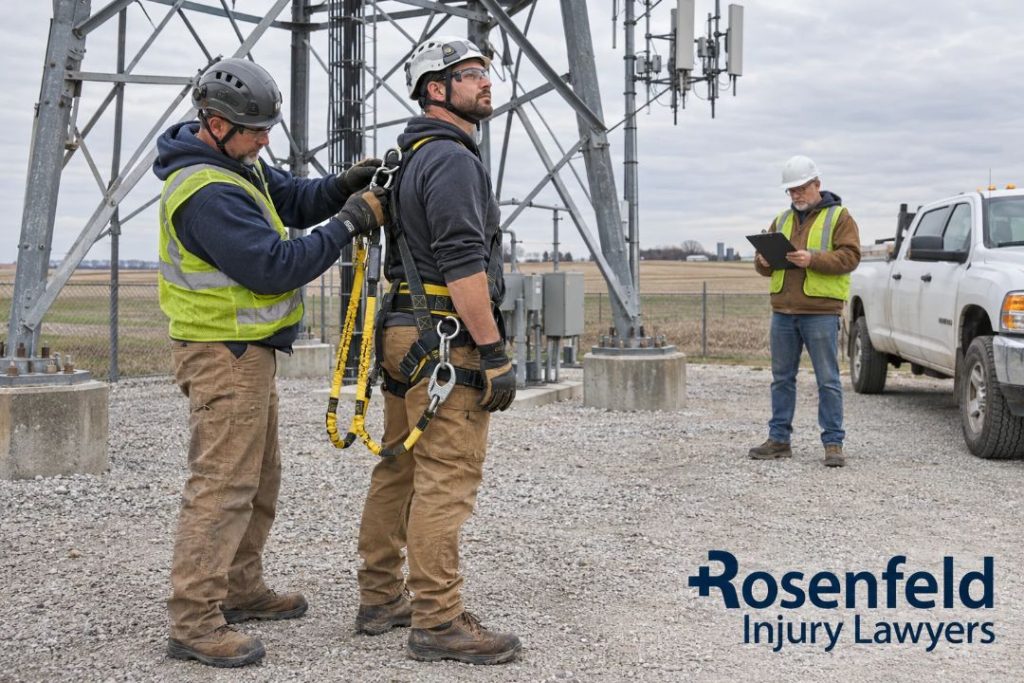
Cell tower climber fall protection means staying tied off to a fall arrest or positioning system at all times, with a trained crew and a rescue plan ready. When it fails, the company that cut the corner is often not the climber’s own employer. That gap is why the contracting chain decides who pays.
Most climbers never work for the carrier whose signal they build. They work for a crew at the bottom of a long chain of contracts. We walk through the rules, the chain, and the Illinois law that connects them. This post is for climbers, their families, and the safety leads who sign off on the work.
What Fall Protection Rules Apply to Cell Tower Climbers?
Which rulebook applies depends on the job. Construction work follows 29 CFR 1926 Subpart M. Telecommunications maintenance follows 29 CFR 1910.268. Defendants often fight over which one fits.
| Rule | Covers | What it requires |
| 1926 Subpart M | Building, installing, changing or removing towers | Fall protection duty, approved systems, and training |
| 1910.268 | Telecommunications maintenance | Fall arrest or positioning above 4 feet on poles and towers |
| 1926 Subpart E and 1910.132 | Lifelines, lanyards, and protective gear | Gear that fits the hazard |
| ANSI/ASSP A10.48 | Communication structure work | Voluntary safe practices and training. Not law. |
OSHA lists A10.48 beside its federal rules. We treat it as a standard of care, not a statute. A crew that ignores it can still look careless to a jury. The OSHA and FCC Communication Tower Best Practices guide from June 2017 adds more detail.
Common OSHA tower climbing standards also cover harness inspection and anchor points. For the general construction rules, see our page on OSHA rules on Illinois construction sites.
100% Tie-Off and the Second Lanyard
A climber should stay connected the whole way up, across, and down. That habit is called 100% tie-off. It is the industry expectation, not a phrase in federal OSHA text.
Good cell tower climber fall protection uses two lanyards. One stays clipped while the other moves past a bracket or a cross member. Free climbing, which means climbing with no connection, shows up again and again in tower deaths. OSHA reported that many climbers who died in 2013 were not tied off.
Fixed tower ladders and climbing systems carry their own risks. For the everyday ladder rules, read our guide to OSHA ladder safety rules on Illinois job sites.
Rescue Plans: The Rule Most Crews Skip
Paragraph d20 of 29 CFR 1926.502 says the employer “shall provide for prompt rescue of employees in the event of a fall or shall assure that employees are able to rescue themselves.” The rule never defines “prompt.” A tower rescue plan fills that hole.
A hanging climber can suffer suspension trauma, where blood pools in the legs and the body goes into shock. Minutes matter. A site-specific plan should name:
- Who performs the rescue
- What gear is on site
- How the team reaches the climber
- How crews call for help with no cell service
- When the team last practiced
Strong cell tower climber fall protection treats rescue as part of the system. A harness that stops a fall only starts the clock. A plan nobody has practiced tends to fail on a windy night. “Call 911” is not a plan. A tower can be hours from the nearest ladder truck.
Training and Climber Credentials
Rule 1926.503 requires training by a competent person. That means someone who can spot hazards and fix them. Industry groups also offer climber and rescue programs, which are voluntary.
Missing training records matter. They can show that a company ignored cell tower climber fall protection basics and sent an untrained climber up a tower.
How Does the Cell Tower Subcontracting Chain Work?
A wireless carrier rarely hires climbers directly. It hires a manager, and that manager hires a crew. Each layer pushes safety duties down through contract language.
A turf vendor is a management firm that runs a carrier’s sites in a region and hires the crews. A typical chain looks like this:
- Wireless carrier
- Tower owner
- Turf vendor or project manager
- Contractor
- Subcontractor
- Sub-subcontractor, often the climber’s employer
ProPublica and FRONTLINE reported one case where a carrier hired a turf vendor. The vendor hired a contractor, and the contractor subcontracted the climbing crew. Their 2012 investigation found tower climbing had a death rate roughly 10 times that of construction. That figure covered 2003 to 2010, so we treat it as history, not a current rate.
Why does this matter? Every layer can point downward. The carrier says the work belonged to the contractor. The contractor says safety belonged to the sub. Cell tower climber fall protection gets lost between those handoffs, and the climber pays for the gap.
OSHA counted 13 communication tower deaths in 2013, 12 in 2014, 3 in 2015, and 6 in 2016. We could not confirm later totals for this article.
Why Is Workers’ Comp Only Part of the Answer?
Illinois workers’ compensation pays medical bills and wage benefits no matter who was at fault. It also bars most suits against the direct employer. Our page on workers’ compensation for construction workers covers the basics.
Comp does not pay for pain and suffering. A lawsuit against another company can. That is where the chain matters.
Who Can Be Sued When a Tower Climber Falls?
A climber may be able to sue companies other than the direct employer after a cell tower climber fall protection failure. The right target depends on who controlled the work, owned the structure, or made the gear. Each claim needs proof, and the claims run on ordinary negligence. Illinois repealed its Structural Work Act in 1995.
Upstream Contractors That Kept Control of Safety
Illinois follows Restatement Section 414. In Carney v. Union Pacific Railroad, decided in 2016, the Illinois Supreme Court held that a general right to enforce safety does not equal retained control. A right to stop unsafe work is not enough.
Real control looks different. Think of a safety plan the upstream company wrote, daily orders on how to climb, or approval of rigging plans. Contracts and emails show it. Our guide to the third-party construction lawsuit explains how these claims move forward.
Tower Owners and Carriers
Owners can face premises claims when they control the structure. Think of damaged ladder rungs, step bolts, or climbing safety cables. A reported 2018 settlement of $30 million followed a ladder rung failure and named a carrier, its subsidiary, and an engineering firm. We have not verified that report, so treat it as a lead, not a rule.
Equipment and Anchor Makers
Harnesses, sleeves, self-retracting lifelines, and anchors can fail. OSHA noted an August 30, 2016 recall of a ladder-climbing safety sleeve. Keep failed gear. Do not hand it back to the employer. Photos of the damage, the serial number, and the purchase date help an expert later.
When the Subcontractor Had No Insurance
Under the statutory employer rule in section 1 of the Illinois Workers’ Compensation Act, an upstream contractor may owe comp benefits to an uninsured sub’s workers. The Illinois Supreme Court discussed this in Laffoon v. Bell and Zoller Coal Co. in 1976. Paying those benefits may not shield the contractor from a lawsuit, so ask a lawyer first.
What Evidence Shows Who Controlled the Climb?
Paper wins these cases. A strong file can include:
- Master service agreements and subcontracts
- The site safety plan and rescue plan
- The climber’s training certificates
- The job hazard analysis
- Gear inspection logs
- Photos of anchors and ladders
- The OSHA inspection file
- Texts from the project manager
Illinois sets strict deadlines. Injury lawsuits commonly carry a two year limit, and comp claims commonly carry three years, with exceptions. Confirm both with a lawyer before waiting.
Ask for these records early. Logs and contracts can disappear, and an employer may not volunteer them. Dropped tools and antennas raise separate claims, so read our post on falling objects on a job site. Radio frequency and power hazards also reach towers, and our electrocution claims post covers them.
What If a Tower Fall Was Fatal?
Families may have a comp death claim plus a wrongful death claim against third parties. Read our overview of fatal construction accident claims, or this post on what families can recover.
For falls from other heights, see falls from roofs and other heights. Our post on roof fall compensation covers the general comp picture.
FAQs
Federal OSHA text does not use the phrase 100% tie-off. Rules still require fall arrest or positioning above set heights, and industry practice expects constant connection.
The climber’s employer must provide for prompt rescue under 29 CFR 1926.502, paragraph d20. Upstream companies may share fault if their contracts or directions shaped the plan.
Possibly. A carrier is not automatically liable. Claims depend on proof of control or a defective structure, as in cell tower climber fall protection cases.
An upstream contractor may owe comp benefits under the statutory employer rule in section 1 of the Illinois Workers’ Compensation Act. Have a lawyer review the contracts.
Yes. Store it, and do not return it to the employer. Gear can prove a defect, and photos of its condition help.
Talk Through Your Tower Fall With Us
A fall from a tower is rarely one person’s mistake. If you or a family member was hurt, talk with an Illinois construction accident lawyer at IL Work Injury Lawyer. The first consultation is free, and we charge no fee unless we recover compensation. Bring your contracts, photos, and gear, and contact us to start. Good cell tower climber fall protection should never depend on who signed the check.
This article is general information, not legal advice.
 Legally Reviewed By
Attorney Jonathan Rosenfeld
Content legally reviewed by Jonathan Rosenfeld The information on this page has been legally reviewed by Attorney Jonathan Rosenfeld, founder and managing partner of Rosenfeld Injury Lawyers LLC. With extensive experience representing injured workers across Illinois, Mr. Rosenfeld is dedicated to helping workplace accident victims pursue the maximum compensation available under the law. His extensive legal knowledge and commitment to client advocacy ensure that the information provided is accurate, reliable, and aligned with current legal standards.