



What Is Maritime Law? Which Federal Laws Cover Workers Hurt on Illinois Rivers and the Great Lakes


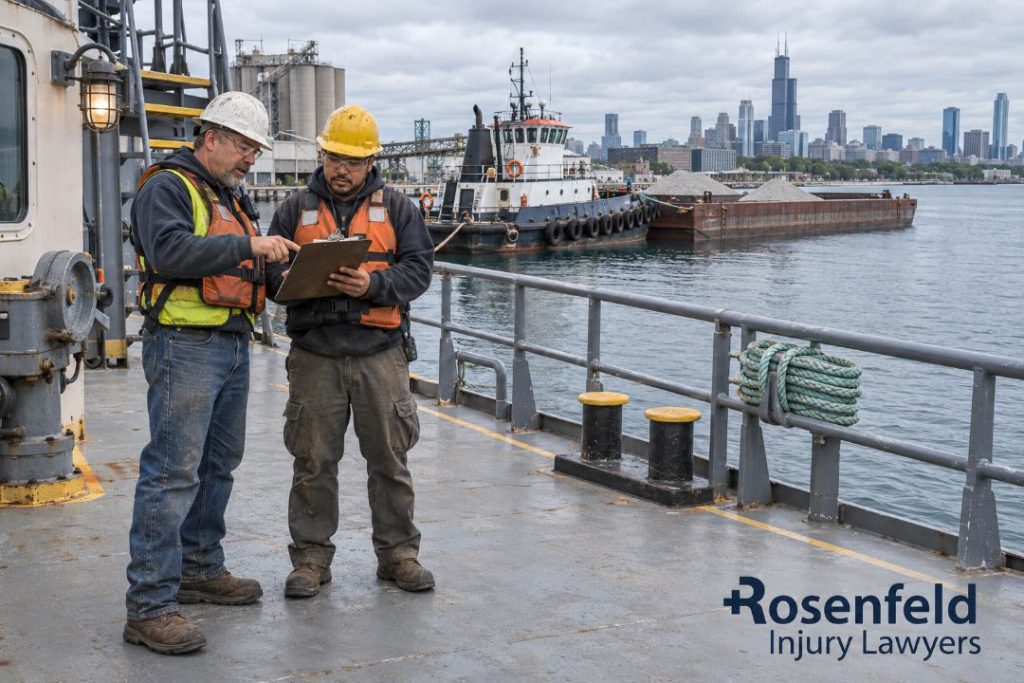
What is maritime law? It is the body of federal law, also called admiralty law, that governs ships, shipping, and work on navigable waters, including the Great Lakes and Illinois rivers. For injured workers, it decides which law pays after an accident: the Jones Act, general maritime law, the Longshore Act, or Illinois workers’ compensation.
That choice changes who you can sue, what you can recover, and how long you have to act.
What Is Maritime Law?
Maritime law, also called admiralty law, is the set of federal rules for activity on navigable waters. It covers vessels, cargo, collisions, salvage, and the rights of people who work aboard and around vessels. It comes from the Constitution, federal statutes, and court-made general maritime law, and it is heard mainly in federal court.
The Constitution is the starting point. Article III, Section 2 extends federal judicial power to “all Cases of admiralty and maritime Jurisdiction.” Federal law fills in the details. Title 28, Section 1333 of the U.S. Code gives federal district courts that jurisdiction, while saving to suitors the other remedies they would otherwise have.
That saving clause matters to workers. Many injury claims can also be filed in state court, often with a jury, rather than only in a federal court.
So what is maritime law made of? A short definition of maritime law has three layers: the Constitution, statutes such as the Jones Act, and rules judges built over time. It is not the law of the sea, which is international law between nations.
What Is Admiralty Law, and Is It Different?
In the United States, admiralty law and maritime law mean the same thing today. “Admiralty” comes from the English Admiralty courts that once heard sea cases. The Constitution uses both words together.
People often ask what is maritime law and whether admiralty law is something else. It is not. You will see both terms in court opinions and statutes. An admiralty claim points to the same body of law.
Where Does Maritime Law Apply in Illinois?
Maritime law applies on navigable waters, including the Great Lakes and inland rivers, not only the ocean. The Supreme Court settled that in 1851. For an injury claim, courts also ask whether the work had a real link to maritime activity.
Early American courts limited admiralty to tidal waters, because that was the English rule. In The Genesee Chief v. Fitzhugh, decided in 1851, the Supreme Court rejected that limit. It held that admiralty jurisdiction reaches the Great Lakes and other navigable inland waters. So what is maritime law doing on Lake Michigan and the Illinois River? It follows the water. See which Illinois waterways count in our guide.
For injury claims, courts generally ask two questions:
- Did the injury happen on navigable water, or did a vessel on navigable water cause it?
- Did the activity have a real connection to traditional maritime work?
The Supreme Court used this test in Jerome B. Grubart, Inc. v. Great Lakes Dredge & Dock Co. in 1995. That case arose from the 1992 Chicago flood. A barge drove piles into the Chicago River bed, and water broke into an old freight tunnel, flooding downtown buildings. The Court held that admiralty jurisdiction applied.
The Admiralty Extension Act, at 46 U.S.C. 30101, reaches injuries on land that a vessel on navigable water causes. A vessel’s crane swinging into a dock worker is one example.
The Federal Laws That Cover Injured Maritime Workers
Six laws matter most. The Jones Act and general maritime law protect seamen. The Longshore Act protects dock and harbor workers who are not crew. Two more laws come up in deaths and vessel owner defenses. Illinois workers’ compensation covers most other workers.
| Law | Citation | Who it covers | What it provides |
| Jones Act | 46 U.S.C. 30104 | Seamen, who are crew members of a vessel | Negligence claim against the employer, with a jury trial |
| General maritime law | Court-made | Seamen | Maintenance and cure with no fault, plus an unseaworthiness claim against the vessel owner |
| Longshore and Harbor Workers’ Compensation Act | 33 U.S.C. 901 and following | Dock, terminal, shipyard, and harbor workers who are not crew | No-fault comp benefits, and a possible claim against a negligent vessel |
| Death on the High Seas Act | 46 U.S.C. 30301 and following | Families of people killed on the high seas, beyond 3 nautical miles | Wrongful death claim for financial losses |
| Limitation of Liability Act | 46 U.S.C. 30501 and following | Vessel owners, who may use it against injured workers | Lets an owner try to cap total liability at the vessel’s value after the accident |
| Illinois Workers’ Compensation Act | 820 ILCS 305 | Workers outside the federal laws above | State no-fault comp benefits |
The Jones Act
The Jones Act lets an injured seaman sue an employer for negligence. It sits at 46 U.S.C. 30104 and is part of the Merchant Marine Act of 1920.
Do not confuse it with the shipping rule at 46 U.S.C. 55102. That rule, called cabotage, requires U.S.-built, U.S.-owned vessels for trade between U.S. ports. Same act, different section.
A seaman needs a substantial connection to a vessel in navigation. Courts use about 30 percent of work time as a rule of thumb, as the Supreme Court explained in Chandris, Inc. v. Latsis in 1995. Read what the Jones Act covers, then check whether you count as a seaman.
Maintenance and Cure and Unseaworthiness
Maintenance is a daily living allowance. Cure is medical care. A seaman is owed both, regardless of fault, until maximum medical improvement. Our page on maintenance and cure explains how to claim them.
Unseaworthiness is a separate claim. It holds a vessel owner liable for an unsafe vessel, crew, or equipment without proof of negligence, as the Court explained in Mitchell v. Trawler Racer, Inc. in 1960. We cover how unseaworthiness claims work on a separate page.
The Longshore Act
The Longshore and Harbor Workers’ Compensation Act gives no-fault benefits to maritime workers who are not crew. The law excludes “a master or member of a crew of any vessel.” Think of dock, terminal, and shipyard workers. The U.S. Department of Labor runs the program.
A worker may also have a claim against a negligent vessel owner. To compare the two systems, see who is covered under the Jones Act.
DOHSA and Maritime Wrongful Death
The Death on the High Seas Act applies to deaths more than three nautical miles from shore. Illinois rivers and the Great Lakes are not the high seas, so this law rarely reaches Illinois workers.
Inland-water deaths are usually handled under the Jones Act for seamen or under general maritime law. The Supreme Court recognized a wrongful death claim under general maritime law in Moragne v. States Marine Lines in 1970. Families can read who can file a maritime wrongful death claim.
The Limitation of Liability Act
A worker should know this law exists, because owners use it against injured people. A vessel owner can ask a federal court to cap its liability at the vessel’s value after the accident. That request can pause other lawsuits and pull every claim into one federal case.
The owner must generally file within six months after written notice of a claim, under 46 U.S.C. 30529.
Which Maritime Law Covers You? A Quick Way to Sort It Out
The facts of your job decide the answer, not your job title or your employer’s paperwork. Ask where you work and how much of that work is tied to a vessel. This list is a starting point, not a final answer.
- You are assigned to a vessel’s crew and spend much of your time aboard, such as a deckhand, tankerman, mate, or cook. You are likely a seaman. The Jones Act, maintenance and cure, and unseaworthiness may apply.
- You work on docks, terminals, shipyards, or harbor projects but not as crew. The Longshore Act likely applies.
- You were hurt on land, away from the water, in a job with no maritime link. Illinois workers’ comp likely applies.
- A family member died at work on the water. The wrongful death rules depend on status and location.
Knowing what is maritime law only gets you halfway. The next step is matching your job to the right statute.
Here are three Illinois examples. A deckhand on an Illinois River towboat is usually crew, as in these barge accident claims. A crane operator at a Chicago-area port terminal is usually not crew. A dredge crew member on Lake Michigan may be crew, depending on time aboard.
How Maritime Claims Differ From Illinois Workers’ Comp
Maritime claims often turn on fault or an unsafe vessel, and they can lead to a jury trial. Workers’ comp is no-fault and runs through an agency. The deadlines also differ.
- Fault: Seaman claims need negligence or unseaworthiness, though maintenance and cure is owed without fault. Comp is no-fault.
- Damages: Jones Act and general maritime claims can include pain and suffering. Comp does not.
- Forum: Seamen can go to court and ask for a jury. Illinois comp goes through the Illinois Workers’ Compensation Commission. Longshore claims go through the U.S. Department of Labor.
- Deadlines: Most maritime injury claims have a three-year limit under 46 U.S.C. 30106. A Longshore claim generally has a one-year limit under 33 U.S.C. 913. Illinois comp generally has a three-year limit from the accident or a two-year limit from the last payment, whichever is later, under 820 ILCS 305/6.
Check the Jones Act filing deadline early. Our overview of Illinois workers’ compensation covers the state system.
What to Do If You Were Hurt on the Water in Illinois
Report the injury, get medical care, and protect your evidence. Then talk to a lawyer before any deadline runs. Early steps often shape which law applies.
- Report the injury to the captain or supervisor and ask that it be logged.
- Get medical care. If you are crew, ask about maintenance and cure.
- Write down the vessel name, the owner, and your time aboard.
- Photograph the area and the equipment.
- Do not sign a statement or a status form without advice.
- Talk to a lawyer before any deadline runs.
Frequently Asked Questions
What is maritime law in simple terms?
Maritime law is the set of federal rules for ships, shipping, and work on navigable waters. It also protects injured workers. Admiralty law is another name for it.
Does maritime law apply on the Great Lakes and Illinois rivers?
Yes. Since The Genesee Chief in 1851, admiralty jurisdiction has reached the Great Lakes and navigable inland waters. Whether your claim fits also depends on your job and the vessel.
Is admiralty law the same as maritime law?
Yes. In the United States, both terms describe the same body of law. Admiralty comes from old English sea courts, and the Constitution uses both words.
Is the Jones Act part of maritime law?
Yes. The Jones Act is one federal maritime law. It lets injured seamen sue employers for negligence, and it works alongside general maritime law.
Can a maritime injury claim be filed in state court?
Often yes. The saving-to-suitors clause preserves other remedies, so Jones Act claims can be filed in state court, and a jury may hear them.
Get Answers About Maritime Law Before a Deadline Runs
Knowing what is maritime law is the easy part. Applying it to your injury takes a closer look at your job, your vessel, and your dates. If you want to understand Jones Act coverage for Illinois maritime workers, start with that page.
If you or a family member was hurt on the water, talk with a Chicago Jones Act lawyer at Illinois Work Injury Lawyer. The consultation is free, and we work on a contingency fee, so you pay no fee unless we win. Call 312-757-7348, and we will explain how maritime law applies to your situation.
This article offers general information, not legal advice.
 Legally Reviewed By
Attorney Jonathan Rosenfeld
Content legally reviewed by Jonathan Rosenfeld The information on this page has been legally reviewed by Attorney Jonathan Rosenfeld, founder and managing partner of Rosenfeld Injury Lawyers LLC. With extensive experience representing injured workers across Illinois, Mr. Rosenfeld is dedicated to helping workplace accident victims pursue the maximum compensation available under the law. His extensive legal knowledge and commitment to client advocacy ensure that the information provided is accurate, reliable, and aligned with current legal standards.