



Trailer Creep at Illinois Warehouse Docks: Early Pull-Aways, Dock Plates and Who Is at Fault


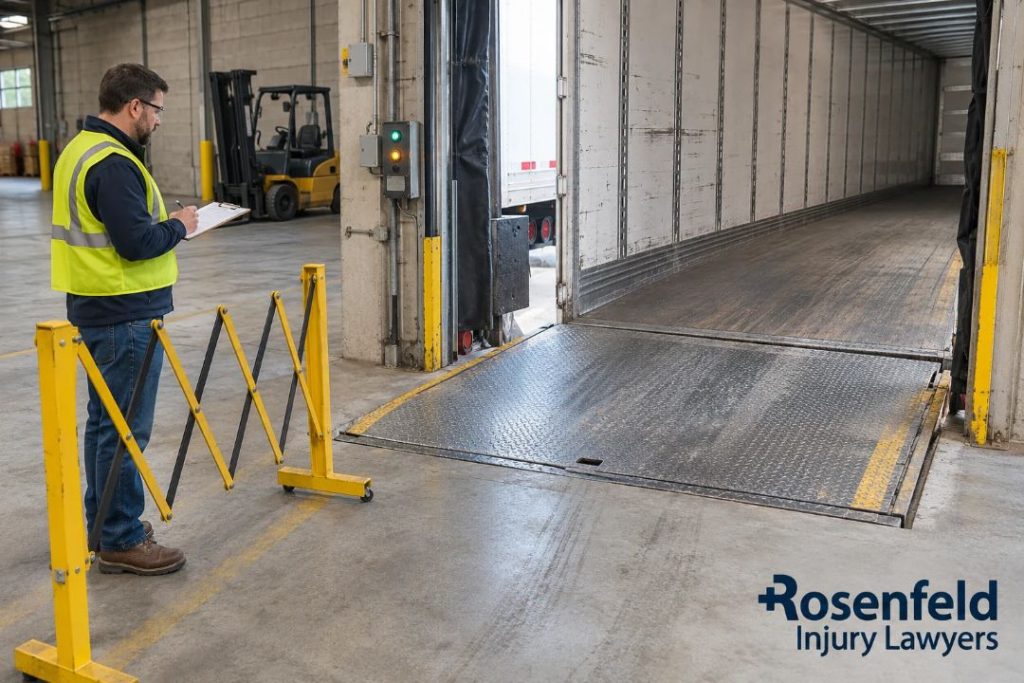
Trailer creep is the slow drift of a parked trailer away from the dock. Each forklift trip nudges it farther. Eventually a gap opens, a dock plate slips, and a forklift can drop to the ground. Early pull-aways cause similar falls. Fault depends on who controlled the trailer and who controlled the dock.
Loading dock work looks routine, but the bridge a forklift crosses is only as steady as the trailer behind it. This guide explains how creep, early departure, and dock plate failure happen, what OSHA expects, and who may be responsible under Illinois law.
What Is Trailer Creep?
Trailer creep, also called dock walk, is the gradual movement of a trailer away from the dock face. Forklifts brake, accelerate, and turn on the trailer floor repeatedly. Over many trips, that force opens a gap between the trailer and the dock plate or leveler.
Safety+Health magazine, published by the National Safety Council, ties creep to the force of equipment moving in and out of the trailer. Wheel chocks and vehicle restraints are the usual defenses. Slick pavement can loosen a chock’s grip, and heavy loads add more force. A trailer resting on its landing gear needs fixed jacks, chocks, or a restraint to stay put.
How Do Creep, Early Pull-Aways and Upending Differ?
These hazards all pull the trailer out of the position a forklift operator expects. Creep is a slow drift. An early pull-away is a driver leaving too soon. Upending is a trailer that tips. Each has its own cause and its own fix.
| Hazard | What happens | Usual cause | What helps |
| Creep | Trailer drifts away a little at a time | Forklift force on an unsecured trailer | Wheel chocks; a restraint that hooks the rear impact guard |
| Early pull-away | Driver leaves while a forklift is entering, inside or leaving | Miscommunication or the wrong door | Restraint with signal lights; driver waits in a set area with the engine off and brakes set |
| Landing gear collapse | Uncoupled trailer tips | Worn or defective landing gear | Trailer stands or fixed jacks; gear inspections |
| Upending | Trailer nose lifts or tips under the load | Heavy forklift and load at one end of an uncoupled trailer | Fixed jacks under the nose |
Early departure can be just as costly here. One case on our loading dock page involved a forklift operator in Romeoville. He fell when the truck left early, and the lift crushed his leg. The case settled for $970,000. Results vary.
How Do Dock Plates Fail When a Trailer Moves?
A dock plate fails when the trailer moves and the plate loses its bearing on the trailer bed. It can slide, tip, or let a forklift wheel drop into the gap. An overloaded or unsecured plate can also fail without any movement.
Dock plate, dock board and dock leveler
- A dock plate is a light bridge, often aluminum, placed by hand.
- A dock board is a heavier steel or aluminum bridge, often moved by forklift.
- A dock leveler is built into the dock. Springs or hydraulics raise it, and its lip rests on the trailer bed.
What happens at the gap
As the trailer drifts, the plate or lip has less trailer bed under it. One bump from a loaded forklift can push it free.
What the dockboard rules say
OSHA 29 CFR 1910.26 sets the baseline. Dockboards must support the maximum intended load. Boards placed in service on or after January 17, 2017 must be built to keep vehicles from running off the edge. Portable boards must be anchored or secured in place. Wheel chocks or sand shoes must keep the vehicle from moving while workers are on the board. Separately, 1910.178, paragraph n11, says to secure dockboards before driving over them and never exceed their rated capacity.
What Does OSHA Require at the Dock?
OSHA wheel chock requirements call for set brakes and chocked wheels before a forklift boards a highway truck. Those rules have a gap for commercial trucks. A missing citation does not mean nobody was at fault.
| Rule | What it requires | Who it reaches |
| 1910.178, paragraph k1 | Set brakes and place chocks under the rear wheels before forklifts board a highway truck | Dock employers, with the trucking gap below |
| 1910.178, paragraph m7 | Keep brakes set and wheel blocks in place during loading; use fixed jacks for an unhitched semitrailer if needed | Dock employers, with the same gap |
| 1910.178, paragraph l3 | Train operators on workplace hazards, which OSHA says includes not driving onto an unsecured trailer | Employers with forklift crews |
| 1910.28, paragraph b1 | Fall protection at edges 4 feet or more above a lower level; a narrow loading dock exception applies only when protection is not feasible | Employers |
Here is the part most guides skip. OSHA letters dated November 8, 2005, and March 7, 2011 say federal motor carrier brake rules apply to commercial motor vehicles. Under federal law, a trailer counts as one when it meets tests such as a gross weight rating of at least 10,001 pounds. So OSHA generally will not cite a dock for an unchocked commercial tractor-trailer.
The 2011 letter adds a second point. Employers that do not run commercial vehicles must still protect forklift operators from trailer movement. That includes training operators not to drive onto an unsecured trailer.
For injured workers, the lesson is plain. No citation does not settle fault. Dock practice and the employer’s own procedures still show what reasonable care looked like in trailer creep cases. See our guides on OSHA forklift regulations and OSHA forklift violations.
Who Is at Fault When a Trailer Moves?
Two companies usually control different halves of the problem. The trucking side controls the trailer. The warehouse side controls the dock. Who can be sued depends on who employed the injured person.
Trucking side parties include the driver, carrier, and trailer owner. Warehouse side parties include the facility operator, property owner, and equipment makers.
| Who was hurt | Workers’ comp from | Possible third-party claims against |
| Warehouse forklift operator or dock workerrestraint, leveler, or dock plate | Their employer or staffing agency | Their employer or staffing agencyThe truck driver and carrier for an early pull-away or unset brakes; the trailer owner for bad landing gear; a separate property owner; the maker of a failed restraint, leveler or dock plate |
| Truck driver unloading or standing at the dock | Their motor carrier | The warehouse operator for an unsecured dock plate, missing restraint or forklift conduct; the property owner under the Illinois Premises Liability Act, 740 ILCS 130; equipment makers |
| Temporary worker placed by an agency | The agency, and possibly the host company | Depends on whether the host company counts as a borrowing employer |
Illinois workers’ compensation is no-fault. The Act generally bars suing your own employer, under 820 ILCS 305/5. You may still sue outside parties, and trailer creep claims often involve both sides. Read more on when you can sue for a forklift accident.
Fault can also be shared. Under 735 ILCS 5/2-1116, Illinois bars recovery if you are more than 50 percent at fault and reduces damages if you are less than 50 percent at fault. See how comparative fault works in Illinois. An employer’s share of fault can still affect contribution claims and the comp lien.
Truck drivers hurt on someone else’s dock have a separate path. Start with workers’ compensation for truck drivers.
What Evidence Shows the Trailer Was Secured?
Records can show whether the restraint held and when the truck moved. Dock logs, truck data, and video matter most. Some are overwritten, so ask early.
- Vehicle restraint and door-control logs
- Dock signal light status and the written dock procedure
- Truck telematics or electronic logging device data showing when the truck moved
- Gate, yard and driver check-in records, plus the time the bill of lading was signed
- Camera footage of the dock door and yard
- Chock placement and condition
- Dock plate or leveler capacity labels and maintenance records
- Landing gear and trailer inspection records from the carrier
- The OSHA inspection file, if OSHA investigated
A lawyer can send preservation letters before logs and video disappear.
What Should You Do After a Dock Separation Accident?
Get medical care first. Then report the injury in writing and document the scene. Illinois generally requires notice to your employer within 45 days.
- Get medical care.
- Report the work injury within 45-days, in writing.
- Photograph the gap, the trailer position, the chocks or restraint, and the dock plate.
- Write down the trailer number, carrier name, and driver’s name.
- Do not give a recorded statement to the carrier’s insurer.
- Talk to a lawyer before logs and video are overwritten.
Frequently Asked Questions
Forklift force on an unsecured trailer causes it. Braking, accelerating, and turning on the trailer floor push it away from the dock little by little.
Use wheel chocks, a vehicle restraint, or both. Keep the truck’s brakes set, and train operators to confirm the trailer is secure before driving on.
Yes, for many trailers, but OSHA generally does not enforce chocking against commercial motor vehicles. Employers must still protect forklift operators from trailer movement.
The driver and motor carrier may be liable. The warehouse may share fault if its dock procedures or restraints failed.
Often yes. A driver’s comp claim is against the motor carrier, but the warehouse is an outside party that may face a separate claim.
Hurt in a Dock Accident? Get Clear Answers
If a trailer moved while you were working the dock, you don’t have to figure out fault alone. A Chicago loading dock accident lawyer can review the logs, the dock setup, and your options. Illinois Work Injury Lawyer offers a free consultation, and we work on a contingency fee, so you pay no fee unless we win. Call 312-757-7348. Before you do, write down the trailer number, the carrier, and any sign of trailer creep you noticed.
This article offers general information, not legal advice.
 Legally Reviewed By
Attorney Jonathan Rosenfeld
Content legally reviewed by Jonathan Rosenfeld The information on this page has been legally reviewed by Attorney Jonathan Rosenfeld, founder and managing partner of Rosenfeld Injury Lawyers LLC. With extensive experience representing injured workers across Illinois, Mr. Rosenfeld is dedicated to helping workplace accident victims pursue the maximum compensation available under the law. His extensive legal knowledge and commitment to client advocacy ensure that the information provided is accurate, reliable, and aligned with current legal standards.