



Forklift vs Pedestrian in a Warehouse: Who Is Liable in Illinois?


A forklift pedestrian accident usually comes down to one question: who failed to act safely? The answer may be the operator, the employer, a property owner, or the maker of the machine. Forklift drivers must yield to people on foot. Pedestrians are not always blameless, though. Illinois law then shapes the claim around your job status.
Who Is Liable After a Forklift Hits a Pedestrian?
Liability can rest with the operator, the employer, the property owner, a contractor, or the equipment manufacturer. The right target depends on who was hurt and what caused the crash. Employees and visitors follow different legal paths.
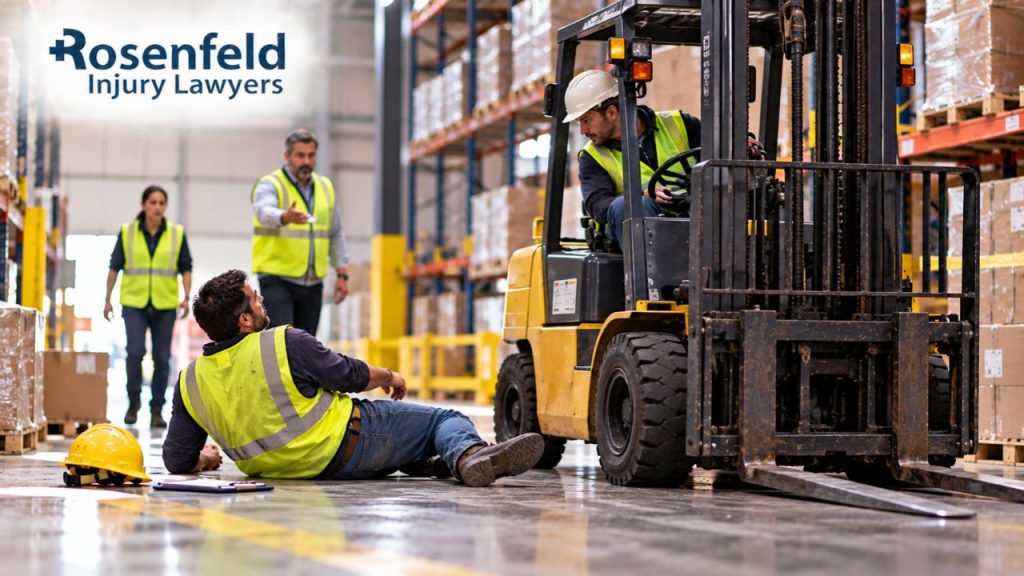
Picture a night shift in a distribution center. A driver backs out of an aisle with a tall load. A picker steps out from behind a rack. Nobody sounds a horn. The impact takes two seconds, but the claim can take years. That is the usual pattern in warehouse forklift accidents in Illinois.
Investigators ask the same few questions every time. Was the driver trained? Was the aisle marked? Did the truck work as designed? Each answer points toward a different responsible party, and the common causes of forklift accidents often overlap.
What Do OSHA Rules Say About Pedestrians?
OSHA’s powered industrial truck standard, 29 CFR 1910.178, sets duties for drivers and employers. Operators must slow down and sound the horn where their view is blocked. Their training must also cover pedestrian traffic.
Federal guidance spells out more:
- Drivers must keep a clear view of the travel path.
- Drivers cannot drive up to a person standing in front of shelving or another fixed object.
- Permanent aisles must stay clear and be marked where forklifts run, under 29 CFR 1910.176.
- NIOSH guidance says pedestrians always get the right of way.
Employers must make sure operators meet forklift operator training requirements before they drive. A rule violation does not win a case on its own. It is strong evidence of unsafe practice, though. Our overview of OSHA forklift regulations explains how those rules connect to worker rights.
Can an Injured Worker Sue the Employer?
Usually no. Illinois workers’ compensation is a no-fault system, so an employee collects benefits without proving the employer was careless. In exchange, the worker generally cannot sue the employer for the same injury. This distinction matters because workers’ compensation and third-party injury claims follow different rules.
Benefits can cover medical care and part of your lost wages. Fault does not decide eligibility. A worker who stepped into a restricted area can still have a valid claim, even if the company says otherwise.
Timing matters. Illinois generally requires you to tell your employer about the injury within 45 days. Read more about forklift accident workers’ comp claims in Illinois before you decide your next step.
Who Else Can Be Held Responsible?
A third party can be sued when someone other than your employer helped cause a forklift pedestrian accident. These claims can run alongside workers’ compensation and may allow damages that comp does not.
Common third parties include:
- Property owners under premises liability, when blind corners or missing walkways were their duty.
- Contractors and subcontractors, when their crews created the hazard.
- Manufacturers, when faulty brakes, steering, or warnings played a part.
- Drivers employed by another company, such as a contractor on site.
Visitors and delivery drivers are not covered by workers’ comp. They can bring a negligence claim instead. That means proving duty, breach, causation, and damages. Our page on customers hit by forklifts covers that path.
| Who was hurt | Main legal path |
| Warehouse employee | Workers’ comp, plus a third-party claim if another party contributed |
| Customer or visitor | Personal injury claim based on negligence |
| Independent contractor | Depends on how the worker is legally classified |
Does Pedestrian Fault Matter?
In a forklift pedestrian accident personal injury claim, yes. Illinois uses modified comparative negligence. A plaintiff more than 50 percent at fault is barred, and a smaller share reduces damages. Workers’ comp ignores fault. Insurers often lean on this rule early, so the facts you save matter.
Defense teams look for distractions, ignored walkways, and missed eye contact with the driver. Strong evidence pushes back. Video footage, inspection logs, and maintenance records can show the truck or the layout was the real problem.
What Should You Do After a Forklift Pedestrian Accident?
Get medical care first. Then report the crash in writing and document the scene while it is fresh. Illinois requires notice to your employer within 45 days.
- Get treatment and keep every record.
- Report the crash to your supervisor promptly, preferably in writing, and keep a copy.
- Photograph the aisle, floor markings, signs, and the forklift.
- Collect witness names and phone numbers.
- Avoid recorded statements to insurers until you have advice.
Illinois generally gives two years to file a personal injury action under 735 ILCS 5/13-202, with exceptions. A comp claim runs on a different clock. Our guide to a forklift accident lawsuit explains those deadlines.
Forklift Pedestrian Accident FAQs
Forklift operators should yield to pedestrians, slow down, and stop when necessary to avoid a collision. OSHA also requires operators to sound the horn at cross aisles and other locations where their vision is obstructed.
Often yes. Illinois workers’ compensation is no-fault, so benefits generally do not depend on who caused the accident. Employers may still raise the rule violation in a dispute.
Report it to your employer within 45 days. Do it sooner and in writing. Filing deadlines for the claim itself are separate.
Yes. A visitor is not covered by workers’ comp, so a negligence or premises liability claim may apply against the business, operator, or property owner.
Video footage, training records, maintenance logs, and witness statements help most. Photos of aisle markings and blind spots also matter.
Ready to Talk Through Your Claim?
A short, free conversation can show which claim fits your situation. Illinois Work Injury Lawyer works on contingency, so you owe no fee unless we recover compensation. Contact our team to request a free consultation today. We can help you sort out the right path after a forklift pedestrian accident before any deadline passes.
 Legally Reviewed By
Attorney Jonathan Rosenfeld
Content legally reviewed by Jonathan Rosenfeld The information on this page has been legally reviewed by Attorney Jonathan Rosenfeld, founder and managing partner of Rosenfeld Injury Lawyers LLC. With extensive experience representing injured workers across Illinois, Mr. Rosenfeld is dedicated to helping workplace accident victims pursue the maximum compensation available under the law. His extensive legal knowledge and commitment to client advocacy ensure that the information provided is accurate, reliable, and aligned with current legal standards.