



Scissor Lift Tip-Over Causes: Wind, Ground Conditions and Who Is Responsible in Illinois


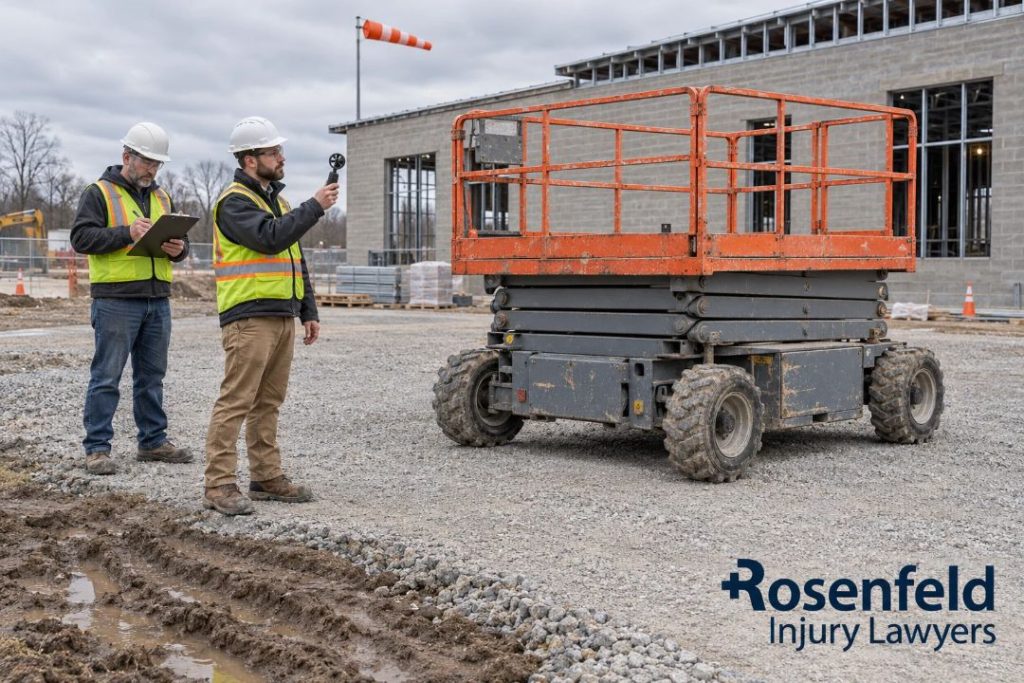
Scissor lift tip-over causes come down to one problem: the machine’s center of gravity moves outside its base. That risk is highest when the platform is raised. Wind, a hole under one wheel, extra weight, or driving while elevated can each be enough. Most of these causes are known before the shift starts.
This post covers the main causes, the numbers behind them, and who controls each risk on an Illinois job site.
Why Do Scissor Lifts Tip Over?
Scissor lifts tip over when the combined weight of the machine, the workers, and the materials shifts past the edge of the wheelbase. Raising the platform makes the lift top-heavy, so a gust, a pothole, an overload, or a sudden stop can push it past its tipping point.
A tall platform on a narrow base works like a long lever. California’s fatality investigation program noted in report 09CA008 that very little force can turn over a fully raised platform.
NIOSH reports that 87 workers died and 1,380 were injured while operating an aerial lift or scissor lift from 2011 to 2014. That count covers all aerial lifts, not only tip-overs.
These seven scissor lift tip-over causes are covered below:
- Wind beyond the rating
- Slopes, potholes and soft ground
- Overloading or uneven loads
- No outriggers and a narrow stability margin
- Driving while elevated
- Removing or climbing the guardrails
- Collisions, overhead snags, and disabled safety systems
What Does a Scissor Lift Wind Rating Mean?
A wind rating is the highest wind speed a lift is built to handle while raised. OSHA says outdoor-rated scissor lifts are generally limited to winds below 28 mph. Indoor-only models carry a rating of 0 mph and should be kept out of the wind.
Wind is one of the scissor lift tip-over causes people underrate. Under the ANSI A92.20 design standard, manufacturers rate a lift for either 0 mph or up to 28 mph (12.5 meters per second). The same lift may carry two people indoors but only one outdoors. The rating and the capacity are printed on the machine, yet many crews never check.
Gusts matter more than the average reading. Drywall, plywood, and signs act like a sail and add wind load, even under the rating.
OSHA describes one fatal incident: an untrained worker raised a lift more than 39 feet to film, and gusts above 50 mph blew it over.
Someone has to check the forecast and the on-site wind before the platform goes up, then bring it down when gusts rise. OSHA’s hazard alert tells employers to ensure lifts will not tip over, and OSHA construction safety regulations set the broader duties.
How Do Slopes, Potholes and Soft Ground Cause Tip-Overs?
Ground problems are among the scissor lift tip-over causes crews can see before lifting. Most slab scissor lifts should be raised only on firm, level ground. A slope, a hole under one wheel, or soft soil can tilt the chassis, and a tall platform can turn that tilt into a fall.
Slopes and the tilt alarm
Newer lifts use a tilt sensor that can sound an alarm and stop lifting or driving when the machine leans too far. The limit varies by model, so check the manual.
The grade a lift can climb while lowered is a travel rating, not permission to raise the platform there.
Potholes and pothole protection
Pothole protection is a set of steel guards under the chassis that drop down when the platform rises. If a wheel falls into a hole, the guard catches the edge and limits the tilt. If the guards do not deploy, do not raise or drive the lift. Debris can jam them.
Holes include floor openings, unfinished drains, utility covers, curbs, and slab edges.
Soft ground, fresh backfill and drop-offs
Soil, gravel, fresh backfill and trench edges can sink under one wheel. OSHA tells employers to pick firm, level locations away from drop-offs, holes, slopes, bumps, and debris.
Cover or barricade floor openings before a lift moves near them. In the California fatality report, the only barrier between the lift and the pit was an orange cone.
Can Overloading Tip a Scissor Lift?
Yes. Every lift has a rated load that covers people, tools, and materials. Going over it, or stacking weight on one side, can move the center of gravity past the base.
Some lifts list a lower rating outdoors, so read the plate.
New machines built to ANSI A92.20 must have load sensing that stops normal lifting when the platform is overloaded. A bypassed or failed sensor removes the warning. OSHA says weight must never exceed the manufacturer’s load rating.
Uneven loads add side force. In California FACE report 10CA008, a planter box being pulled onto a fully extended lift started a rocking motion, and the lift fell over.
Why Do Most Scissor Lifts Have No Outriggers?
Most electric slab scissor lifts are built without outriggers. They rely on a wide wheelbase, a heavy chassis, and a low center of gravity. That design leaves little room for slopes, holes, or side force.
Some larger rough-terrain models have outriggers or leveling jacks. They must be fully set before the platform rises. On lifts without them, the tilt alarm is the main warning.
Is It Safe to Drive a Scissor Lift While Raised?
Often it is not safe, and it ranks high among scissor lift tip-over causes. Many lifts can creep while raised, but most manufacturers tell operators not to move the lift while it is elevated. A raised lift can hit a bump or hole at the worst possible height.
OSHA treats many scissor lifts like mobile scaffolds, which we explain in “Why OSHA Treats a Scissor Lift as a Scaffold.” Paragraph w6 of 29 CFR 1926.452 lets workers ride a moving mobile scaffold only on a surface within 3 degrees of level and free of pits, holes, and obstructions.
California FACE report 09CA008 shows the cost. A 48-year-old welder moved a lift raised about 12 feet, and it tipped into a pit roughly three feet away. He died. The investigator urged manufacturers to add interlocks that block travel while the platform is raised.
Can Climbing or Removing Guardrails Cause a Tip-Over?
Yes. Standing on a rail, setting a ladder or plank on the deck, or leaning far over the edge raises the center of gravity and shifts weight toward the edge.
Folding rails down removes the barrier that keeps a worker’s weight inside the platform. Operator safety guides say never to lean on, climb, or stand on guardrails. Harness requirements are a separate safety consideration and depend on the applicable equipment guidelines and workplace safety rules.
How Do Collisions and Disabled Safety Systems Tip Lifts?
A hit from other equipment, a snag on overhead material, or a disabled safety device can each tip a lift.
A forklift, truck, or other machine strikes the lift. OSHA recommends traffic control and ground guides.
The platform catches a beam, duct, or sprinkler pipe while driving or lifting.
Worn tires, leaking hydraulics, or a disabled tilt alarm, load sensor, pothole guard or brake weaken the machine itself. OSHA guidance calls for checking controls and components before each use.
Contact with power lines is a separate danger. We cover it under construction electrocution accidents.
Who Is Responsible for Each Tip-Over Cause in Illinois?
Usually the company that controlled the risk. An injured worker’s own employer is generally shielded from lawsuits by Sections 5 and 11 of the Illinois Workers’ Compensation Act, 820 ILCS 305. So the question after a tip-over is often which other company controlled each of the scissor lift tip-over causes above.
| Cause | Who usually controls it | Records that show it |
| Wind beyond the rating | The employer or contractor directing the work, or the general contractor if it set weather rules | Wind rating plate, weather logs, stop-work rules, texts and radio calls |
| Holes, slopes, soft ground | The general contractor or site controller, or the trade that left an opening uncovered | Site safety plan, hazard assessments, floor-opening logs, photos |
| Overloading | The employer or contractor directing material handling | Capacity plate, load-sensor status, delivery logs |
| Pothole guard, tilt alarm or load sensor not working | The rental company or lift owner, and the employer for pre-use checks | Pre-use inspection sheets, rental maintenance records, repair invoices |
| Driving while elevated | The employer for training and supervision, or the manufacturer if the design allowed unsafe travel | Training records under 29 CFR 1926.454, operator records, the manual |
| Struck by other equipment | The contractor running that equipment, and the general contractor for traffic control | Site traffic plan, incident reports, witness statements |
A general contractor is not responsible just because it was on site. Illinois repealed its Scaffold Act in 1995, so these cases usually turn on how much control a company kept over the work and site safety. A defect in the lift or its safety devices may support a product liability case against the manufacturer.
We explain the legal route for when you can pursue instead of only claiming workers’ comp.
What Should You Document After a Scissor Lift Tip-Over?
After any of these scissor lift tip-over causes, record the lift, the ground, and the people involved before anything is repaired or returned.
- Get medical care and report the injury in writing. Illinois generally sets a 45-day window, covered in the 45-day rule.
- Photograph the lift, the ground under each wheel, the plates, and any warning lights.
- Note the rental company name and the unit number.
- Write down the wind, the platform load, and who told you to raise or drive the lift.
- Ask that the lift not be repaired or returned until it is inspected.
- Get the names of witnesses.
More steps are in what to do after a construction accident.
Scissor Lift Tipping Over: Common Questions
No single cause leads every time. Uneven ground, driving while raised, wind, and overloading are the scissor lift tip-over causes named most often in OSHA and FACE reports.
OSHA says outdoor-rated lifts are generally limited to winds below 28 mph. Indoor-only lifts carry a 0 mph rating. Check the plate and lower the platform as gusts rise.
Yes, but it is far less likely. A lowered lift sits low and wide, though a steep slope, a large hole, or a heavy impact can still overturn it.
Pothole protection is a set of steel guards that drop below the chassis when the platform rises. They limit the tilt if a wheel enters a hole.
It depends on who caused it. The rental company may be responsible for a faulty safety device, while the site controller or contractor may be responsible for ground conditions, wind, or training.
Speak With an Illinois Scissor Lift Accident Lawyer
If a lift tipped and you were hurt, a free consultation can show which company owned the risk. Illinois Work Injury Lawyer handles these cases on a contingency fee, so you pay no fee unless the firm wins. Learn how the team approaches an Illinois scissor lift accident lawyer search, or call 312-757-7348. Once you know the scissor lift tip-over causes behind your fall, you can ask the right questions.
This post is general information, not legal advice.
 Legally Reviewed By
Attorney Jonathan Rosenfeld
Content legally reviewed by Jonathan Rosenfeld The information on this page has been legally reviewed by Attorney Jonathan Rosenfeld, founder and managing partner of Rosenfeld Injury Lawyers LLC. With extensive experience representing injured workers across Illinois, Mr. Rosenfeld is dedicated to helping workplace accident victims pursue the maximum compensation available under the law. His extensive legal knowledge and commitment to client advocacy ensure that the information provided is accurate, reliable, and aligned with current legal standards.