



Does OSHA Require Heavy Equipment Operator Certification? Training Rules on Illinois Job Sites and Why They Matter After an Injury


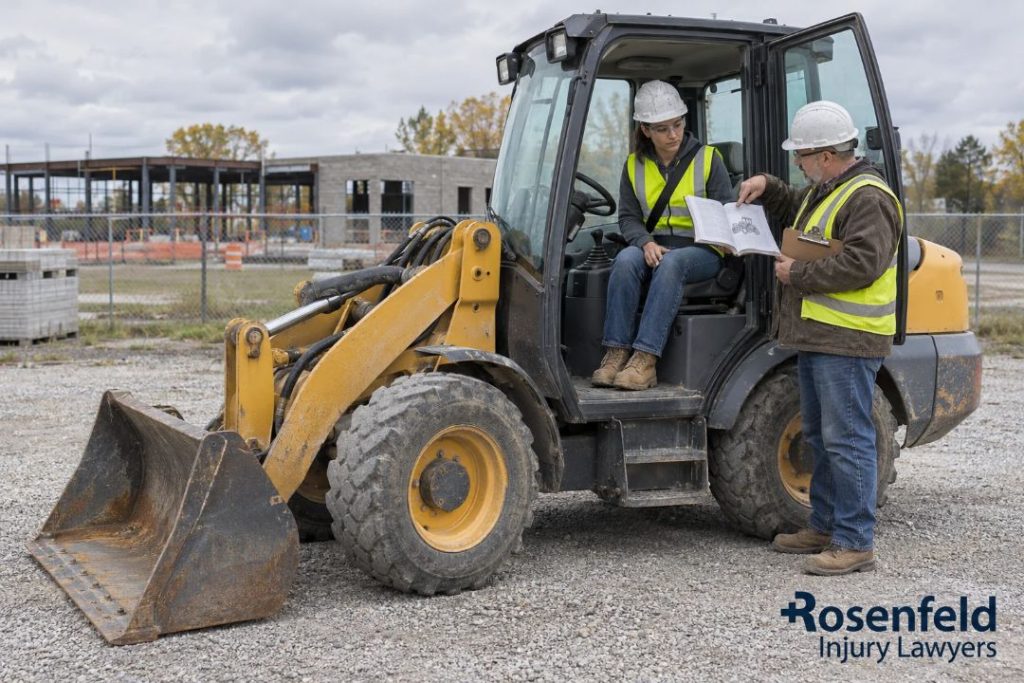
OSHA does not require a general heavy equipment operator certification. OSHA does not issue a card or license for excavator, loader, or dozer operators. OSHA requires employers to train operators and ensure only qualified people run machines. Certification applies to a few machines, mainly cranes and forklifts. When an untrained operator hurts someone, that training gap can matter a great deal.
Does OSHA Require Heavy Equipment Operator Certification?
No. A general OSHA heavy equipment operator certification does not exist. OSHA does not issue or require one for operators of excavators, loaders, bulldozers, backhoes, or graders. Employers must train workers to recognize and avoid hazards under 29 CFR 1926.21, and may only let employees qualified by training or experience run equipment under 1926.20.
OSHA said the same thing in its July 14, 2016 letter of interpretation. The agency said it does not certify heavy equipment operators and pointed to the employer’s training duty. The same letter noted that employers must train and certify powered industrial truck operators.
Many web pages about OSHA heavy equipment operator certification blur three terms. Here is the difference:
- Certificate of completion: proof that someone finished a course.
- Certification: a credential from a testing body or employer evaluation, which OSHA requires only for certain equipment.
- License: a permit issued by a government, such as a commercial driver’s license or a city crane license.
So a shop selling a “heavy equipment training course” is not selling something OSHA demands. Good training still matters, as we explain below.
What Does OSHA Require for Equipment Operators?
OSHA requires employers to train workers on job hazards and to allow only qualified people to operate machinery. It sets no required hours, written test, or wallet card for most heavy equipment. The duty belongs to the employer, not the worker.
The Training Duty in 1926.21
Section 1926.21 says the employer must teach each employee to recognize and avoid unsafe conditions. It also covers the rules that apply to that worker’s job. Notice what is missing. The rule names no number of hours, no exam, and no card.
Qualified by Training or Experience in 1926.20
Section 1926.20 says the employer may permit only employees qualified by training or experience to operate equipment and machinery. The employer decides who qualifies and must be able to show how. Experience can count. But a worker who has never run that machine is not qualified just because a foreman says so.
Equipment Rules That Assume a Trained Operator
The OSHA heavy equipment regulations in Subpart O and elsewhere assume the person in the seat knows the machine. These rules include:
- Seat belts and rollover protection on earthmoving equipment.
- Service brakes able to stop and hold a loaded machine.
- Horns and reverse alarms where the rules call for them.
- Rules on leaving equipment unattended.
- Following the manufacturer’s operating manual and load limits.
The same section requires frequent and regular equipment inspections by competent persons the employer designates. For a wider look at these rules, see our guide to OSHA construction regulations.
Where Is Certification Actually Required?
Certification is required for a short list of machines, mainly cranes and forklifts. For most other equipment, no OSHA heavy equipment operator certification exists, and training rules apply instead. The table below shows how each one works.
| Equipment | Rule | What it requires |
| Cranes and derricks | 29 CFR 1926.1427 | The operator is trained, certified, or licensed and evaluated by the employer. Employer pays for required certification. |
| Small hoisting equipment rated 2,000 pounds or less | 1926.1441 | Operator training, not certification. |
| Forklifts and other powered industrial trucks | 1910.178 and 1926.602. | Employer trains, evaluates, and certifies the operator. Performance is re-evaluated at least every three years. |
| Aerial lifts | 1926.453 | Only authorized persons may operate. |
| Scissor lifts and scaffolds | 926.454 | Training by a qualified person. |
Forklift rules have their own details, covered in our post on OSHA’s forklift certification and 3-year rule. For scissor lifts, see what OSHA requires for scissor lift harnesses.
One more catch. An excavator or loader used to lift suspended loads with rigging may fall under the crane standard. That can change the operator rules. Anyone working that way should check before the lift. Our page on crane accident claims covers that area.
Do You Need a License to Operate Heavy Equipment in Illinois?
Generally, no. We are not aware of a general Illinois license required to run earthmoving equipment on a job site. Readers often mix up OSHA heavy equipment operator certification and state licensing, but they are separate questions. Three exceptions come up often, so here is what to know about each.
Commercial Driver’s Licenses
A commercial driver’s license covers driving on public roads, not operating a machine on site. You may need one to haul equipment on public roads once the truck passes federal weight thresholds, which start at 26,001 pounds gross vehicle weight rating. Equipment that stays on the site is generally not treated as a commercial vehicle.
City of Chicago Crane Operator License
Chicago requires a city-issued license for crane operators. Check the current rules with the city before any lift. We mention it only to show that local law can add a license on top of OSHA.
Union Apprenticeships and Employer Requirements
Many Illinois operators learn through union apprenticeships, such as those run by the International Union of Operating Engineers Local 150. Project specifications and contractors often require proof of training, too. Those are contract or employer requirements, not OSHA rules.
What Does Proper Operator Training Look Like?
Proper training is machine-specific, hands-on, and documented. A video and a signature on a sheet do not meet that standard. Good heavy equipment operator training usually includes:
- Instruction on the exact model, including the manufacturer’s operator’s manual.
- Hands-on practice under supervision before any solo work.
- Site hazards, such as buried and overhead utilities, trench edges, ground conditions, and nearby trades.
- Pre-use checks of brakes, steering, alarms, seat belts, and attachments.
- An evaluation by someone competent, with the result written down.
- Refresher training after a near miss, an accident, or a move to a new machine.
When an employer cannot show any of this, it is hard to argue the operator was qualified by training or experience. Ask for the written evaluation first. If none exists, that gap is worth noting early.
Why Do Training Rules Matter After an Injury?
They matter because OSHA’s training duty binds the operator’s employer. On a multi-employer Illinois site, the injured worker and the operator often work for different companies. A training failure by the operator’s employer is then usually a third-party issue, not a workers’ compensation issue.
A missing OSHA heavy equipment operator certification is not the real question, since most machines don’t require one. The real question is whether the operator was trained and qualified. The table maps common training gaps to what each can show. The first two scenarios are illustrative, not real cases.
| Training gap | What it can show | Record to ask for |
| Untrained operator on that machine | The employer let an unqualified person operate under 1926.20 | Training records, sign-in sheets, evaluation forms |
| Laborer told to “jump on” a machine for a quick task | A supervision and qualification failure | Daily logs, foreman texts, witness names |
| Crane-type lift by an uncertified operator | A possible violation of the crane certification rules | Certification card, employer evaluation, lift plan |
| No site hazard training | A failure to train under 1926.21 | Safety program, toolbox talk records |
| Rental machine handed to an obviously inexperienced operator | Possible negligent entrustment by the supplier, depending on Illinois law | Rental agreement, operator information |
Who can be held responsible depends on the facts. Claims may reach the subcontractor that employed the operator, a general contractor that kept control over safety, or the company that supplied the equipment. Our article on who can be held liable for a heavy equipment accident goes deeper.
A safety rule violation in Illinois is generally evidence of negligence, not automatic negligence. An untrained operator who is hurt can still claim workers’ compensation, because that system does not depend on fault. A claim against that worker’s own employer is usually barred.
The numbers show the stakes. The Bureau of Labor Statistics reported 49 fatal work injuries among construction equipment operators in 2024. That is a rate of 11.7 per 100,000 full-time workers, against 3.3 for all workers.
Workers’ Comp or a Third-Party Claim?
Workers’ compensation is no-fault and pays medical care, lost wages, and permanent disability. It does not pay for pain and suffering. A third-party claim can add those damages, though the comp insurer usually has a lien on that recovery.
Deadlines differ. An Illinois personal injury lawsuit generally has a two-year limit. A comp claim generally must be filed within three years of the accident, or two years from the last compensation payment. Read more on when you can sue instead of only claiming workers’ comp.
What Should You Do If an Untrained Operator Hurt You?
Get medical care first, then report the injury in writing as soon as possible and start collecting facts. Even without an OSHA heavy equipment operator certification requirement, training records can prove a lot, and they can disappear fast. These steps help protect them:
- Get medical care and report the injury to your employer in writing. Illinois generally expects notice within 45 days.
- Write down the machine, its owner or rental tag, and who was operating it.
- Note which company the operator works for.
- Ask coworkers what they saw and whether the operator usually ran that machine.
- Do not give a statement to another contractor’s insurer.
- Talk to a lawyer before records are lost.
Our checklist on what to do after a construction accident at work in Illinois covers the first days in more detail.
Talk to a Lawyer About Your Equipment Injury
Questions about training, qualification, or an OSHA heavy equipment operator certification gap are easier to answer early. Our team at IL Work Injury Lawyer can review what happened and tell you which claims may apply. We work on a contingency fee, so you owe nothing unless we win. Learn how a Chicago heavy equipment accident attorney can help by calling 312-757-7348 for a free consultation.
This article offers general information, not legal advice.
Frequently Asked Questions
Usually not on a job site. Illinois has no general operator license we know of, but a commercial driver’s license may apply on public roads, and Chicago licenses crane operators.
No. Those cards show completion of a general safety outreach course. They are not an OSHA heavy equipment operator certification and do not prove a person can run a specific machine.
The operator’s employer. OSHA requires employers to train workers on hazards and to let only qualified people operate equipment. A union or school may help, but the employer still has the legal duty.
Possibly. If the operator worked for a different company, you may have a third-party claim in addition to workers’ compensation. The facts and Illinois law decide who can be held responsible.
Workers’ compensation still applies because it is no-fault. A lawsuit against your own employer is usually barred, but other companies on site may share responsibility. A lawyer can review that.
 Legally Reviewed By
Attorney Jonathan Rosenfeld
Content legally reviewed by Jonathan Rosenfeld The information on this page has been legally reviewed by Attorney Jonathan Rosenfeld, founder and managing partner of Rosenfeld Injury Lawyers LLC. With extensive experience representing injured workers across Illinois, Mr. Rosenfeld is dedicated to helping workplace accident victims pursue the maximum compensation available under the law. His extensive legal knowledge and commitment to client advocacy ensure that the information provided is accurate, reliable, and aligned with current legal standards.