



Anhydrous Ammonia Burns on Illinois Farms: Symptoms, First Aid, and Who Is Responsible


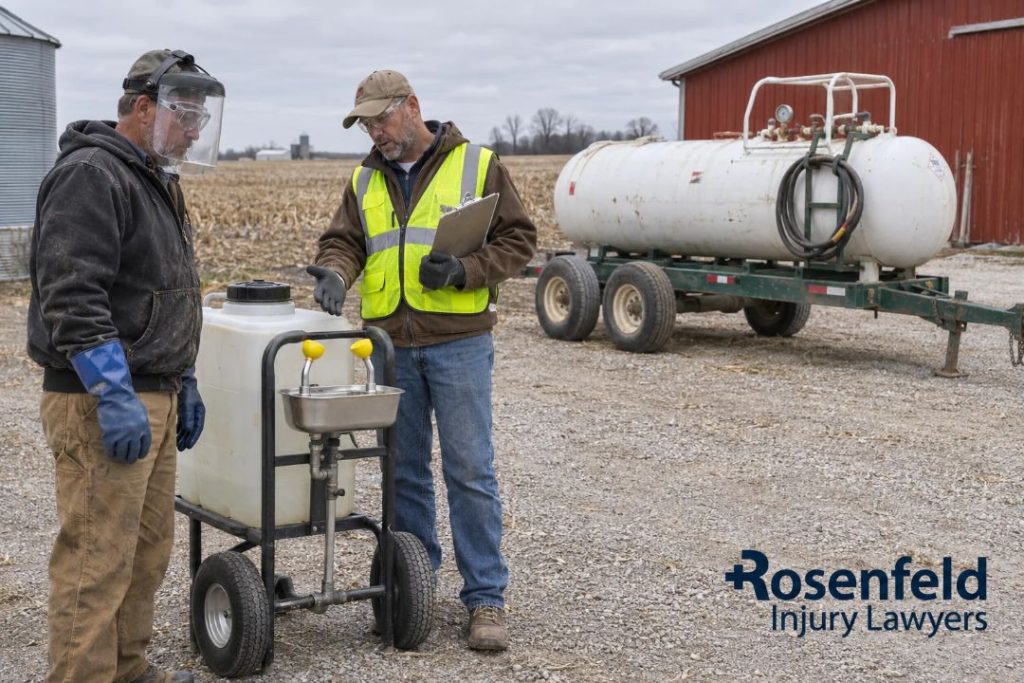
Anhydrous ammonia burns hit in two ways at once. The liquid freezes tissue on contact, then the chemical keeps working on skin, eyes, and lungs after the cloud is gone. Water is the first aid, and it has to start within seconds and run for a long time. On Illinois farms, most anhydrous ammonia exposure happens during fall and spring application, and many injuries trace back to a hose, coupler, or tank that someone else owned or maintained. For a serious exposure, call 911. This article is general information, not medical advice.
What Is Anhydrous Ammonia and Why Does It Burn So Badly?
Anhydrous ammonia (NH3) is a nitrogen fertilizer stored as a pressurized liquid. Once released, it boils at about -28°F and turns into gas. Because “anhydrous” means without water, it pulls moisture from skin, eyes, and lungs, causing both freeze burns and alkali chemical burns.
Picture a cold burn and a chemical burn on one patch of skin. The cold damages tissue first. The alkali then keeps working its way deeper, which is why anhydrous ammonia burns can look minor at first and get worse over the following hours.
Size matters too. NDSU reports that one cubic foot of liquid expands to roughly 850 cubic feet of gas, so a split hose near a cab or toolbar can quickly become a cloud.
Note: Ammonia is a fertilizer, not a pesticide. Pesticide exposure is a different problem, and we cover it in pesticide exposure symptoms at work.
Anhydrous Ammonia Exposure Symptoms by Body Part
Symptoms depend on which part of the body was exposed. Here is how they usually break down, from the first minutes to the problems that can show up later.
| Area | Early signs | Serious or delayed signs |
| Skin | Pain, redness, white or gray frozen patches, blisters, clothing frozen to skin | Deep chemical burns that may need debridement or grafts; scarring |
| Eyes | Burning, tearing, swelling, blurred vision | Corneal burns, cataracts, glaucoma, permanent vision loss |
| Nose, mouth, throat | Burning, coughing, hoarseness | Throat swelling that blocks the airway |
| Lungs | Coughing, chest tightness, shortness of breath | Fluid in the lungs (pulmonary edema), lasting breathing problems |
Symptoms can develop or worsen for up to 24 hours, according to CDC and ATSDR medical guidance. A worker who “feels fine” after rinsing still needs a medical exam. Early records also lock in how severe the injury really was, which matters if a claim follows.
Exposure levels, from the NIOSH Pocket Guide: people often smell ammonia somewhere between 5 and 50 ppm. The NIOSH recommended limit is 25 ppm, the OSHA limit is 50 ppm, and 300 ppm is considered immediately dangerous to life and health.
Serious scarring can follow a deep burn, and Illinois workers’ comp has specific rules for it. Our page on scarring and disfigurement benefits explains them.
First Aid for Anhydrous Ammonia Burns
Seconds count here, so this list comes before everything else. It reflects guidance from CDC and ATSDR, Purdue Extension (S-71), NDSU, and the Minnesota Department of Agriculture.
- Get upwind and out of the cloud. Move the person to fresh air.
- Flush skin and eyes with clean water right away, for at least 15 minutes. Keep flushing on the way to care.
- For eyes, hold the lids open while flushing. Remove contact lenses if possible.
- Do not pull off clothing frozen to the skin. Thaw it loose with water first, then remove the soaked clothing.
- Do not apply salves, creams, or ointments.
- Call 911 for any eye exposure, breathing trouble, or large burns. Tell responders it was anhydrous ammonia.
- Get a medical exam even if symptoms fade.
The water rule is not just advice. OSHA requires farm vehicles carrying ammonia to carry at least 5 gallons of water (29 CFR 1910.111(g)(6)(iv)). Illinois Department of Agriculture rules (8 Ill. Adm. Code Part 215) require at least 5 gallons of clean water on every nurse tank.
An empty, missing, or filthy water container is more than a safety lapse. It becomes evidence later. Photograph it before it’s refilled.
How Anhydrous Ammonia Accidents Happen on Illinois Farms
Most anhydrous ammonia in central Illinois goes on in the fall after harvest, with some spring pre-plant application, according to Illinois Extension (March 2026). Anhydrous ammonia burns cluster in those windows. The same failure points come up again and again:
- A hose rupture or coupling failure at the nurse tank or toolbar. NDSU notes most hose failures happen near the ends.
- A breakaway coupler that fails to separate, or separates and keeps leaking, when the tank and toolbar pull apart.
- Opening the wrong valve, or bleeding lines while standing downwind.
- Leaks at the fill site when tanks are filled at the co-op.
- A nurse tank rupture from a weld or shell defect. The NTSB investigated one in Calamus, Iowa, in 2003, and NIOSH published a FACE report on a nurse tank rupture that killed a cooperative worker.
- Road crashes while towing tanks between fields.
Here is an illustrative example, not a case result. A farm employee hooks a co-op nurse tank to an applicator. A hose past its replacement date splits at the coupling and sprays his face and forearms. He has water on the tank, but the container is nearly empty.
Safety Rules for Nurse Tanks, Hoses, and Applicators
Rules matter after a burn because they show what the people in charge of the equipment were supposed to do. Here are the main ones.
| Rule or guideline | What it requires | Why it matters after a burn |
| OSHA 29 CFR 1910.111 (hoses) | Hose rated for at least 350 psig working pressure | A hose with the wrong rating or no markings is a red flag |
| OSHA 29 CFR 1910.111 (water) | 5 gallons of water on farm vehicles; a shower or 50-gallon drum at stationary storage | Missing water delays first aid and can worsen the burn |
| Illinois Department of Agriculture, 8 Ill. Adm. Code Part 215 | 5 gallons of clean water on each nurse tank, safety chains, and other tank, storage, and transport rules | State rules show what a retailer or operator had to provide |
| Industry hose and coupler guidance | Replace rayon-braid hose about every 2 years, nylon or Kevlar about 4, stainless about 6, and breakaway couplers about 3, counted from the manufacture date (NDSU) | Date stamps show whether a failed part was overdue |
That last row is industry guidance, not law. Even so, a hose stamped years past its window tells a story.
Federal child labor rules also bar workers under 16 from handling anhydrous ammonia, except on a parent’s farm. For protective gear, see our overview of OSHA PPE requirements.
Who Is Responsible for an Anhydrous Ammonia Burn?
The person hurt is often not the one who owned, filled, or maintained the equipment. Responsibility follows control of the tank, the hose, and the work. Here is how responsibility for anhydrous ammonia burns usually maps out.
| Party | When it may be responsible | Records that show it |
| Fertilizer retailer or co-op that owns and leases the nurse tank | Worn or out-of-date hose, missing water, bad valves, poor inspection, overfilling | Tank ID and inspection logs, hose date stamps, fill tickets |
| Hose, coupler, valve, or tank manufacturer | A part failed in normal use or lacked adequate warnings | The failed part itself, model and lot numbers |
| Custom applicator company | Its crew or equipment caused the release | Work orders, crew training records |
| Farm owner or operator (as employer) | Unsafe practices, no PPE, no training, no water Training rec | Training records, PPE purchases, witness statements |
| Another driver | A crash with a tank on a public road | Crash report, photos |
Product claims in Illinois can rest on strict liability or negligence. Very old tanks and parts may trigger a statute of repose, so the equipment’s age matters. Our post on a defective farm equipment lawsuit walks through those claims.
Workers’ Comp and Third-Party Claims After an Ammonia Burn
Many farm employees are covered by Illinois workers’ comp, but some small farms are exempt under the agricultural rules. We explain who falls where when it comes to whether Illinois farm workers are covered by workers’ comp.
Comp pays medical care and wage benefits, but not pain and suffering. A third-party claim against a co-op or manufacturer can, and it does not depend on comp coverage. Deadlines run short, generally 2 years for an Illinois personal injury lawsuit and 3 years for a comp claim. See farm accident filing deadlines before waiting on anything.
What to Do After an Anhydrous Ammonia Accident
Tanks go back to the co-op, and hoses get replaced the same day, so evidence disappears fast. Move quickly on these steps.
- Get medical care and keep every record.
- Photograph the tank, hose, coupler, valves, and water container, including date stamps and tank ID numbers.
- Ask that the tank and failed parts not be repaired, returned, or thrown out.
- Report the injury to your employer in writing. Illinois comp notice is generally 45 days.
- Write down who filled the tank and when.
- Talk to a lawyer before the co-op or its insurer takes the equipment back.
If you are weighing a claim, our page on agricultural chemical exposure claims is the place to start.
FAQ
Flush skin and eyes with clean water for at least 15 minutes, starting immediately. Keep rinsing on the way to care if you can. Stopping early lets the chemical keep working, so more water is almost always better than less.
Yes. Symptoms can develop or worsen for up to 24 hours, and deep chemical burns can look mild at first. Anyone exposed should get a medical exam even if the skin looks fine after rinsing.
Yes. Serious eye exposure can cause corneal burns, cataracts, glaucoma, and permanent vision loss. Flush the eyes right away, hold the lids open, and call 911 for any eye exposure.
It depends on who controlled the tank and the hose. A co-op that owns, fills, or leases the tank may be responsible, and so may a manufacturer. Hose date stamps, inspection logs, and fill tickets can help show who is responsible.
Possibly. Helping out does not automatically cancel your rights. Comp coverage may be unclear, but a claim against a co-op or manufacturer does not depend on it. Read about being hurt on someone else’s farm.
Talk to Someone Before the Evidence Disappears
If anhydrous ammonia burns injured you or a family member, an Illinois farm accident lawyer can help identify who owned, operated, or maintained the equipment. Acting promptly can help preserve important evidence. The consultation is free, and you pay no attorney fees unless we win your case. Call 312-757-7348 today for a consultation.
This post summarizes CDC/ATSDR and extension guidance and is not medical advice. It is general information, not legal advice.
 Legally Reviewed By
Attorney Jonathan Rosenfeld
Content legally reviewed by Jonathan Rosenfeld The information on this page has been legally reviewed by Attorney Jonathan Rosenfeld, founder and managing partner of Rosenfeld Injury Lawyers LLC. With extensive experience representing injured workers across Illinois, Mr. Rosenfeld is dedicated to helping workplace accident victims pursue the maximum compensation available under the law. His extensive legal knowledge and commitment to client advocacy ensure that the information provided is accurate, reliable, and aligned with current legal standards.