



Trench Collapse Causes: Soil Type, Shoring and the OSHA Rule That Decides Liability


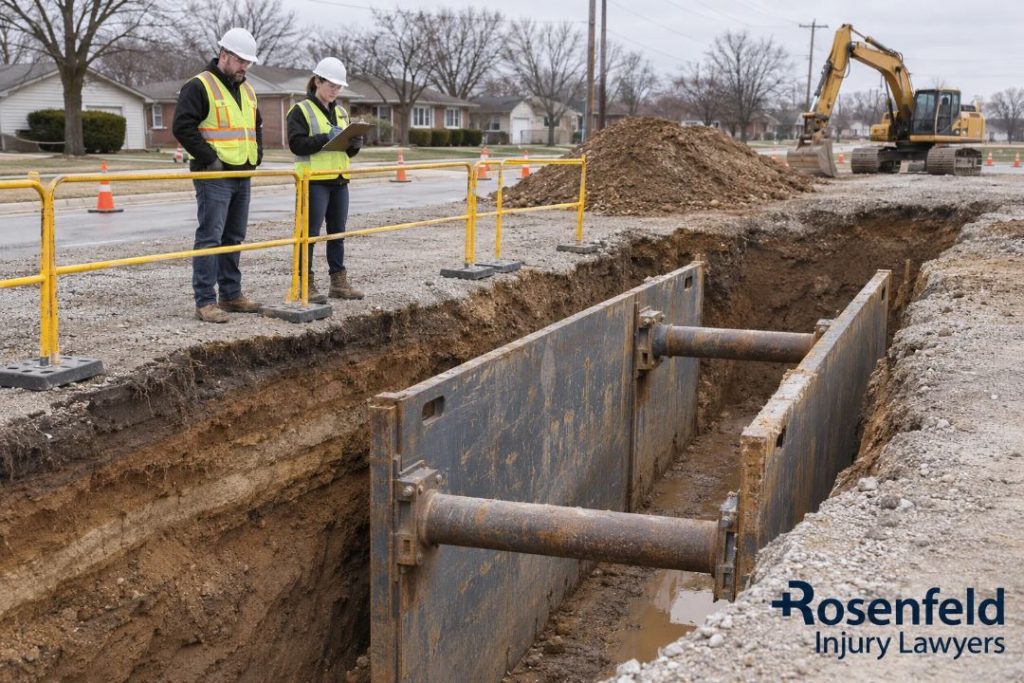
Trench collapse causes come down to one fact: digging removes the soil that held the walls in place. Soil type, water, vibration, and weight at the edge then push on those walls. Without sloping, shoring, or a shield, they give way. Federal rules in 29 CFR 1926 Subpart P say how to stop that.
OSHA reported 39 trenching and excavation deaths in 2022, up from 15 in 2021. These fatal construction accidents follow a pattern, and the pattern starts with the dirt. We wrote this for the person standing in the trench, not the person in the office. Every cause below ties to a plain rule, so you can see what went wrong and which OSHA trench requirements applied.
Why Do Trenches Collapse?
A trench collapses when its walls lose the side support that the removed soil used to give. Gravity pulls the face inward. Water, vibration, or extra weight speeds it up, and without a protective system nothing holds it back.
Soil is heavier than most people expect. A cubic yard can reach nearly 3,000 pounds, about a car. A worker buried to the chest often cannot breathe, even with the head clear, because the pressure stops the lungs from filling. A cave-in is one of the caught-in and caught-between hazards that OSHA counts among construction’s fatal four.
Walls fail in a few familiar ways:
- Lip slide: The spoil pile or top edge slips into the trench.
- Wall slough: Chunks of the face peel away, also called spalling.
- Bottom heave: The floor bulges up as the walls squeeze in.
- Undermined structures: A sidewalk, slab, or foundation drops into the cut.
What Are the Most Common Trench Collapse Causes?
The most common trench collapse causes are missing or wrong protective systems, misjudged soil, water, and weight at the edge. Most collapses involve two or three at once. Each cause below names the rule it breaks.
- No protective system, or the wrong one. Trenches 5 feet or deeper need sloping, shoring, or a shield. The rule is 1926.652 paragraph a1.
- Soil misclassified or never tested. Crews call fissured or disturbed soil Type A and keep digging. Appendix A to Subpart P explains why that fails.
- Water. Rain, groundwater seepage, a leaking water or sewer line, and thawing ground all soften walls. See 1926.651 paragraph h.
- Spoil piles too close. Dirt and materials must sit at least 2 feet back or be held by retaining devices. See 1926.651 paragraph j2.
- Heavy equipment at the edge. Excavators, dump trucks, and compactors add surcharge load. Keep heavy equipment near the trench edge only when the walls are built for it.
- Vibration. Traffic, pile driving, and compaction shake soil loose. They also rule out Type A.
- Previously disturbed ground. Utility trenches under Chicago-area streets and alleys were backfilled years ago. That soil is rarely as strong as it looks.
- Skipped inspections. Daily checks, and checks after rain, are required. See 1926.651 paragraph k1.
- Shield and shoring misuse. Common errors are digging far below a trench box, standing inside a box as it moves, and pulling shoring in the wrong order. See 1926.652 paragraph g.
- Unsupported neighbors. Sidewalks, foundations, and retaining walls beside the trench need support. See 1926.651 paragraph i.
A 2019 CPWR study of recent trenching deaths, hosted by the CDC, points to missed OSHA rules as a leading reason workers die in trenches. Those gaps are the excavation and trenching hazards a competent person should catch. That is why the check described below matters so much.
How Do OSHA Soil Types A, B and C Differ?
OSHA sorts soil into stable rock, Type A, Type B, and Type C by strength. Type A is strongest and Type C is weakest. The class decides which protective systems and slopes are allowed.
Before anyone enters, a competent person must classify the soil. Appendix A to Subpart P calls for at least one visual test and at least one manual test.
| Soil class | Strength in tons per square foot | Typical soils | Maximum slope |
| Stable rock | Not applicable | Solid rock that stays intact | Vertical, 90 degrees |
| Type A | 1.5 or more | Clay, silty clay, sandy clay, hardpan | 3/4 to 1, 53 degrees |
| Type B | Over 0.5 and under 1.5 | Silt, silt loam, angular gravel, disturbed soil not rated C | 1 to 1, 45 degrees |
| Type C | 0.5 or less | Gravel, sand, loamy sand, submerged soil, seeping water | 1 1/2 to 1, 34 degrees |
These slopes apply to excavations 20 feet deep or less. Four things knock soil out of Type A: fissures, vibration from heavy traffic or pile driving, earlier disturbance, and seeping water.
Crews test with thumb penetration, a pocket penetrometer or shearvane, plasticity, dry strength, and drying checks. In layered soil, the weakest layer usually sets the class. “It looks like clay” is not a classification. A wrong label is one of the quietest trench collapse causes, because it hides the danger.
How Do Sloping, Benching, Shoring and Shielding Work?
Any trench 5 feet or deeper needs a protective system unless it sits entirely in stable rock. Sloping and benching cut the walls back. Shoring props them up. Shields protect workers if a wall falls. Shallower trenches still need protection when a competent person sees a cave-in risk.
Sloping and Benching
Crews cut the walls back to the angle the soil allows. Benching cuts steps into the wall. Benching is not allowed in Type C soil. Past 20 feet deep, a registered professional engineer must design the system, as Appendix B and 1926.652 paragraph b explain.
Shoring
Hydraulic, timber, or screw-jack supports push against the walls and stop movement. They must follow OSHA’s tables, the maker’s tabulated data, or an engineer’s design under 1926.652 paragraph c. Installation and removal follow a set order so workers stay protected throughout.
Shielding With Trench Boxes
A shield protects workers if a wall falls. It does not stop the wall from falling. Nobody may be inside while it is installed, removed, or moved vertically, under 1926.652 paragraph g1. Crews may dig no more than 2 feet below the shield, and only if it is rated for the full depth and no soil is slipping from behind it, under paragraph g2.
| System | Prevents collapse? | Best used when | Common mistake |
| Sloping | Yes | Open space allows wide cuts | Slope too steep for the soil |
| Benching | Yes | Type A or B soil with room | Used in Type C soil |
| Shoring | Yes | Tight sites near structures | Wrong installation or removal |
| Shield | No | Long pipe runs | Digging far below the box |
Match the system to the soil and the depth. A mismatch is how a trench that looks protected still fails.
What Does 29 CFR 1926 Subpart P Require?
Subpart P sets the minimum rules for every construction trench. It covers utilities, exits, water, spoil, inspections, and protective systems. Many trench collapse causes are simply broken Subpart P rules.
| Rule | What it requires | Risk it addresses |
| 1926.651 paragraph b | Locate underground utilities before digging | Strikes that shake the ground |
| 1926.651 paragraph c2 | Ladder, ramp, or stairs in trenches 4 feet or deeper, within 25 feet of workers | Trapped workers |
| 1926.651 paragraph h | No work in accumulated water without precautions | Softened walls |
| 1926.651 paragraph j2 | Materials and equipment 2 feet back or retained | Surcharge loads |
| 1926.651 paragraph k | Inspections daily and after rain; remove workers if a hazard appears | Missed changes |
| 1926.652 paragraph a1 | Protective system at 5 feet, or less if a cave-in is possible | Bare walls |
Illinois adds a step. The Illinois Underground Utility Facilities Damage Prevention Act, 220 ILCS 50, requires a call to JULIE at 811 before digging. Notice must come at least 48 hours ahead, counting only working days.
Federal OSHA covers private employers in Illinois. Illinois OSHA, run by the Illinois Department of Labor, covers state and local government workers, such as municipal water and sewer crews. OSHA also runs a national emphasis program on trenching and excavation. For the wider picture, see our guide to OSHA regulations on construction sites.
Who Is the Competent Person on a Trench?
Under 29 CFR 1926.32 paragraph f, a competent person can spot existing and predictable hazards and has the authority to fix them fast. On a trench, that person classifies soil, checks the protective system, inspects daily and after rain, and pulls workers out when conditions change.
Many trench collapse causes trace back to this role. Either nobody held it, or someone held it on paper only. After a collapse, we ask four questions:
- Was a competent person named for this trench?
- How was the soil tested, and by whom?
- When was the last inspection, and was it after the rain?
- Did anyone tell workers to keep going while the walls showed cracks?
Subpart P requires the inspections but does not name a written form. Many contractors keep logs anyway, and a missing log tells its own story.
In the cases we handle, evidence disappears fast. The trench gets backfilled. The shield goes back on a truck. Soil test notes get lost. Those questions are worth asking early, before the proof is gone.
What Are the Warning Signs of a Trench Collapse?
Warning signs include cracks along the trench edge, bulging walls, falling soil, and water seeping in. If you see any of them, leave the trench at once and tell the competent person. Walls often send clear signals before they fall.
- Cracks in the ground parallel to the trench edge
- Bulging or sagging walls
- Small chunks or raveling falling from the face
- Water seeping in or pooling
- Shoring that creaks, bends, or shifts
- Spoil or equipment creeping toward the edge
Under 1926.651 paragraph k2, workers must be removed until the hazard is fixed. If nobody acts, you can report an unsafe trench to OSHA.
How Is a Subpart P Violation Used After a Cave-In?
In Illinois, breaking a safety rule is generally treated as evidence of negligence, not automatic negligence. Workers’ comp is no-fault and is usually the only claim against your own employer. A third party that controlled the trench, such as a general contractor, another subcontractor, an engineer, or an equipment supplier, may face a separate claim.
We cover who can be held liable for a trench collapse and when you can sue instead of only claiming workers’ comp in separate guides. One published result of ours shows the stakes: $3,599,000 for Tom, a contractor who was crushed in a trench collapse while cleaning an excavation site in River Forest.
Trench Collapse FAQs
Most start with no protective system, or one that does not suit the soil. Water or weight at the edge adds to it. These trench collapse causes a stack.
At 5 feet deep, a protective system is required. Shallower trenches need one if a cave-in looks possible. Past 20 feet, an engineer must design sloping or benching.
No, a trench box shields workers after a wall fails and does not prevent the failure. Misuse, such as digging more than 2 feet below it, defeats the protection.
A competent person decides. They must use at least one visual test and one manual test before workers enter. A quick look at the dirt does not count.
Get out now and tell the competent person. Do not return until it is fixed. If anyone is hurt, see what to do after a construction accident.
Get Help After a Trench Collapse
Talk with a Chicago excavation accident attorney at Illinois Work Injury Lawyer if a trench cave-in hurts you or someone you love. The consultation is free, and there is no fee unless we win. Call 312-757-7348. Knowing the trench collapse causes your accident is the first step toward holding the right people responsible.
This article is general information, not legal advice.
 Legally Reviewed By
Attorney Jonathan Rosenfeld
Content legally reviewed by Jonathan Rosenfeld The information on this page has been legally reviewed by Attorney Jonathan Rosenfeld, founder and managing partner of Rosenfeld Injury Lawyers LLC. With extensive experience representing injured workers across Illinois, Mr. Rosenfeld is dedicated to helping workplace accident victims pursue the maximum compensation available under the law. His extensive legal knowledge and commitment to client advocacy ensure that the information provided is accurate, reliable, and aligned with current legal standards.