



How to Read a Forklift Data Plate: Load Center, Capacity and the Mistake That Causes Tip-Overs


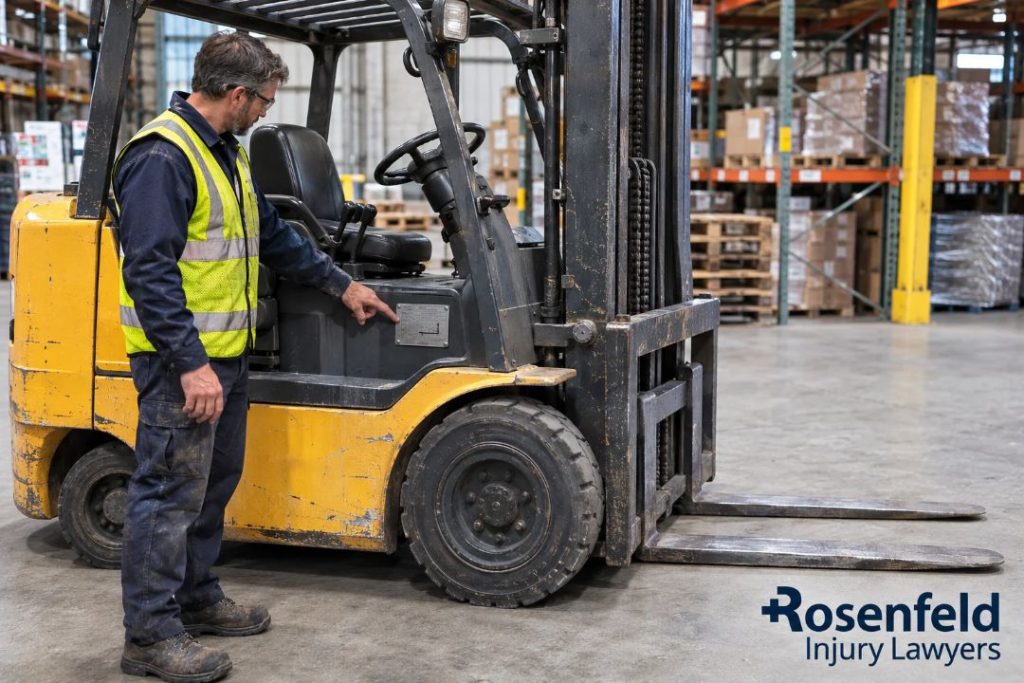
The forklift load center is the distance from the face of the forks to the center of gravity of the load. The capacity printed on the forklift data plate is true only at that distance, at the listed lift height, and with the listed attachment. A longer or poorly placed load moves the center outward and cuts what the truck can safely carry.
Most tip-overs start with one habit. A driver reads the big number on the plate and stops there. Below, we cover each plate line, the math, and the mistake to catch.
What Is a Forklift Load Center?
A forklift load center is the horizontal distance from the vertical face of the forks to the load’s center of gravity. The plate rates the truck at one set distance. Move the weight farther out, and the truck can safely lift less.
OSHA’s powered industrial truck eTool uses this same definition.
The standard load center is 24 inches for trucks rated at 30,000 pounds or less. OSHA’s Appendix A to 29 CFR 1910.178 says larger trucks usually use 36 or 48 inches. Always trust the number on your own plate.
A 48 inch pallet, loaded evenly and pushed back against the heel of the forks, has a 24 inch load center. That is half its length, measured from the fork face.
Where Is the Forklift Data Plate and What Does Each Line Mean?
The forklift data plate, also called the nameplate or capacity plate, is usually riveted near the operator’s seat, dashboard, or mast. It lists the truck’s model, weight, rated capacity, load center, lift height, and attachment.
OSHA’s eTool says not to operate a truck with a missing or illegible nameplate. Layouts differ by manufacturer, so read your own plate against the operator’s manual.
| Field | What it tells you | Why it matters |
| Model and serial number | The exact truck | Matches the truck to its manual and capacity charts |
| Type designation, such as LP, G, D, or E | Fuel and fire-safety rating | Tells you where the truck may be used |
| Truck weight | Weight without the load, and on electric trucks often without the battery | Part of the balance against the load |
| Battery weight, electric trucks only | Minimum and maximum battery weight | The battery counts as counterweight |
| Attachment | Any attachment the rating assumes | No attachment listed means the rating is for forks only |
| Capacity, load center, and lift height | Maximum load at a stated distance and height | The three numbers only work together |
| Tilt and tire type | Mast tilt and tire specs | Changes in tires or tilt can change stability |
What Do the Three Capacity Numbers Mean Together?
A line such as 5,000 lb at 24 in. load center to 189 in. lift height means 5,000 pounds only when the load’s center is 24 inches out and the forks stay at or below 189 inches. Change either number, and the capacity changes.
We use generic values here, not a real plate. The forklift load center is the middle number in that set.
How Do Attachments Change the Plate?
An attachment adds weight and pushes the load farther forward, so it lowers capacity. OSHA’s eTool shows a truck rated 5,000 pounds with forks only and 4,500 pounds with a sideshifter.
Under 1910.178 a.5, a truck with a non-factory front-end attachment must be marked with the approximate weight of the truck and attachment together at maximum elevation. If the plate still shows the forks-only rating after an attachment was added, that number is wrong for the truck.
Why Does Battery Weight Matter on Electric Trucks?
Battery weight matters because the battery works as a counterweight. A battery lighter than the plate lists leaves the truck with less balance against the load, so real capacity drops.
Any change that affects capacity needs the manufacturer’s written approval.
Why Does Lift Height Change Capacity?
A higher load is less stable, so the rating can fall as the forks rise. That is why the plate names a lift height next to the capacity. Capacity at a low lift does not carry over to full mast height.
How Do You Calculate Capacity at a Different Load Center?
To find forklift load capacity at a longer load center, multiply the rated capacity by the rated load center. Then divide that number by the real load center of your load. The result is a safe weight estimate.
OSHA publishes this method in Appendix A. Follow three steps.
- Multiply the rated capacity by the rated load center. This gives the maximum load moment in inch-pounds.
- Measure the real load center. For an evenly loaded item pushed back against the fork heel, use half its length. Otherwise, find the actual center of gravity.
- Divide the maximum load moment by the real load center.
OSHA’s own example runs like this. A 3,000 pound truck rated at 24 inches has a maximum load moment of 72,000 inch-pounds. A 60 inch load has a 30 inch load center. Divide 72,000 by 30 and you get 2,400 pounds.
Now try a common 5,000 pound truck rated at 24 inches. Its maximum load moment is 120,000 inch-pounds.
| Load length, evenly loaded | Load center | Approximate maximum load |
| 48 in. | 24 in. | 5,000 lb |
| 60 in. | 30 in. | 4,000 lb |
| 72 in. | 36 in. | 3,333 lb |
| 96 in. | 48 in. | 2,500 lb |
The method works because the forklift load center acts like a lever arm. Double the distance, and the safe weight drops by half.
This is a field estimate. Appendix A notes it understates what the truck can handle, because the true distance is measured from the front wheels. So it errs on the safe side and never allows more than the plate. It also ignores lift height and attachments.
When in doubt, the manufacturer’s forklift capacity chart, sometimes called a load chart, controls. For how capacity works in general, see our page on forklift weight capacity.
What Does a Bad Estimate Look Like?
Take the same 5,000 pound truck and a crate that is 96 inches long and weighs 3,000 pounds. The crate is well under the headline number. But its load center is 48 inches, and the limit there is 2,500 pounds.
The load is 500 pounds over. The numbers are made up, but the trap is real.
What Mistake Causes Forklift Tip-Overs?
The most common mistake is treating the headline capacity as the limit for any load. That number holds only at the rated load center, lift height, and attachment. Outside those, the real limit is lower.
Here is how it goes wrong:
- A long or bulky load, such as a crate, coil, or machine, pushes the load center past 24 inches.
- The load is not pushed back to the fork heel, which adds the gap to the load center.
- An attachment was added, but the plate still shows the forks-only rating.
- The capacity at a low lift is assumed to hold at full mast height.
- The plate is missing, painted over, or older than a truck modification.
A wrong forklift load center is the hidden input in all five. Once the load moment is bigger than the counterweight can hold, the rear wheels lift and the truck tips forward. A raised load also makes a sideways tip more likely. For the full physics, read our post on why forklifts tip over.
What Does OSHA Require About Data Plates and Capacity?
OSHA’s standard for powered industrial trucks, 29 CFR 1910.178, requires legible nameplates and loads within rated capacity. It also bars capacity changes without the manufacturer’s written approval and requires training on capacity and stability.
OSHA data plate requirements come down to six rules.
| Rule | What it requires |
| 1910.178 a.4 | No changes that affect capacity or safe operation without the manufacturer’s prior written approval. Capacity plates must be changed to match. |
| 1910.178 a.5 | Non-factory front-end attachments: the truck must be marked with the truck-plus-attachment weight. |
| 1910.178 a.6 | All nameplates and markings in place and legible. |
| 1910.178 o.1 and o.2 | Only stable loads, and only loads within the truck’s rated capacity. |
| 1910.178 l.3.i.H and I | Operator training must cover vehicle capacity and vehicle stability. |
| 1910.178 q.7 | Trucks examined before use, at least daily. |
For a wider look at citations, read our guide to OSHA forklift violations. Training duties are covered on our operator training page.
What Happens When a Load Center Mistake Causes an Injury?
When a forklift load center mistake leads to an injury, the data plate, the attachment, and the load’s weight become key evidence. Photograph them early, before repairs.
Keep anything that shows the load’s weight and size, such as a bill of lading or crate label. Training records show whether the operator learned to read the plate. In our experience, the records that go missing are the plate photographed too late, the attachment removed, and the bill of lading never kept.
Illinois workers’ compensation is no-fault. An injured employee does not have to prove the load was over capacity to get benefits. Lawsuits against the employer are generally barred, but a third party may be responsible.
Examples include a rental company that supplied a truck with a wrong or missing plate, a dealer that fitted an attachment without re-plating the truck, a shipper that mislabeled the load weight, or the manufacturer. Our breakdown of when you can sue for a forklift accident explains the difference.
This article is general information, not legal advice. Follow the manufacturer’s capacity chart and your employer’s rules over any estimate here.
What Should You Check Before Every Lift?
Read the plate, match the attachment, and know the load’s weight and length. Run the math if the center sits past the rating. If anything does not match, stop.
- Find and read the plate. Do not operate the truck if it is missing or unreadable.
- Check that the attachment line matches what is on the truck.
- Know the load’s weight.
- Measure its length and estimate its center.
- Do the load-moment math if the center is past the rated load center.
- Check the capacity at the height you will lift to.
- Push the load back against the fork heel.
- If anything does not match, stop and ask a supervisor.
If a lift has already gone wrong, our guide on what to do after a forklift accident lists the next steps.
Frequently Asked Questions
What is the standard load center for a forklift?
The standard load center is 24 inches for trucks rated up to 30,000 pounds. Larger trucks usually use 36 or 48 inches. Your plate shows the exact figure for your truck.
What is the load center of a 48 inch pallet?
A 48 inch pallet has a 24 inch load center when loaded evenly and pushed back against the fork heel. That is half its length.
How do I calculate forklift capacity at a different load center?
Multiply rated capacity by rated load center, then divide by the real load center. A 5,000 pound truck rated at 24 inches handles about 4,000 pounds at 30 inches.
Can you operate a forklift without a data plate?
No. OSHA’s eTool says not to operate a truck with a missing or illegible nameplate. Report it to a supervisor so the plate can be replaced before use.
Does an attachment change the forklift load center and capacity?
Yes. An attachment adds weight and shifts the load forward, so capacity drops. OSHA’s eTool shows 5,000 pounds with forks only and 4,500 pounds with a sideshifter.
What Should You Do Next?
If a forklift tipped or dropped a load, the plate, the load, and the attachment may matter to your claim. Our Chicago forklift accident lawyer team offers a free consultation and works on a contingency fee, so you pay no fee unless we win. If a forklift load center mistake played a part in your injury, call us at 312-757-7348.
 Legally Reviewed By
Attorney Jonathan Rosenfeld
Content legally reviewed by Jonathan Rosenfeld The information on this page has been legally reviewed by Attorney Jonathan Rosenfeld, founder and managing partner of Rosenfeld Injury Lawyers LLC. With extensive experience representing injured workers across Illinois, Mr. Rosenfeld is dedicated to helping workplace accident victims pursue the maximum compensation available under the law. His extensive legal knowledge and commitment to client advocacy ensure that the information provided is accurate, reliable, and aligned with current legal standards.