



Arc Flash Injury on Illinois Job Sites: What NFPA 70E Requires and What a Breach Proves


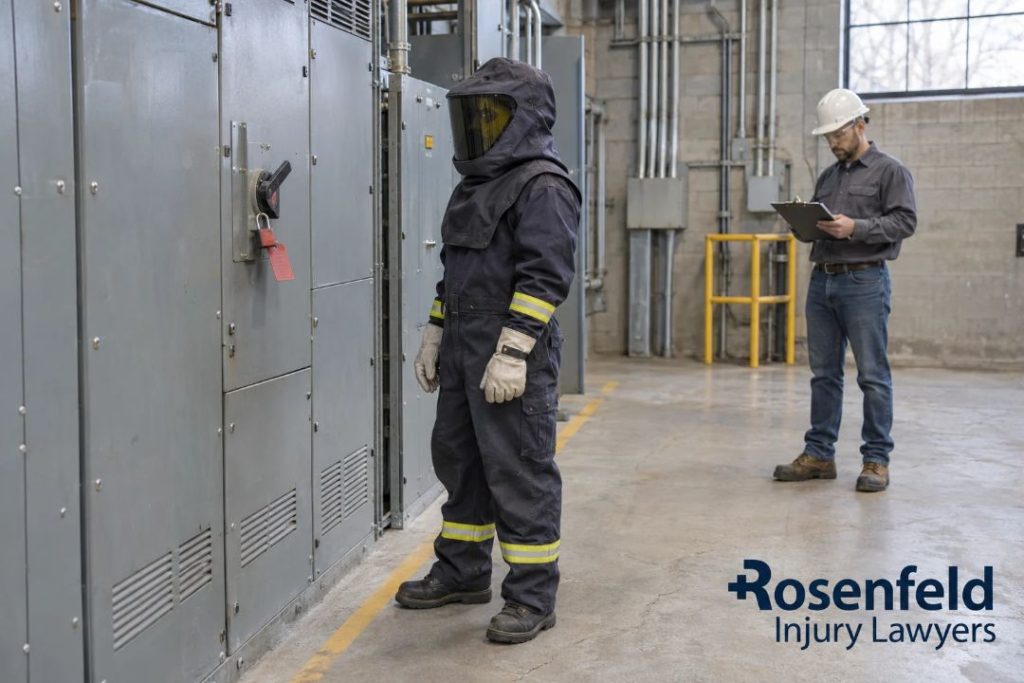
An arc flash injury happens when electricity jumps through the air and burns a worker, often without any touch. On Illinois job sites, NFPA 70E and OSHA rules tell employers how to prevent it. When those steps are skipped, the gap can become evidence of negligence in a legal claim.
What Is an Arc Flash?
An arc flash is a sudden burst of light and heat. It happens when electric current leaves its path and travels through the air between conductors or to ground. A dropped tool, a loose connection, dust, corrosion, or a slipping test probe can set one off.
An arc flash is thermal energy moving through the air. An arc blast is the pressure wave, molten metal, and flying debris that can follow. Electrocution is current passing through the body.
The CDC and NIOSH make a similar split. They describe electrical burns from contact with current and thermal burns from arc flashes and blasts. They also report that temperatures as high as 36,000 degrees Fahrenheit have been recorded in arc flashes.
That heat reaches a worker who never touched a live part.
What Injuries Can an Arc Flash Cause?
Arc flash burns are the best known harm, but rarely the only one:
- Thermal burns, often second and third degree, to the face, hands, arms, and neck
- Clothing ignition, which can make burns deeper and cover more skin
- Eye injuries from intense light and ultraviolet energy, including flash burns and retinal damage
- Hearing loss and ruptured eardrums from the pressure wave
- Inhalation injury from superheated air and vaporized metal
- Blast trauma, such as being thrown off a ladder or lift, or struck by molten metal
- Psychological injury, including anxiety, PTSD, and fear of going back to electrical work
A fall from a lift can also cause a brain injury.
Burns can look modest on day one and worsen over the following days. Treatment may then run for months, including skin grafts and scar revision. Early medical records and photos lock in how severe the injury was. They also support scarring and disfigurement benefits if the damage is permanent.
Who Is Most at Risk on Illinois Job Sites?
Workers closest to the panel face the most risk, but a blast does not check job titles. Those most often exposed include:
- Electricians and apprentices working in panels and switchgear
- Maintenance and HVAC technicians troubleshooting energized equipment
- Workers near temporary power on active construction sites
- Laborers and other trades standing a few feet away
NIOSH has estimated that five to 10 arc flash incidents happen in electrical equipment in the United States every day. Treat that as a rough estimate, not an exact count.
Here is an illustrative example, not a case result. An apprentice is told to install a breaker in a live panel so the electrical contractor does not have to shut down the floor. The panel has no current label and no permit exists. The apprentice did not choose that risk. Someone above him did.
What Does NFPA 70E Require?
NFPA 70E is the national consensus standard for electrical safety in the workplace. The National Fire Protection Association publishes it, and the 2024 edition is the current one. It is not a law by itself, but it still matters in court, as we explain below.
Electrically Safe Work Condition First
The default is to turn the power off, lock it out, and verify there is no voltage. Energized work is allowed only when shutting down creates a greater hazard or is not feasible.
Arc Flash Risk Assessment
The employer must identify arc flash hazards, estimate how likely and severe an event could be, and choose protective measures, including PPE. The 2024 edition keeps a five year review limit.
What Is the Arc Flash Boundary?
The arc flash boundary is the distance from a possible arc at which incident energy equals 1.2 calories per square centimeter. At that point, an unprotected worker could suffer a second-degree burn. Anyone inside the boundary needs arc-rated protective gear.
PPE Categories and Arc-Rated Clothing
NFPA 70E groups protection into PPE categories based on arc rating. Employers use either an incident energy analysis or the category tables. They should not mix both methods on the same equipment.
| PPE Category | Minimum arc rating | Typical gear |
| 1 | 4 cal/cm² | Arc-rated shirt and pants, face shield, hard hat, safety glasses, hearing protection, leather gloves |
| 2 | 8 cal/cm² | Category 1 gear plus an arc-rated balaclava or flash suit hood |
| 3 | 25 cal/cm² | Arc flash suit, hood, arc-rated gloves |
| 4 | 40 cal/cm² | Arc flash suit rated 40 cal/cm², hood, arc-rated gloves |
Energized Electrical Work Permits
Certain energized work calls for a written, signed energized work permit. It states why the work cannot be done with the power off, and it lists the hazards, the PPE, and who approved the job.
Equipment Labels
Equipment likely to be worked on while energized must carry an arc flash label. It shows at least the nominal voltage, the arc flash boundary, and either the incident energy or the PPE category.
Training for Qualified Persons
Only trained, qualified persons may cross the limited approach boundary unescorted. Training must be documented and refreshed.
How Do OSHA Rules Apply to Arc Flash?
OSHA enforces its own electrical standards, and which one applies depends on the work. Construction sites fall under Subpart K, while maintenance work in finished buildings can fall under general industry rules. Our guide to OSHA regulations on construction sites shows how those rules fit together.
| Rule | What it covers | Why it matters after an arc flash |
| 29 CFR 1926 Subpart K | Electrical safety on construction sites, including keeping workers away from live circuits unless protected | Shows what a contractor had to do before the work began |
| 29 CFR 1910.333 | Work practices for general industry, including de-energizing and lockout and tagout | Shows power should have been off unless that was not feasible |
| 29 CFR 1910.335 | Protective equipment and warning devices for electrical hazards | Supports claims that gear and warnings were missing |
| General Duty Clause | Recognized hazards likely to cause death or serious harm | Fills the gap when no specific rule fits |
Power generation and distribution work has its own rules, which require employers to estimate incident heat energy and provide arc-rated clothing. Our guide to OSHA PPE requirements covers protective gear.
Here is the key point. OSHA says it does not enforce NFPA 70E directly. Its interpretation letters add that it may use NFPA 70E to support citations, and that consensus standards can show a hazard was recognized and a feasible fix existed. That is the bridge between a safety standard and a lawsuit.
What Does a Breach Prove in an Illinois Arc Flash Case?
A breach can show that a hazard was known and that someone chose not to control it. In Illinois, breaking a safety rule is generally evidence of negligence, not automatic negligence. The other side can still argue it acted reasonably. OSHA rules and NFPA 70E help define what a careful contractor would have done.
In an arc flash injury case, each missing duty points to a specific kind of proof:
| Safety failure | What it can show |
| No arc flash risk assessment, or an outdated one | The hazard was recognized industry-wide and nobody evaluated it |
| Missing or wrong equipment labels | Workers were not told the boundary or the PPE needed |
| Worker inside the boundary without rated PPE | PPE was not provided, not required, or not enforced |
| Live work with no energized work permit | Someone kept power on without the required justification or sign-off |
| Unqualified worker sent into the panel | Training and supervision failures |
| Equipment failed or would not clear the fault | A possible maintenance or product defect claim |
Each NFPA 70E violation can be tied to a document, a person, or a decision.
Who Is the Evidence Used Against?
The Illinois Workers’ Compensation Act generally bars a lawsuit against your own employer. So the breach evidence is usually aimed at a third party who controlled the work or the equipment. That could be a general contractor, another subcontractor, a property owner, or an equipment maker. This is a third-party negligence claim. We cover the full list in our article on who is liable for electrocution on a construction site.
Control often decides these cases. A general contractor that ran the safety program stands in a different position than one that never visited the site.
What Records Should Be Preserved?
Labels get replaced, panels get repaired, and gear gets thrown away. These items matter most:
- The arc flash study and equipment labels
- The energized work permit, or proof that none existed
- Lockout, PPE issue, and training records
- The OSHA inspection file and any citations
- Photos of the panel and work area
- Your damaged clothing, gloves, and face shield
Workers’ Comp or a Third-Party Lawsuit After an Arc Flash?
Most injured workers can use both. Workers’ compensation is no-fault and covers medical care, lost wages, and permanent injury, including scarring. It does not pay for pain and suffering. A third-party claim can add those damages.
The employer’s comp insurer usually has a lien on a third-party recovery. Deadlines are short. Illinois generally allows two years for a personal injury lawsuit, and a comp claim has its own limit.
Our article on workers’ comp benefits and third-party claims after an electrical injury breaks down the benefits. If you want to know when you can sue instead of only claiming workers’ comp, start there.
What Steps Should You Take After an Arc Flash Injury?
Get medical care first, then protect the evidence. Follow these steps:
- Get emergency burn care, even if the burns look minor.
- Report the injury to your employer in writing. Illinois sets a 45 day notice window for comp claims.
- Keep your damaged clothing, gloves, and face shield.
- Photograph the panel, the labels, and the work area if you can.
- Write down who told you to work live and whether a permit existed.
- Do not sign statements for another contractor’s insurer.
- Talk to a lawyer before evidence is repaired or replaced.
Our guide on what to do after a construction accident walks through the first days in more detail.
FAQ
Yes. Heat, light, and pressure travel through the air. A worker standing near a fault can be burned without touching any live part.
No. NFPA 70E is a voluntary consensus standard. OSHA does not enforce it directly, but OSHA and courts can use it to show a hazard was recognized.
Usually not. The Illinois Workers’ Compensation Act generally bars suits against your employer. You may still bring a third-party claim against a contractor, owner, or equipment maker.
It depends on the task and the hazard. NFPA 70E uses PPE categories from 1 to 4, with minimum arc ratings from 4 to 40 cal/cm².
Deadlines vary by claim type. Illinois generally allows two years for a personal injury lawsuit, and workers’ comp has separate limits. Report the injury in writing quickly.
Talk With a Lawyer Before the Evidence Changes
If an arc flash left you burned, the records that explain why may not last. We can review what happened and explain your legal options.
Our work as a Chicago electrocution and arc flash accident lawyer starts with a free consultation. We work on contingency, so there is no fee unless we win. Call Illinois Work Injury Lawyer at 312-757-7348. This article is general information, not legal advice, and one call can show you where your arc flash injury case stands.
 Legally Reviewed By
Attorney Jonathan Rosenfeld
Content legally reviewed by Jonathan Rosenfeld The information on this page has been legally reviewed by Attorney Jonathan Rosenfeld, founder and managing partner of Rosenfeld Injury Lawyers LLC. With extensive experience representing injured workers across Illinois, Mr. Rosenfeld is dedicated to helping workplace accident victims pursue the maximum compensation available under the law. His extensive legal knowledge and commitment to client advocacy ensure that the information provided is accurate, reliable, and aligned with current legal standards.