



Railroad Workers Cancer Lawsuit: Diesel Exhaust, Asbestos, and FELA Claims in Illinois


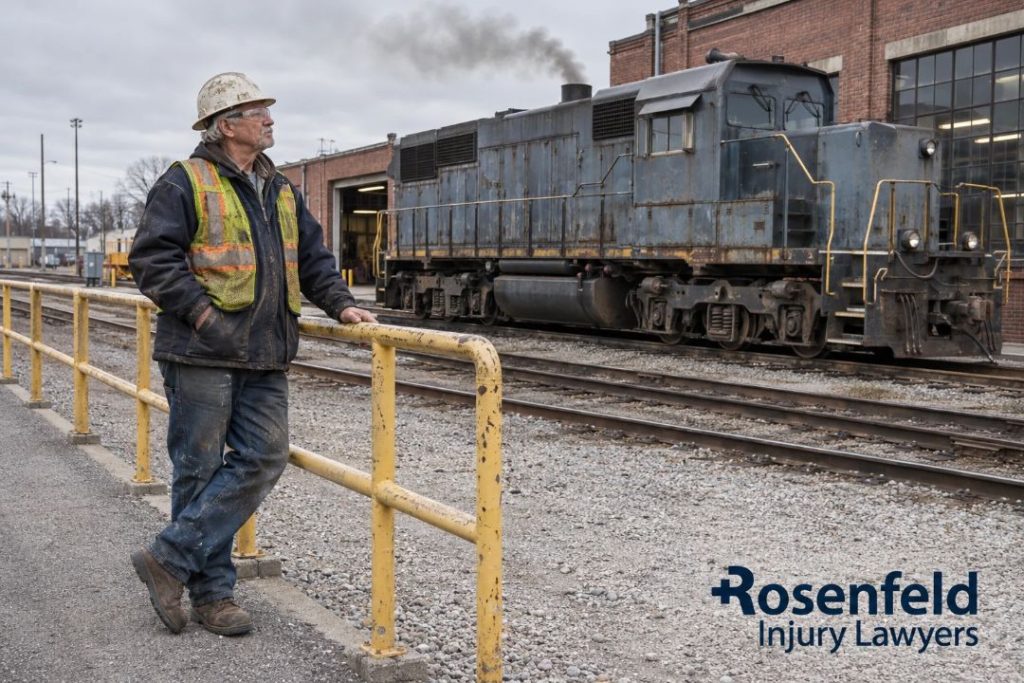
A railroad workers’ cancer lawsuit is possible when a railroad’s negligence exposed an employee to diesel exhaust, asbestos, benzene, or another cancer-causing substance. The Federal Employers’ Liability Act, or FELA, lets sick workers sue the railroad, even for cancer found after retirement. The worker must show negligence, but linking it to the illness is easier than in most injury cases.
Chicago is the country’s busiest rail hub. So many of these claims begin in Illinois yards, shops, and terminals. Here is how FELA claims work for cancer in plain terms, step by step.
Can Railroad Workers Sue for Cancer?
Yes. FELA makes interstate railroads liable when their negligence causes an employee’s injury or illness, in whole or in part. In Urie v. Thompson (1949), the Supreme Court confirmed the law covers slow-developing disease, not only sudden accidents.
Covered employees work for railroads in interstate commerce. That includes freight carriers, Amtrak, and commuter lines such as Metra. A railroad workers’ cancer lawsuit can be filed in state or federal court.
FELA is not workers’ comp. Fault matters. The railroad is also the opposing party in a claim, and its claims staff works for the railroad, not for you. We cover how FELA differs from workers’ comp in a separate post.
Which Railroad Exposures Are Linked to Cancer?
Several substances common in railroad work are classified as human carcinogens by the International Agency for Research on Cancer, called IARC. The table matches each one to where workers met it.
| Exposure | Where railroad workers met it | Cancers most linked, per IARC |
| Diesel exhaust | Locomotive cabs, trailing units, tunnels, roundhouses, diesel shops, idling yards | Lung cancer. Limited evidence for bladder cancer. Group 1, 2012 |
| Asbestos | Boiler and pipe insulation, brake shoes, gaskets, cab and car insulation, older shops | Mesothelioma, lung, larynx, ovary. Group 1 |
| Benzene | Diesel fuel, solvents, degreasers, parts-cleaning tanks | Acute myeloid leukemia. Group 1 |
| Crystalline silica | Ballast dust from track work, sandhouses, locomotive sanding | Lung cancer. Group 1 |
| Welding fumes | Car shops, thermite and arc track welding | Lung cancer. Group 1, 2017 |
| Creosote | Treated wood ties and bridge timbers | Classified as probably carcinogenic. Group 2A |
| Right-of-way herbicides | Spraying along track | Raised in some claims. Proof depends on the product used |
Group 1 means IARC found enough evidence that the substance causes cancer in humans. A classification shows a substance can cause cancer in people. It does not prove it caused one worker’s cancer. That link comes from exposure history and medical opinion.
Researchers have studied railroad crews directly. A study led by Eric Garshick followed nearly 55,000 U.S. railroad workers from 1959 to 1996. It was published in Environmental Health Perspectives in 2004. The authors said the results suggest diesel exhaust contributed to lung cancer deaths in that group.
That is why a railroad workers’ cancer lawsuit often starts with diesel exhaust and a lung cancer diagnosis.
Long cancer lists online can mislead. IARC ties each substance to specific cancers. A claim is strongest when the cancer type fits the exposure, such as mesothelioma with asbestos or lung cancer with diesel exhaust. Other cancers can still be reviewed, but they need stronger medical support.
Why Do Railroad Workers Still Get Mesothelioma?
Asbestos railroad workers handled for decades can cause mesothelioma long after the last shift. A retiree with a new diagnosis can still have a claim.
Railroads used asbestos in steam locomotives, railcars, brakes, and shop buildings. Mesothelioma railroad workers face today often traces back to those years. The disease usually appears decades after exposure. Anyone working near disturbed insulation or worn brake parts could breathe the fibers, even without handling asbestos directly.
One legal point surprises many families. In Kurns v. Railroad Friction Products, decided in 2012, the Supreme Court held that federal law blocks most state-law claims against makers of locomotive parts. So the FELA claim against the railroad is usually the main path. Asbestos bankruptcy trust claims may run alongside it, depending on the facts. Trust rules and deadlines differ from FELA, so each path needs its own check.
Workers who were not railroad employees may have other options. See our page on occupational asbestos claims in Illinois.
Which Railroad Jobs Had the Heaviest Exposure?
Jobs inside diesel shops, locomotive cabs, and track crews carried the most documented risk. Each craft met different substances.
- Engineers and conductors: Diesel exhaust in the cab
- Machinists, electricians, and pipefitters: Exhaust, asbestos, and solvents in shops and roundhouses
- Carmen: Brakes, insulation, and welding fumes
- Track and maintenance-of-way crews: Ballast silica, creosote, welding fumes, and herbicides
- Yard switchmen and brakemen: Idling locomotives
Job titles are only a starting point for the review. Many workers rotated between shops, yards, and cabs. A full history matters more than any single title.
The Association of American Railroads says roughly one in four U.S. freight trains passes through Chicago. That means many Illinois workers spent careers around these hazards. Many also faced railyard injuries on the same job sites.
What Must a Railroad Cancer Claim Prove?
A railroad workers’ cancer lawsuit turns on four things. You must show each with records and medical opinion.
- You worked for a covered railroad.
- You were exposed to a harmful substance on the job.
- The railroad was negligent.
- The exposure played some part in causing your cancer.
What counts as negligence for a toxic exposure?
The railroad knew or should have known of the hazard and did not act reasonably. Examples include no cab ventilation, no respirators, no air testing, and no warnings. Railroad safety bulletins, industry studies, and internal memos can show what the company knew and when. Violating a safety law, such as the Locomotive Inspection Act, can constitute negligence in itself. For the basics, read about proving FELA negligence.
How low is the causation standard?
Lower than usual. In Rogers v. Missouri Pacific Railroad, decided in 1957, the Court said negligence need only play a part, “even the slightest.” CSX v. McBride (2011) kept that standard. You still need a medical expert, often an oncologist or occupational physician, to connect exposure to disease.
What if you smoked or had other exposures?
Smoking does not end a claim. Under FELA, fault shared by the worker reduces damages but does not bar them. In Norfolk and Western v. Ayers (2003), the Court held a worker may recover full damages from the railroad even if others also contributed. One limit remains. A worker exposed but not yet sick generally cannot recover for fear of cancer alone, per Metro-North v. Buckley.
How do you prove exposure from decades ago?
This is where most claims are won or lost. A railroad workers’ cancer lawsuit often depends on records that nobody kept for this purpose. We rebuild the story from seniority rosters, shop assignments, locomotive cab records, and coworker accounts.
Federal records help too. Researchers in the Garshick study built work histories from Railroad Retirement Board files. The same files can show which jobs a worker held and when.
Picture a retired carman with lung cancer. His rosters show years in a diesel-era car shop. Two coworkers remember the welding and the idling engines. That is an illustration, not a case result. It shows how scattered facts become proof.
Evidence that helps:
- Job, craft, and shop history
- Locomotive models you worked on
- Union and Railroad Retirement Board records
- Coworker statements
- Air-sampling or safety bulletins
- Pathology and medical records
How Long Do You Have to File a Railroad Cancer Claim?
Three years under 45 U.S.C. 56. For disease, the clock generally starts when you know, or should know, you are sick, and that work likely caused it.
That rule is why a diagnosis years after retirement can still qualify. A worker who learned of lung cancer last spring is measured from that discovery, not from the last day on the job. This is a summary. Details and exceptions live in our guide to the FELA filing deadline and the discovery rule.
If a worker has died, families may bring wrongful death and survival claims under FELA. Have the start date checked quickly. Waiting costs evidence, since records and witnesses get harder to find over time. See fatal railroad injury claims.
What Can a FELA Cancer Claim Cover?
A claim can seek compensation for the financial and personal toll of the illness. The exact damages depend on the facts.
- Past and future medical care
- Lost wages and lost earning capacity
- Pain and suffering
- For families, loss of support and services
Medical records and expert opinions support each item. Future care and lost earnings often need professional estimates, not guesses. Lost earning capacity matters most for workers who had to stop working earlier than planned.
Fear of cancer is recoverable only in limited cases, such as an existing asbestosis diagnosis, and the fear must be genuine and serious. We do not predict values here. Read how FELA settlements are calculated for the method.
What If You Were Not a Railroad Employee?
Contractors, vendors, and others exposed on railroad property fall outside FELA. Their path is usually different.
A railroad workers’ cancer lawsuit under FELA is limited to railroad employees. So the first question is simple: who employed you? Check who issued your paychecks, not whose gate you walked through.
In Illinois, many outside workers use the Workers’ Occupational Diseases Act, 820 ILCS 310, through their own employer. Some may also have a third-party claim against the railroad or a product maker. That depends on the facts, so each case needs its own review.
What Steps Should You Take After a Diagnosis?
Start by recording your full work history while memories and documents are fresh. Early records shape any railroad workers’ cancer lawsuit and help your doctors.
- Tell your oncologist your complete railroad work history.
- Write down every job, location, decade, piece of equipment, and substance.
- List coworkers who can describe conditions.
- Gather pay stubs, seniority rosters, union cards, and Railroad Retirement Board records.
- Do not give a recorded statement to a railroad claims agent before getting advice.
- Keep pathology reports and imaging.
- Talk to a FELA lawyer before the three-year window closes.
Writing things down now also protects against fading memory. Coworkers retire, move away, or pass on, and their accounts are hard to replace.
Any scenario here, such as a retired carman with lung cancer, is only an illustration. It is not a case result.
Frequently Asked Questions
Yes. Retirement does not end a claim. FELA generally allows a suit within three years of learning you are sick and that work likely caused it.
IARC classifies diesel exhaust as carcinogenic to humans, with sufficient evidence for lung cancer. Whether it caused your illness depends on your exposure history and medical opinion.
Yes. Smoking can reduce damages by your share of fault, but it does not automatically bar a FELA claim.
Yes. Families may bring wrongful death and survival claims under FELA. Have the filing deadline checked quickly.
No. You must show the railroad’s negligence played some part in causing the illness. It does not have to be the only cause.
What Is a Good Next Step?
A railroad workers’ cancer lawsuit depends on records that fade with time. If you or a loved one has a diagnosis, speak with a Chicago FELA lawyer at Illinois Work Injury Lawyer before the deadline passes. The consultation is free, and you pay no fees unless the firm wins. Call 312-757-7348 to talk through your work history. Bring any rosters, pay stubs, or medical records you already have.
This article gives general information, not legal advice.
 Legally Reviewed By
Attorney Jonathan Rosenfeld
Content legally reviewed by Jonathan Rosenfeld The information on this page has been legally reviewed by Attorney Jonathan Rosenfeld, founder and managing partner of Rosenfeld Injury Lawyers LLC. With extensive experience representing injured workers across Illinois, Mr. Rosenfeld is dedicated to helping workplace accident victims pursue the maximum compensation available under the law. His extensive legal knowledge and commitment to client advocacy ensure that the information provided is accurate, reliable, and aligned with current legal standards.