



Conveyor Belt Injuries in Illinois Warehouses: Lockout/Tagout and the Cases It Decides


This article gives general information, not legal advice. Results depend on the facts of each case.
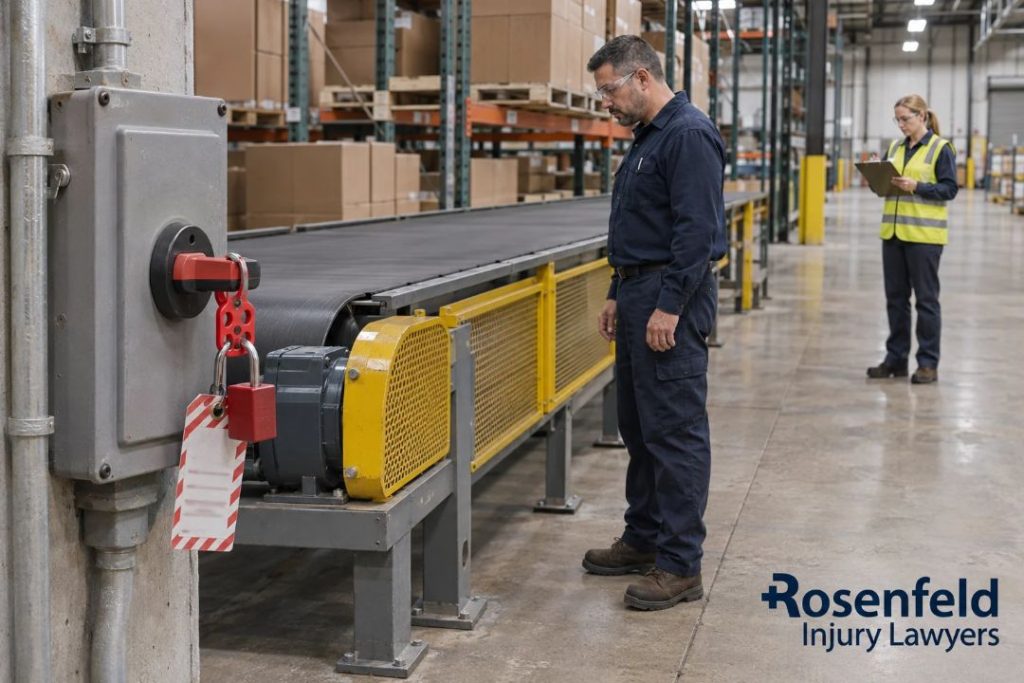
Lockout tagout OSHA rules require employers to shut down a machine, isolate every energy source, and lock or tag the controls before anyone services it. The federal standard is 29 CFR 1910.147. On a warehouse conveyor, skipping those steps can mean a crushed hand, a lost arm, or worse.
Conveyors are a classic lockout machine because a belt that looks stopped can still hold power. A co-worker restarts it. A sensor kicks it back on. A loaded incline slides backward. This post covers the rule itself, and what a violation means for an injured Illinois worker.
What Is OSHA’s Lockout/Tagout Standard?
OSHA’s lockout/tagout standard is the federal rule on the control of hazardous energy. It covers servicing and maintenance in general industry when a machine could start up or release stored energy and hurt a worker.
OSHA published the standard in the Federal Register on September 1, 1989. Its fact sheet estimates that compliance prevents about 120 deaths and 50,000 injuries every year. In fiscal year 2025, it ranked fourth on OSHA’s most-cited list. Safety and Health magazine reported 2,562 citations in the final data, while early figures released in September 2025 showed 2,177.
Lockout is a physical lock on the device that cuts off power. Tagout is a warning tag on that same device. A tag is allowed only where the device cannot take a lock, or where the employer can show the tag gives equal protection.
Some work falls under other rules. Construction, agriculture, maritime work, and certain electric utility and oil and gas work sit outside this standard. The core idea of lockout tagout OSHA compliance is simple: no one touches a machine that can still move.
What Does the Standard Require Employers to Do?
Employers must write an energy control program, build machine-specific procedures, use durable locks and tags, inspect the program yearly, and train workers. OSHA lockout tagout requirements also cover outside contractors and group lockouts.
OSHA labels each part with letters and numbers, so c4 means paragraph c, item 4.
| Requirement | Paragraph | What it means on a warehouse floor |
| Written energy control program | c1 | A document that says who locks out what, and when |
| Machine-specific procedures | c4 | A posted procedure for each conveyor line, not one generic sheet |
| Durable, standardized, identifiable locks and tags | c5 | A lock that survives a dusty floor and shows who owns it |
| Annual inspection with certification | c6 | Someone audits a real lockout at least once a year and signs off |
| Training and retraining | c7 | Pickers, maintenance techs, and temps each learn their role |
| Outside contractor coordination | f2 | The conveyor vendor’s technician and the warehouse swap procedures |
| Group lockout, shift and personnel changes | f3 and f4 | Every crew member adds a lock, and the next shift picks up cleanly |
Compliance with lockout tagout OSHA rules is not a paper exercise. Locks must be on the machine, and the people holding the keys must know why.
What Are the Lockout/Tagout Steps for a Conveyor?
The standard sets a six-step order: prepare, shut down, isolate, apply locks, release stored energy, and verify. A conveyor adds twists because power can come from motors, gravity, air, and belt tension.
- Prepare for shutdown: List every energy source. On a conveyor, that means the drive motor, gravity on incline sections, air lines to diverters and gates, take-up tension, and upstream feed belts that can push product into the zone.
- Shut the machine down: Use the normal stop, and warn nearby workers.
- Isolate the energy: Open the disconnect and close the air valve. An emergency stop or a start button does not count. Those are control devices, not an energy-isolating device.
- Apply locks or tags: Each person working on the line adds a personal lock.
- Release or restrain stored energy: Block inclined belts so they cannot roll back, bleed air from cylinders, and relieve belt tension.
- Verify isolation: Try to start the conveyor and confirm zero energy.
Release from lockout has its own order. Check that tools and people are clear, tell affected employees, and let the person who put on each lock remove it.
The same steps apply when someone services a powered industrial truck. We cover that equipment in our guide to OSHA forklift violations.
Who Needs Lockout/Tagout Training, and How Often?
Every worker near the machine needs some training, but the level depends on the role. The standard names three groups: authorized, affected, and other employees. Retraining follows changes and gaps, not a fixed yearly date.
- Authorized employees lock out a machine to service it, such as a maintenance technician.
- Affected employees run the machine or work beside it, such as a picker feeding the belt.
- Other employees work in the area but do neither, such as a temp walking past. They must never restart or touch locked equipment.
Employers must retrain when a job or machine changes, when a new hazard appears, when a procedure changes, or when an inspection finds gaps. Employers must also certify training in writing, with names and dates.
Temporary workers count too. OSHA has said host employers and staffing agencies share responsibility for temp worker safety, including training. If you were hurt while placed through an agency, our page on temporary worker injuries explains your options.
When Does the Minor Servicing Exception Apply?
The minor servicing exception lets workers do small tasks during normal production without lockout. The task must be routine, repetitive, and integral to production, and other measures must protect the worker effectively. Clearing a conveyor jam is the most common dispute.
A second exception covers equipment with a cord and plug. Unplugging it counts as control only if the plug stays under the exclusive control of the person doing the work.
Employers often call jam clearing minor servicing. OSHA has said the employer carries the burden of proving the exception fits. That claim weakens fast when there is no guarding, no jog control, no barrier, or when the only safeguard is an emergency stop.
Reaching into a belt that is stopped but still energized is the textbook gray zone. If a belt had power when your hand went in, ask what alternative measure protected you. That question sits at the center of many lockout tagout OSHA disputes after an injury.
How Do Conveyor Belt Injuries Happen When Lockout Is Skipped?
Most conveyor injuries start when a worker reaches into moving parts that someone failed to power down, or into energy nobody released. The result is often a crush, a pull-in, or an amputation.
Common mechanisms include:
- Nip points: Hands and sleeves get caught where the belt meets the head or tail pulley.
- Unexpected restart: A co-worker, a sensor, or an automated control starts the belt mid-repair.
- Released stored energy: An incline rolls back, or a pneumatic cylinder fires.
- Crush points: A worker gets pinned between product and the frame.
These events can cause fractures, crush injuries, degloving, and the loss of fingers, hands, or arms.
Lockout covers servicing. Machine guarding rules under 29 CFR 1910.212 cover normal operation. Both matter. In the final fiscal year 2025 data, machine guarding ranked tenth, with 1,498 citations.
Fulfillment centers link many belt zones, so one stop button may not isolate everything. Our page on Amazon warehouse injuries covers those sites. Factory lines with powered belts raise the same issues, which our page on assembly line injuries explains.
If a belt injured you at work, a warehouse injury lawyer can match the facts to the right claim. Every lockout tagout OSHA failure on this list shares one root: someone worked on live equipment.
Does a Lockout/Tagout Violation Change Your Illinois Workers’ Comp Claim?
No, not the amount. Illinois workers’ compensation is a no-fault system. The employer’s lockout failure does not raise your benefits, and your own shortcut does not cut them.
Your workers’ compensation benefits include medical care, temporary total disability while you cannot work, and permanent partial disability for lasting loss. A hand or arm injury often falls under scheduled loss.
Comp does not ask who was careless. It asks whether you were hurt on the job. Our guide on getting comp even if you skipped lockout yourself explains the details.
The trade-off is that you generally cannot sue your employer for negligence. Section 5 of the Illinois Workers’ Compensation Act, 820 ILCS 305/5, sets that rule. Courts recognize narrow exceptions, such as intentional harm, so have a lawyer review the facts before ruling anything out.
A violation still matters in comp. It can show how the accident happened and push back on an insurer that doubts your story. A lockout tagout OSHA failure often explains exactly why the belt moved.
When Can a Lockout Failure Support a Third-Party Claim?
Yes, when someone other than your employer helped create the danger. A conveyor maker, a contractor, or a property owner may share the blame, and a third-party claim can recover losses that comp does not cover.
Possible defendants include:
- The manufacturer or integrator, if the conveyor had no lockable disconnect, weak guarding, missing warnings, or a design that forced workers to clear jams while it ran.
- A maintenance or installation contractor that left the system energized.
- A property owner or general contractor that controlled the site.
Comp does not pay for pain and suffering. A third-party claim can seek those losses and full lost earnings. The comp insurer is generally repaid from that recovery under Section 5, less a share of attorney fees and costs.
Deadlines are strict. Illinois personal injury claims generally must be filed within two years, under 735 ILCS 5/13-202. Product claims also face a separate statute of repose in 735 ILCS 5/13-213 that can cut off claims over older equipment.
A worker who lost his dominant hand because of a defective safety mechanism on a punch press received a $7,000,000 settlement. That was a punch press case, not a lockout case. It shows why machine design matters. Read more about punch press injury claims and factory and machine injuries.
How Do OSHA Citations Become Evidence?
OSHA inspection files, citations, and the employer’s lockout records can serve as evidence of the safety standard. A citation alone does not prove a third party is at fault.
Several records can help:
- The OSHA inspection file, which you can request through the Freedom of Information Act
- The employer’s written lockout program
- Training certifications
- Annual inspection records
Some settlement agreements with OSHA may face limits on use, so a lawyer should judge what a jury may see.
Federal OSHA covers most private-sector Illinois employers. Illinois OSHA covers state and local government workplaces.
An employer may not punish you for raising a lockout hazard. A retaliation complaint under Section 11c of the OSH Act generally must be filed within 30 days. To file a safety complaint, see our post on how to report an OSHA violation in Illinois anonymously.
A lockout tagout OSHA citation is a starting point, not a verdict.
What Should You Do After a Conveyor Injury?
Get medical care first, then report the injury in writing. Illinois generally requires notice to your employer within 45 days of the accident.
- Report the injury to your employer in writing.
- Get medical care.
- Photograph the machine and the disconnect, if it is safe.
- Write down who was on shift and whether anyone applied locks.
- Keep any tags, photos, or messages about the incident.
- Do not sign statements about fault.
- Talk to a lawyer before giving a recorded statement.
Lockout/Tagout and Conveyor Injury FAQs
It is 29 CFR 1910.147, titled The Control of Hazardous Energy. It covers servicing and maintenance in general industry when unexpected startup or stored energy could injure workers.
No. An emergency stop is a control device, not an energy-isolating device. Lockout requires opening the disconnect or closing the valve, applying a lock, and verifying zero energy.
Training comes before a worker services or works near the equipment. Retraining is required when jobs, machines, or procedures change, or when inspections find gaps.
Generally no. The Workers’ Compensation Act makes benefits your exclusive remedy against your employer. You may still pursue a third party, such as an equipment maker or contractor.
Usually yes. Illinois workers’ compensation is no-fault, so a shortcut does not automatically bar benefits. A lawyer can review how your accident happened.
Talk to a Lawyer Before You Give Any Statement
If a conveyor or another machine hurt you, and you suspect no one locked it out, we can review what happened. Illinois Work Injury Lawyer offers a free consultation, and you pay no fee unless we win. Our office is at 225 W Wacker Dr in Chicago.
Start with our page on workers’ compensation for warehouse workers, or contact our team directly. We will explain how comp, third-party claims, and the lockout tagout OSHA record fit your facts.
 Legally Reviewed By
Attorney Jonathan Rosenfeld
Content legally reviewed by Jonathan Rosenfeld The information on this page has been legally reviewed by Attorney Jonathan Rosenfeld, founder and managing partner of Rosenfeld Injury Lawyers LLC. With extensive experience representing injured workers across Illinois, Mr. Rosenfeld is dedicated to helping workplace accident victims pursue the maximum compensation available under the law. His extensive legal knowledge and commitment to client advocacy ensure that the information provided is accurate, reliable, and aligned with current legal standards.