



Barge Deckhand Injuries on the Illinois and Mississippi Rivers: Who Pays and Under Which Law


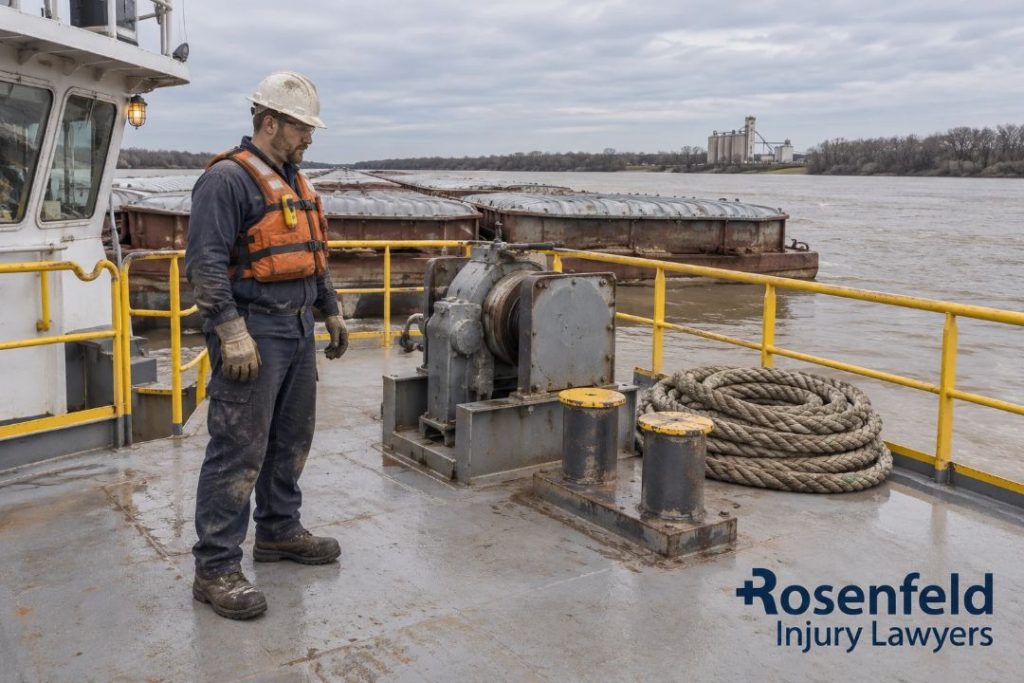
Barge deckhand injuries usually come from falls, crushing, snapped lines, and heavy lifting. A deckhand who qualifies as a seaman can often seek payment in three ways. The employer owes maintenance and cure. The employer can face a Jones Act negligence claim. The vessel owner can face an unseaworthiness claim. Illinois workers’ comp generally does not cover seamen.
This guide matches each common injury to the claim it supports and the party responsible for payment. It offers general information, not legal advice.
Why Is Deckhand Work on River Barges So Dangerous?
Deckhands work on narrow, wet steel at all hours, close to moving lines and tight lock walls. One slip can mean a fall into cold, fast water or a crushed hand.
A towboat deckhand makes and breaks tow, tightens face wires and ratchets, walks gunwales, and handles lines at locks. On the Illinois Waterway and the Upper Mississippi, that work happens at night, in ice, and in high water. Fleeting work from Joliet to Alton adds constant barge movement.
The numbers back this up. A Coast Guard and American Waterways Operators safety review found that falls overboard, mostly of deckhands, are the leading cause of towing vessel crew deaths. A later industry report, covered by WorkBoat, reviewed 118 falls overboard from 2012 to 2024. Sixty-eight percent happened on barges, 66 percent happened at night, and deckhands were involved in more than half. For more figures, see our page on maritime injury statistics.
Many deckhands also live aboard for weeks at a time. That makes quick medical care harder and can tempt crews to keep working hurt. Reporting the injury to the captain in writing before the shift ends helps protect later claims for barge deckhand injuries.
What Are Common Barge Deckhand Injuries?
The most common barge deckhand injury types are drowning, crush injuries, line and wire injuries, back and shoulder strain, falls on deck, head trauma, and burns. Each points to a different claim.
| Injury | How it happens | Claim it often supports |
| Drowning and hypothermia | Falling overboard from a gunwale or between barges, often at night | Jones Act for weak training or lighting; unseaworthiness for missing rails |
| Crush injuries and amputations | Hand or leg caught between barges, a lock wall, or a kevel as lines tighten | Jones Act for rushed orders; unseaworthiness |
| Line and wire injuries | Parted lines snapping back, wires under tension, hands pulled into a winch | Unseaworthiness for worn gear; Jones Act |
| Back, shoulder, and hernia injuries | Throwing ratchets and wires, using cheater bars, months of rigging | Jones Act for short crews; maintenance and cure |
| Slips and falls | Wet, icy, or oily decks, open hatches, tripping on fittings | Unseaworthiness; Jones Act |
| Head injuries | Falls, swinging rigging, hatch covers | Depends on the cause |
| Burns and chemical exposure | Tank barge vapors, deck fires, hot work | Jones Act; unseaworthiness |
Injuries that build up over time count too. A deckhand does not need one dramatic accident to claim maintenance and cure or bring a Jones Act claim. Proving causation does require medical documentation. We secured $630,000 for a barge worker with overuse injuries using the Jones Act. We also secured $4,000,000 for a deckhand with extensive burns from a deck fire. Every case is different, and past results do not guarantee future ones.
Our guide to Jones Act injuries covers other maritime injury types.
Who Pays for Barge Deckhand Injuries?
Up to three parties can owe money after a seaman is hurt. The employer pays maintenance and cure, and Jones Act damages. The vessel owner pays for unseaworthiness. Each claim has its own proof.
Maintenance and Cure: Paid by Your Employer
Maintenance covers daily living costs. Cure covers medical care. Both continue until maximum medical improvement. The employer owes them even if the deckhand caused the accident, under the 1903 Supreme Court case The Osceola.
Unreasonable refusal can expose the employer to attorney fees under Vaughan v. Atkinson. Willful refusal can bring punitive damages under Atlantic Sounding Co. v. Townsend. The daily rate is often low and often disputed. Keep receipts for prescriptions and medical travel. Ask the employer for maintenance and cure in writing, so any refusal leaves a record. Our guide to maintenance and cure explains how to push back on a denial.
Jones Act Negligence: Paid by Your Employer
The Jones Act, 46 U.S.C. 30104, lets an injured seaman sue the employer for negligence. The bar is low. The deckhand must show the employer’s carelessness played any part, even a small one.
Barge examples include sending one deckhand to make a tow that needs two, skipping man-overboard drills, poor deck lighting, pushing tired crews, ordering work in ice without precautions, or ignoring a report of a worn wire. Damages can include lost wages, lost earning capacity, medical costs, and pain and suffering.
Unseaworthiness: Paid by the Vessel Owner
The owner must provide a vessel and gear reasonably fit for their use. Liability does not depend on fault or notice, according to Mitchell v. Trawler Racer. Examples include frayed lines, broken ratchets, loose deck fittings, bad hatch covers, slick decks, missing handrails, and short crews.
One careless act by a coworker is generally not enough. Punitive damages are not available, as held in Dutra Group v. Batterton.
River tows add a wrinkle. The barge a deckhand stood on often belongs to a different company than the towboat employer. Who owes the duty then depends on the facts, so ask for help early.
Other Parties That May Pay
Another towboat whose tow or wake caused the accident, a terminal or fleeting company that is not the employer, or the maker of a faulty winch, capstan, or ratchet may share liability. Claims involving government-run locks or vessels can carry shorter deadlines and special rules.
Who Pays at a Glance?
For most barge deckhand injuries, the employer pays under maintenance and cure and Jones Act negligence. Unseaworthiness comes from the vessel owner. Only maintenance and cure requires no proof of fault.
| Claim | Who pays | Must you prove fault? | Deadline |
| Maintenance and cure | Employer | No | Often treated as three years |
| Jones Act negligence | Employer | Yes, but the bar is low | Three years |
| Unseaworthiness | Vessel owner | No, but an unsafe condition must cause the injury | Three years |
| Third-party negligence | The other company | Yes | Generally three years |
What if a Deckhand Is Not a Seaman?
Some barge workers fall under the federal Longshore Act, not the Jones Act. That changes who pays and how.
Fleet, terminal, and shipyard workers who spend most of their time on the bank are common examples. Employers sometimes label deckhands as Longshore workers to avoid Jones Act claims. Our post asking am I a seaman under the Jones Act explains how seaman status works.
The rules above reach barge deckhand injuries only when the worker is a seaman. A crew member who lives and works aboard a towboat often fits that profile. A worker who handles barges mostly from the dock may not.
Does Your Own Fault Change the Claim?
Fault reduces Jones Act and unseaworthiness damages by your share, but it does not bar recovery. It never reduces maintenance and cure.
If the employer broke a safety rule that contributed to the injury, your fault may not reduce the award at all. This comes from 45 U.S.C. 53, applied through the Jones Act. Following a supervisor’s order is generally not carelessness. Still, employers often argue that a deckhand should have been more careful. Keep your own notes on what a supervisor ordered and when.
What Should You Do Right After an Injury?
Report it, get care, and protect proof. Small steps in the first days often shape the whole claim.
- Tell the captain or mate, and ask them to file an incident report.
- See a doctor and say the injury happened at work. Mention every symptom, even minor ones.
- Photograph the deck and gear, and get the names of crew who saw it.
- Do not sign any statement or release you have not read.
- Write down symptoms, missed work, and expenses each week, and keep pay stubs.
What Records Help Prove an Injury Claim?
Ask for these records early:
- Coast Guard Report of Marine Casualty, Form CG-2692, required for injuries needing treatment beyond first aid under 46 CFR 4.05
- Post-casualty drug and alcohol test results under 46 CFR 4.06
- Vessel logbook and deck log entries for your watch
- Towing safety management system records under Subchapter M, such as hazard reports, line and winch inspections, and drill records
- Crew list and watch schedule, which show a short-handed tow
- River stage, weather, and AIS vessel-track data
- Photos of the deck and gear, plus names of crew witnesses
- The company accident report, which you can ask to see
A seaman can generally choose a personal doctor for cure, even if the company suggests its own.
How Long Do Deckhands Have to File?
Jones Act and unseaworthiness claims generally have a three-year limit under 46 U.S.C. 30106. Government-owned vessels can bring shorter deadlines. Details are in our post on the three-year Jones Act deadline. Waiting can weaken barge deckhand injuries claims, because memories fade, crews rotate, and gear gets repaired or replaced.
Families can read who can file a Jones Act wrongful death claim after a fatal accident.
Frequently Asked Questions
Yes. Maintenance and cure does not depend on fault. Your employer generally owes it until you reach maximum medical improvement, even if you caused the accident.
Yes. Cumulative strain from lifting and rigging can support maintenance and cure or a Jones Act claim, but you will need medical records tying it to the work.
Your employer still owes maintenance and cure and may face a Jones Act claim. The barge owner may also be liable for unseaworthiness, depending on the facts.
Generally no. A seaman can usually choose a personal doctor for cure. Keep treatment records and receipts, and tell the doctor how the injury happened.
Federal law, 46 U.S.C. 2114, protects seamen from retaliation for reporting injuries. Document the report in writing with the date, and contact a lawyer if you face discipline.
Your Next Step After a Deckhand Injury
Write down what happened, keep your records, and see your own doctor. Then talk with a Chicago barge injury lawyer at Illinois Work Injury Lawyer. The consultation is free, and you pay nothing unless we win. Call 312-757-7348 to talk through your options after barge deckhand injuries.
 Legally Reviewed By
Attorney Jonathan Rosenfeld
Content legally reviewed by Jonathan Rosenfeld The information on this page has been legally reviewed by Attorney Jonathan Rosenfeld, founder and managing partner of Rosenfeld Injury Lawyers LLC. With extensive experience representing injured workers across Illinois, Mr. Rosenfeld is dedicated to helping workplace accident victims pursue the maximum compensation available under the law. His extensive legal knowledge and commitment to client advocacy ensure that the information provided is accurate, reliable, and aligned with current legal standards.