



Why Was My Workers’ Comp Claim Denied? 7 Illinois Reasons and How to Appeal Each One


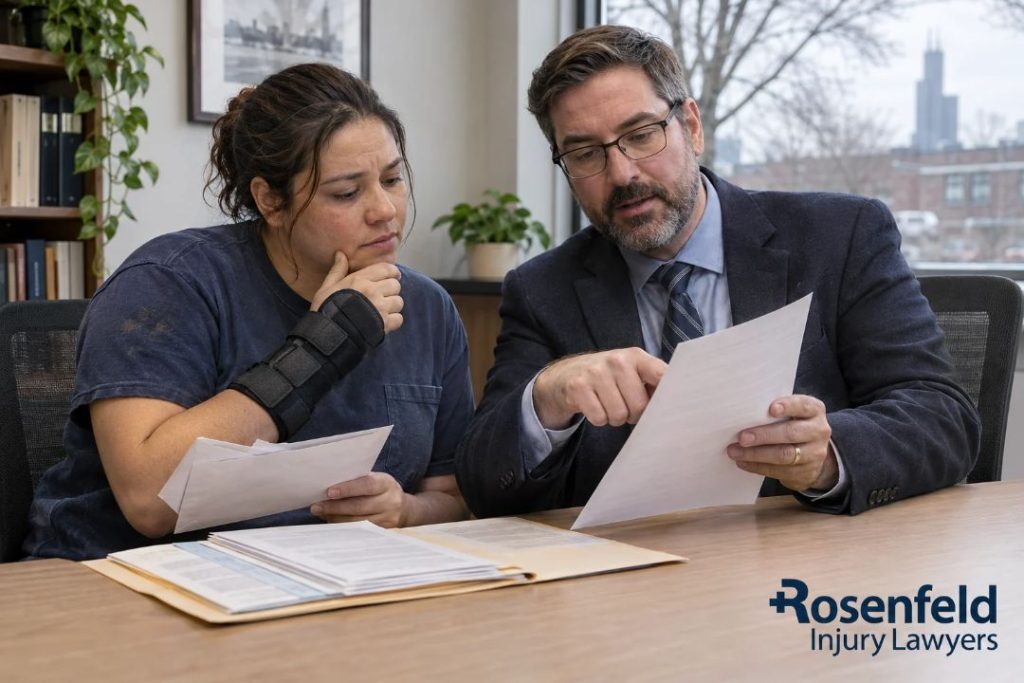
Why was my workers’ comp claim denied? Most Illinois denials come down to seven reasons: late notice, a dispute over whether the work caused the injury, weak medical proof, a pre-existing condition, an insurer exam, an employee-status dispute, or a misconduct claim. A denial is the insurer’s position, not a final ruling.
Only an arbitrator at the Illinois Workers’ Compensation Commission (IWCC) can decide whether benefits are owed. Each reason below has a specific fix. Some denials are bargaining positions. Others will not move without a hearing. Knowing which one you face shapes everything that follows.
Quick Answer: The 7 Most Common Reasons for a Denial
The reasons workers’ comp claims are denied fall into seven groups. Start by asking for the denial in writing. That letter tells you which group you face.
- Late notice to the employer.
- The injury “didn’t arise out of” the job.
- Not enough medical proof linking work to the injury.
- A pre-existing condition.
- The insurer’s doctor or a utilization review disputes your treatment or work status.
- You are not treated as an employee because of a contractor label or an uninsured employer.
- A misconduct defense: intoxication, horseplay, or leaving your job duties.
Illinois rules require an employer to explain in writing a denial of lost-time pay or medical care. That rule sits in 50 Ill. Adm. Code 9110.70. Ask for the explanation first.
7 Reasons and How to Appeal a Workers Comp Denial
Each denial reason has its own evidence and its own filing. Match your fix to the reason in your letter. Workers often ask why was my workers’ comp claim denied when the injury clearly happened at work, and this section answers that.
1. You Did Not Report the Injury in Time
Insurers check the date you told your employer. If it looks late, they may deny everything. Section 6 of the Illinois Workers’ Compensation Act gives you 45 days to give notice. Spoken notice can count. A supervisor who saw the injury can count too, because the employer then had actual knowledge. A flaw in your notice doesn’t bar the claim unless the employer proves it caused real harm. Read more on the 45-day rule.
How to fight it:
- Collect texts, emails, and witness statements showing who knew what and when.
- File an Application for Adjustment of Claim and argue notice at arbitration.
2. The Insurer Says Work Did Not Cause the Injury
Your injury must arise out of and in the course of your job. Insurers sometimes call the risk personal instead. Illinois sorts risks into three types: employment risks, personal risks, and neutral risks. Employment risks are covered. Personal risks usually are not. In McAllister v. IWCC, a 2020 Illinois Supreme Court case, a sous chef hurt his knee while kneeling at work. The court held that it could count as a job risk. Our post on why slip-and-fall claims get denied shows how this fight plays out.
How to fight it:
- Gather your job description, an incident report, scene photos, and co-worker statements.
- Ask for a Section 19b hearing if the insurer is withholding lost-time pay or medical care.
3. Your Medical Records Do Not Connect the Injury to Work
Gaps in treatment hurt. So does an ER history that never mentions your job. Without a doctor’s opinion tying the injury to work, an insurer has room to say no. Many workers ask why was my workers’ comp claim denied after a doctor visit, and a chart with no mention of work is a common answer. Illinois lets you choose your own providers, with limits and referrals allowed under Section 8a. Our page on medical care benefits explains your options.
How to fight it:
- Ask your treating doctor for a written opinion on causation.
- Correct any history that left out the work event.
- Keep every appointment, and describe the work event to each provider.
4. The Insurer Blames a Pre-Existing Condition
Old injuries and wear and tear are the most common excuse for a cutoff. But Illinois protects workers who already had a problem. Under Sisbro, Inc. v. Industrial Commission, a 2003 Illinois Supreme Court decision, work can aggravate or speed up a condition and still be compensable. Work only has to be a cause, not the only cause. Insurers often lean on a records review by their own doctor. Your treating doctor can answer it. A clear note that explains how work changed your symptoms, function, or need for treatment carries real weight.
How to fight it:
- Pull records from before and after the injury.
- Get a doctor’s opinion that work worsened the condition.
5. The Insurer’s Doctor Says You Are Fine
This one often shows up partway through a claim. The insurer sends you for an exam under Section 12 or a utilization review under Section 8.7, then cuts off lost-time pay or refuses surgery. Many workers ask, “Why was my workers’ comp claim denied after months of paid care?” A cutoff after an insurer exam is often the reason.
Illinois changed the rules in August 2026. Public Act 104-0792 says that when an employer uses an exam instead of utilization review, the report must go to you and your treating provider. The examiner must share the treating doctor’s specialty. If the employer misses these steps, a rebuttable presumption of added compensation can follow.
How to fight it:
- Get a rebuttal report from your treating doctor.
- File a Section 19b-1 emergency petition if you are off work and unpaid.
- Ask for penalties under Section 19k or 19l if the cutoff was unreasonable.
6. You Are Told You Are Not an Employee, or There Is No Insurance
Some companies label workers as contractors. Staffing agencies and host employers also point at each other. Illinois courts look at who controls the work, not just the label. They weigh who sets the schedule, who supplies the tools, and who can end the job. Temporary workers face this often, and our page on temporary and staffing-agency workers explains their rights.
If your employer had no coverage at all, you may be able to seek benefits from the Injured Workers’ Benefit Fund under Section 4d.
How to fight it:
- Save pay stubs, schedules, and texts with your boss.
- Ask co-workers who saw how you were supervised to write short statements.
- Note who supplied the tools and who gave the instructions.
7. The Insurer Claims Misconduct: Intoxication, Horseplay, or Rule Breaking
Illinois comp is no-fault. Breaking a safety rule usually does not bar your claim. Intoxication matters only when it was the proximate cause of the injury under Section 11, and you can challenge test results. A positive test is not the end of the story. Timing, handling, and cause all matter. Horseplay claims turn on who started it and whether it was part of the job. Our post on workers’ comp when the accident was your fault goes deeper.
How to fight it:
- Question the test chain of custody.
- Collect witness accounts of what really caused the injury.
- Show the task was part of your job.
- Ask for the insurer’s written proof, not just its conclusion.
How the Illinois Appeal Process Works After a Denial
You do not appeal an insurer’s denial the way you appeal a court ruling. You open a case at the IWCC, and an arbitrator decides it. Arbitrators rule on evidence, not on how an insurer words its letter. Once you know why was my workers’ comp claim denied, your next move is a filing, not a phone call. The table below shows each step and the deadline that usually applies.
| Step | Filing | Deadline | What happens |
| 1. Get the denial in writing | Request under 50 Ill. Adm. Code 9110.70 | As soon as benefits are refused | Fixes the insurer’s stated reason |
| 2. Open a caseApplication for | Adjustment of Claim | 3 years from the accident or 2 years from the last payment, under Section 6d | An arbitrator is assigned, and status calls begin |
| 3. Fast-track if unpaid | Section 19b-1 emergency petition or Section 19b petition | While you are off work and unpaid | Pre-trial conference within 20 days, then trial within 15 days |
| 4. Arbitration hearing | Request for Hearing | When the case is ready | The arbitrator issues a written decision |
| 5. Commission review | Petition for Review | 30 days from receiving the decision | A Commission panel reviews the record |
| 6. Circuit court | Review under Section 19f | 20 days from receiving the Commission decision | A judge reviews the Commission ruling |
| 7. Appellate Court | Notice of appeal | Per Supreme Court rules | The Workers’ Compensation Commission Division reviews |
Two fast routes deserve a closer look. A Section 19b petition asks for an early hearing on lost-time pay and medical care. A Section 19b-1 petition is the emergency version for workers who are off work and not being paid. Bring your denial letter, medical records, pay records, and witness names to either one.
The insurer can settle at any stage, and the IWCC must approve any settlement. For more, see our page on filing and appeal deadlines. Our post on how long arbitration takes covers hearing timing, and our guide to how an Illinois workers’ comp claim works, step by step, covers the first filing.
When Benefits Stop Partway Through a Claim
A cut-off check or a refused surgery is a denial too, and it gives a different answer to why was my workers’ comp claim denied. Often the reason is a doctor’s note or an exam, not your injury date. If your workers’ comp benefits stopped, the insurer must explain why in writing. For lost-time pay, that explanation is due within 14 days of learning you could not work, or by your last payment date if checks stop.
Unreasonable delay has a price. Section 19k allows 50 percent extra compensation. Section 19l adds $30 a day, up to $10,000. Section 16 allows attorney fees. Meanwhile, use your group health insurance for care where you can. Keep a log of every missed check and every call with the adjuster. Dates and names make a penalty request stronger.
What to Do in the First 30 Days After a Denial
Asking why was my workers’ comp claim denied is natural, but fast action matters more. Insurers often move quickly after a denial, and the first month sets the tone. These six steps protect your claim.
- Ask for the written reason.
- Keep treating, and tell every provider the injury happened at work.
- Gather proof of notice, witness names, and pay records.
- Do not sign a recorded statement or a “full and final” release.
- Check your filing deadline.
- Get a free case review before the insurer’s exam or a hearing.
Write down what happened while it’s fresh in your memory. Save the denial letter and the envelope it came in. Photograph your injury as it heals, and note every day of missed work. Keep copies of all of it in one folder, paper and digital.
FAQ
Disputes over whether work caused the injury come up often, along with late notice and thin medical proof. Illinois publishes no official ranking, so check your letter.
Yes, you can start a case yourself by filing an Application for Adjustment of Claim. Deadlines get technical, so many workers request a free case review first.
Your health insurance may cover care while the dispute continues. If you win, the insurer can owe those bills, so keep every bill and record.
It depends on the case, so no single timeline fits. Emergency petitions move faster than regular cases, and our settlement timeline guide explains arbitration timing.
No, Illinois law protects workers from retaliation for filing a claim. Read our guide on being fired while on workers’ comp.
Get a Free Review of Your Denial Letter
If you still wonder why was my workers’ comp claim denied, bring us the letter. Illinois Work Injury Lawyer reviews denials for free. Our fee is contingent, so you pay nothing unless we win, and Illinois law caps comp fees at 20 percent under Section 16a. Call 312-757-7348 or reach a Chicago workers’ compensation lawyer online.
This article is general information, not legal advice.
 Legally Reviewed By
Attorney Jonathan Rosenfeld
Content legally reviewed by Jonathan Rosenfeld The information on this page has been legally reviewed by Attorney Jonathan Rosenfeld, founder and managing partner of Rosenfeld Injury Lawyers LLC. With extensive experience representing injured workers across Illinois, Mr. Rosenfeld is dedicated to helping workplace accident victims pursue the maximum compensation available under the law. His extensive legal knowledge and commitment to client advocacy ensure that the information provided is accurate, reliable, and aligned with current legal standards.