



Does Your Employer Have to Pay for Your PPE? What OSHA Actually Requires


Does my employer have to pay for PPE? Generally, the answer is yes.
Under OSHA rules, employers must provide and pay for personal protective equipment (PPE) when it is required to protect employees from workplace hazards, subject to limited exceptions. Workers generally should not have to buy required protective equipment out of pocket simply because their employer has not budgeted for it.
Understanding who must provide and pay for PPE can help Illinois workers recognize unsafe workplace practices and understand their rights when inadequate or missing safety equipment contributes to an injury.
What Counts as Personal Protective Equipment on the Job?
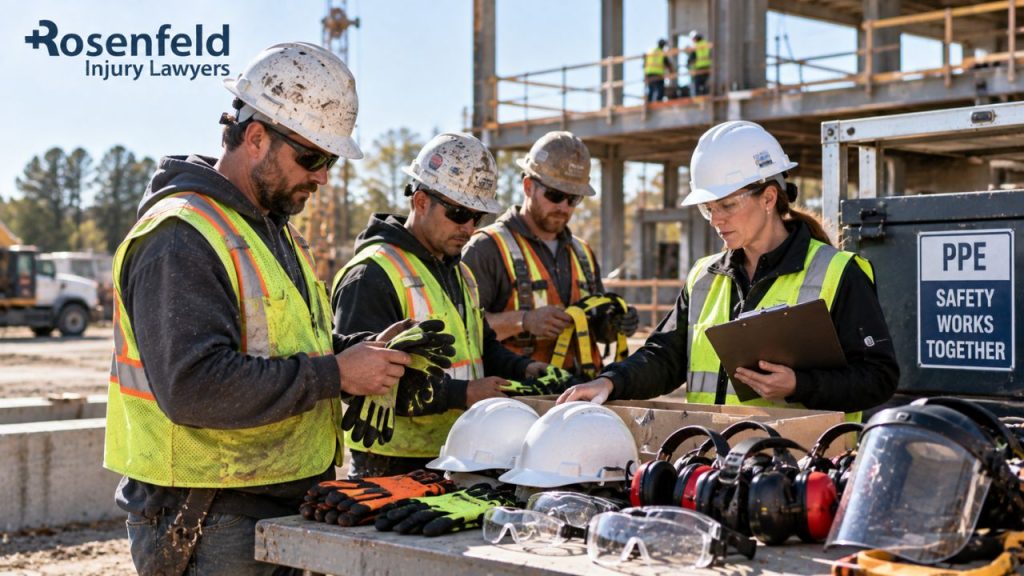
Personal protective equipment (PPE) covers the gear workers rely on to reduce exposure to mechanical, chemical, electrical, or biological hazards. That includes hard hats, safety glasses, hearing protection, respirators, gloves, high-visibility vests, protective footwear, and fall protection harnesses. Construction crews, warehouse staff, factory workers, and anyone handling machinery or hazardous materials typically need some combination of this equipment just to do the job safely.
The Short Answer: Your Employer Has to Pay for Required PPE
So, does your employer have to pay for PPE tied to your specific job duties? Under federal workplace safety law, that responsibility falls on the employer in almost every circumstance. This has been the rule since 2008, when the Occupational Safety and Health Administration closed a long-standing gap in its regulations. Before that, employers could sometimes push the cost of mandatory safety gear onto workers, even gear a job could not legally be performed without. That loophole is gone.
What OSHA’s PPE Payment Rule Actually Says
The regulation in question is 29 CFR 1910.132(h) known as OSHA’s PPE payment standard. It states plainly that employers must provide protective equipment used to comply with OSHA requirements at no cost to employees. That covers hard hats, eye and face protection, hearing protection, respirators, fall protection systems, and most protective clothing worn for chemical or thermal hazards.
The rule became effective in 2008 after years of inconsistent enforcement. Before then, some employers passed the cost of required equipment onto workers as a condition of employment. Today, if an OSHA standard requires a piece of protective gear for a specific task, the employer supplies it and covers the cost.
Exceptions Where Workers May Pay
OSHA carved out a small number of exceptions, and they are frequently misunderstood.
- Everyday steel toe boots or non-specialty prescription safety eyewear, as long as the employer allows the worker to wear them off the job site
- Ordinary clothing, such as long pants or a company shirt, that provides no specialized protection
- Items lost or intentionally damaged by the employee, which may need to be replaced at the worker’s cost
- General weather gear, unless it also serves as required protective clothing for a specific hazard
Outside these limited categories, if the job requires the equipment, the employer pays for it.
Why PPE Shortcuts Lead to Serious Injuries
When employers try to save money by rationing safety gear or shifting the cost onto workers who then go without it, the consequences show up on the job site. Cracked eye protection, worn out harnesses, and missing hearing protection are not just paperwork problems. They cause real harm.
- Missing or damaged eye protection contributes to serious eye injuries from flying debris, chemical splash, or welding flash
- Inadequate fall protection is tied to some of the most severe injuries on Illinois construction sites
- Poor or missing hearing protection contributes to permanent hearing loss claims
- Insufficient protective clothing during electrical work raises the risk of serious electrocution injuries
- Missing respiratory protection can lead to chemical burns or long-term respiratory illness
What Happens If an Employer Refuses to Pay for PPE
An employer that refuses to provide required PPE or pressures workers to buy their own, is violating federal workplace safety law. OSHA can issue citations for this, and the penalties are not minor. As of 2026, OSHA can assess up to $16,550 for a serious violation and up to $165,514 for a willful or repeated violation.
A citation does not put money back in an injured worker’s pocket, though. If an employer’s failure to provide proper safety equipment contributes to an on-the-job injury, that failure can support a stronger workers’ compensation claim and, in some cases, point toward a separate liability claim if a contractor, property owner, or equipment manufacturer also shares responsibility.
What to Do If Your Employer Won’t Pay for Safety Gear
If you are currently being asked to buy your own required PPE, or you were injured because proper equipment was missing, a few steps can protect you.
- Document what equipment was provided, missing, or damaged before your injury
- Keep receipts if you were forced to purchase your own gear
- Report the injury to your employer within 45 days, as required under Illinois law
- Photograph the job site and any defective or absent safety equipment
- Speak with a workers’ compensation attorney before accepting a settlement offer
Contact A Trusted Attorney
If your employer failed to provide the safety equipment your job required, and that failure led to an injury, contact IL Work Injury Lawyer for a free consultation. We work on a contingency fee basis, so you owe nothing unless we recover compensation for you.
Frequently Asked Questions
If you already own qualifying equipment and choose to use it instead of employer-provided gear, your employer generally does not need to reimburse you. However, they cannot require you to supply your own PPE as a condition of employment.
29 CFR 1910.132(h) is the federal regulation requiring employers to provide most required personal protective equipment at no cost to employees, with a narrow set of exceptions.
No. Employers cannot deduct the cost of required safety equipment from an employee’s wages or require a deposit.
Seek medical treatment, report the injury to your employer within 45 days, document the missing or inadequate equipment, and speak with a workers’ compensation attorney about your options.